
Internet memes are more than funny images or viral jokes – they are a form of affective media practice. While some memes circulate globally, their formats, humour, and conventions are often shaped for specific communities, producing moments of shared understanding, inside jokes, and relatability. Memes do more than entertain: they help form collectives, connect people through shared experiences and feelings, and make everyday life socially and politically visible. Scholars like Brigitte Weingart and Florian Schlittgen describe memes as “interventionist tools for the micropolitics of everyday life,” capable of highlighting inequalities while also enabling experimentation and connection.
A clear illustration is the Twitter meme “It me.” Its minimal structure – just two pronouns and no verb – creates a self-objectifying, almost childlike way of identifying with an image or feeling. Users recognise themselves in a gesture, an expression, or a scenario while participating in a collective circulation that goes beyond any single iteration of the meme. This example shows that memes gain their power not from static content but from the way they move, evolve, and generate shared affect within and across communities.
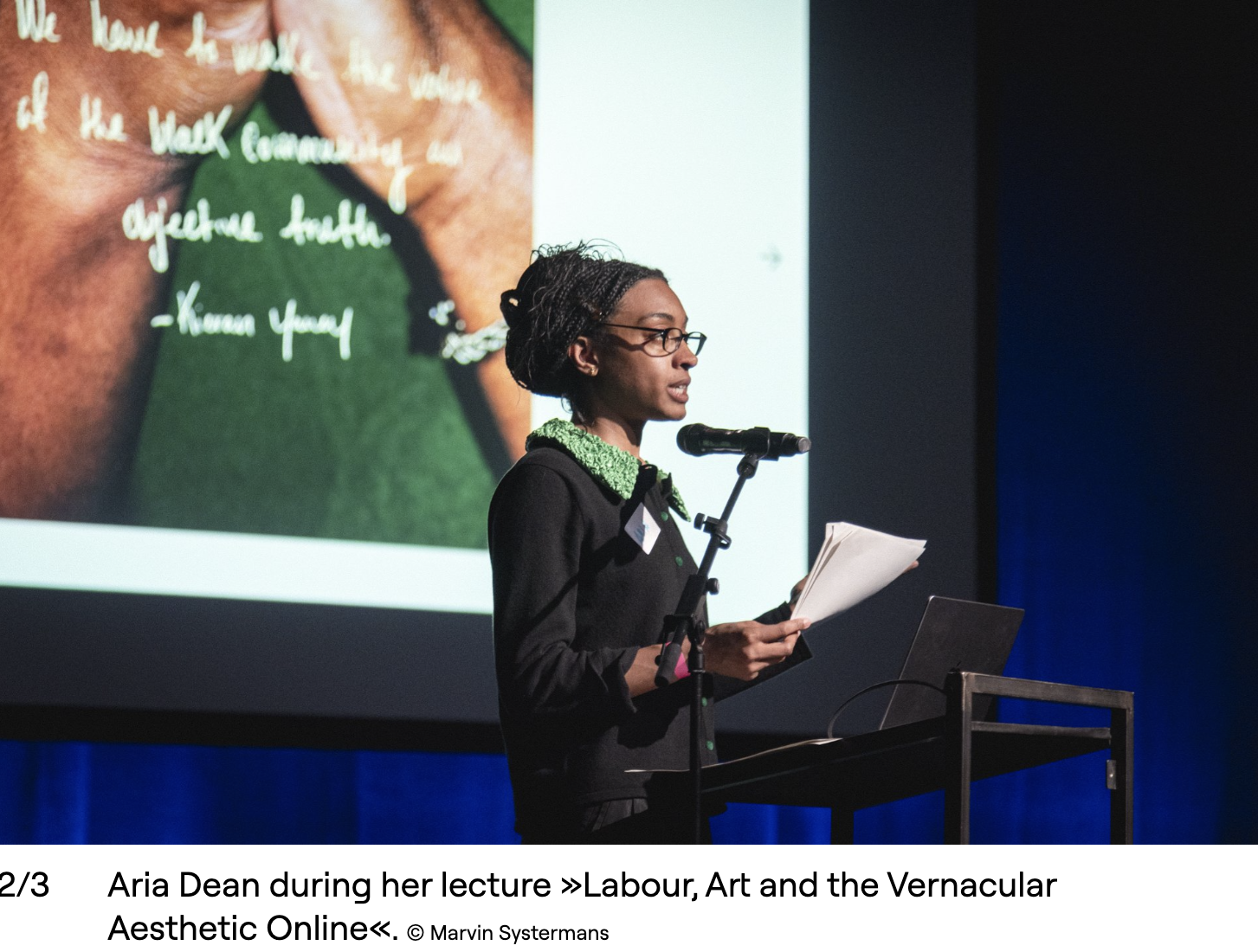
It is in this context of circulation, connection, and collective affect that Aria Dean’s work is particularly illuminating. She frames memes not simply as cultural objects, but as expressions of Blackness in motion, a relational, circulating force that carries cultural labour and vernacular far beyond its origins. In Dean’s view, Blackness is “real but not actual”: it is ascribed, collective, and operational rather than material, and memes are one of its clearest digital manifestations.
Blackness as Operational and Collective
Dean’s key insight is that Blackness cannot be pinned down as a stable object or identity. Instead, it exists in a state of “radical ontological agility”: moving across contexts, generating affect, and operating as a relational force rather than a material entity. Digital memes mirror this agility. Like Blackness, memes are collective and mutable: they transmit cultural labour, shared experience, and affect while circulating beyond individual control. In this sense, memes exemplify the relational, operational, and collective dynamics that define Dean’s understanding of Blackness.
Meme Culture as Inherently Black
In her 2015 essay Poor Meme, Rich Meme, Dean argues that meme culture is fundamentally shaped by Black creativity. Memes carry the improvisational energy, linguistic rhythms, and humour of Black communities, encoding shared experiences in formats that travel widely online. From “It me” captions to viral dance clips and absurdist imagery, memes perform Blackness in motion, influencing how audiences experience and relate to culture collectively.
Dean emphasises that memes’ survival strategies – adaptation, remixing, and circulation – reflect long-standing traditions in Black cultural practice: adaptive, improvisational, and relational. Even when memes move into broader networks or are decontextualised, their structural and affective roots in Black life remain visible in the forms, rhythms, and humour they carry. Meme culture is not simply produced by Black communities; it is shaped by Black cultural logics.

Circulation as Value and Power
Dean draws a compelling parallel between memes, Blackness, and capital: all gain meaning through circulation. Memes become significant not as static objects but as events moving through networks, being shared and interpreted only to then be appropriated and reimagined again – and so the cycle continues. Similarly, Black cultural labour has historically been recognised and consumed without full credit or compensation. Circulation produces value and visibility but also exposes inequities in both online and offline systems.
The “poor image” quality of memes – low-resolution, quickly remade, endlessly circulated – serves as a metaphor for the resilience and relationality of Black cultural production. Memes thrive not in polished presentation or proprietary ownership, but in their capacity to travel, change, and generate affect. Like Blackness itself, their strength lies in circulation, relationality, and collective engagement.

Affect, Collectivity, and Political Potential
Memes are deeply affective, shaping shared feelings and experiences. The humour, joy, frustration, or exasperation encoded in a meme communicates collectively, signalling belonging and fostering networks. Dean argues that this affective circulation carries political potential: memes make everyday experiences visible, amplify underrepresented voices, and create solidarity.
At the same time, memes remain vulnerable to appropriation and co-optation. The same mechanisms that allow Blackness and affect to circulate – their visibility, mutability, and relationality – also expose them to exploitation. Dean’s analysis highlights circulation as both a source of power and a site of precarity, reflecting broader patterns in the distribution and valuation of Black cultural labour.
Memes as Expressions of Blackness in Circulation
Dean encourages us to see memes not merely as entertainment but as expressions of Blackness in circulation: operational, relational, and collective. Influence and value emerge relationally, through movement, remixing, and affect, rather than through fixed ownership or singular representation. Memes are low in resolution but rich in affect, fleeting but generative, and closely tied to the histories, labour, and creativity of Black communities.
Next time you scroll past a viral meme, consider its journey: who created it, how it moves, and what histories and communities it carries. Memes are microcosms of collective Black life, carrying affect, labour, and cultural knowledge through everyday digital networks. In their circulation lies both power and possibility.
Written by Emily Kindermann
Bibliography:
- Dean, Aria. “Poor Meme, Rich Meme.” Real Life Mag, 25 July 2016, https://reallifemag.com/poor-meme-rich-meme/
- Dean, Aria. “Labour, Art, and the Vernacular Aesthetic Online.” Lecture, Digital Interventions: Bodies, Infrastructures, Politics, Collaborative Research Centre (CRC) Intervening Arts, HAU Hebbel am Ufer, Berlin, 9 May 2025.
- Figlerowicz, Marta. “It Me: The Trouble with Memes.” The Yale Review, 2015, https://www.researchgate.net/publication/225649658_The_Trouble_with_Memes
- Steyerl, Hito. “In Defense of the Poor Image.” e-flux Journal, no. 10, Nov. 2009, http://worker01.e-flux.com/pdf/article_94.pdf
- Weingart, Brigitte, and Florian Schlittgen. “How Memes Intervene.” Collaborative Research Centre (CRC) Intervening Arts, 30 May 2022, https://interveningarts.com/articles/aneignen-bearbeiten-weiterverbreiten-zum-interventionspotential-von-internet-memes?refer=%252Fpeople%252Fbrigitte-weingart%253Flang%253Dov
