Nantes has an elephant memory, and it is time to tell it. This article is not only the tale of a giant mechanical creature wandering through the mist of a once-industrial city, but also of how entrepreneurship and innovation, mixed with a cultural strategy, can reshape a city’s identity.
Nantes at a crossroads
In the aftermath of the trauma of deindustrialization, symbolized by the closing of the shipyard in 1987, Nantes stood at a crossroads. When it could have fallen into decline, the city chose to bet on culture to power its reinvention. This gamble turned Nantes into a renowned urban laboratory, where the boundaries between street art, engineering, and city branding blurred in an original way.
At the core of the city, as at the core of its rebirth, Nantes gives a central place to the symbol of the post-industrial transformation of the Île de Nantes: the Grand Éléphant. This huge mechanical creature, 12 meters high and able to carry forty-five people on its back, is the main attraction of Les Machines de l’Île (and therefore of Nantes). It parades daily on the old construction site, offering dozens of visitors a glimpse of Jules Verne’s universe. The Grand Éléphant is the symbol of a city that has “clearly put imagination into office.”
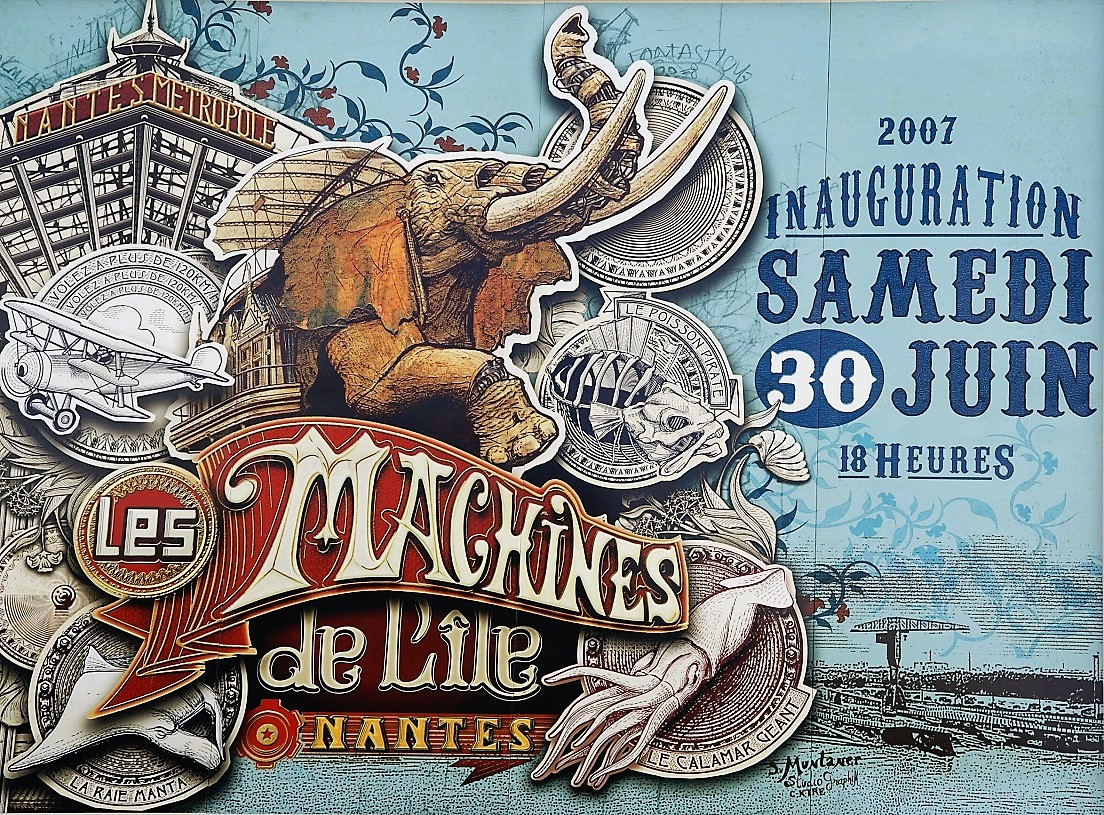
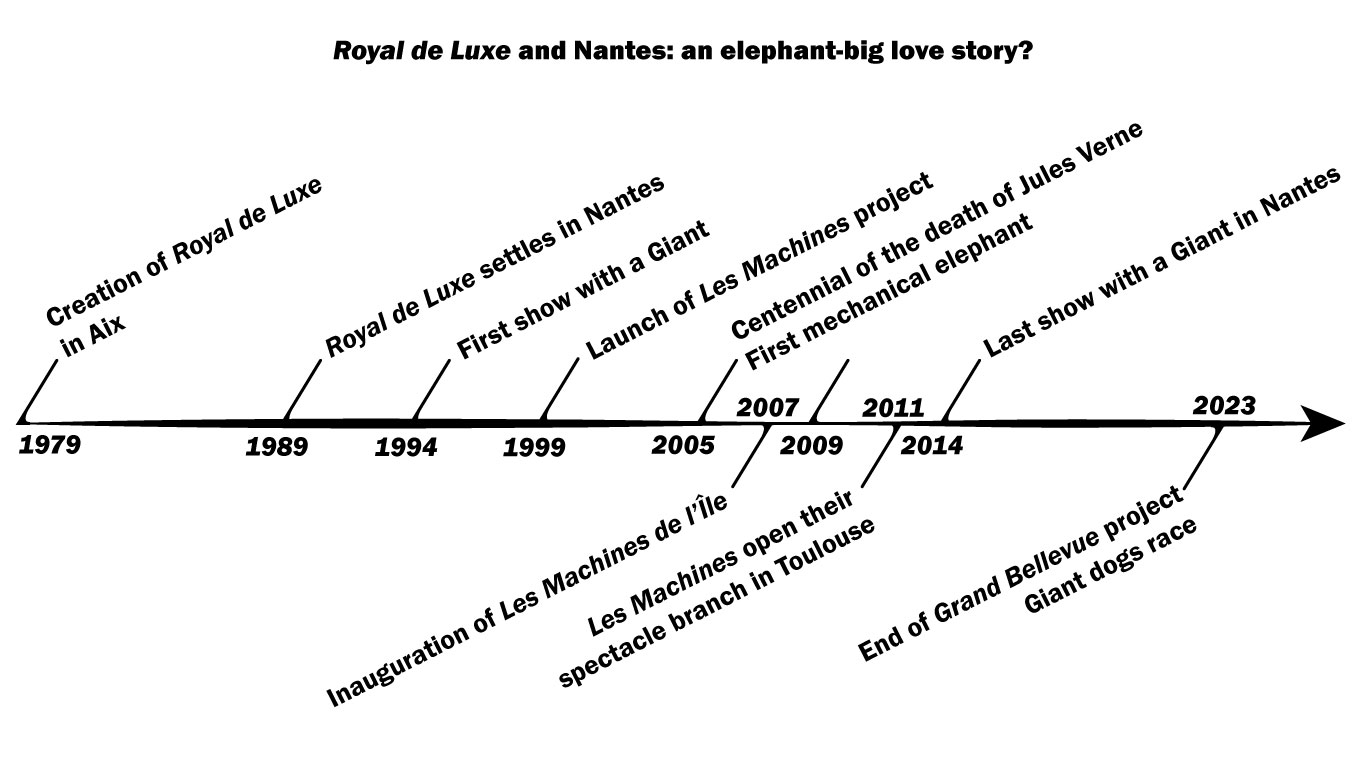
Les Machines de l’Île were inaugurated with the Grand Éléphant in 2007, in an old naval hangar on the island. Since then, it has been a marvellous place of creativity and fine engineering. The founders of Les Machines, François Delarozière and Pierre Oréfice, drew on the interest of Nantes (its administration, but also the locals) to build up the entire concept. Both founders found inspiration in an earlier creative project they had worked on: Royal de Luxe, a street theatre company that took cultural policies in Nantes to another level.
The arrival of Royal de Luxe
Royal de Luxe is a street theatre troupe founded in 1979 by Jean-Luc Courcoult in Aix-en-Provence. For a decade, the company remained committed to performing close to its audience, with poetic performances in the street. It arrived in Nantes in 1989 at the invitation of former mayor Jean-Marc Ayrault, while the troupe was looking for a new city to settle in after feeling sidelined and rejected in Toulouse. Nantes, then considered “all grey” and “asleep for ages,” chose this company to be its spearhead of change. Royal de Luxe had already been known for many shows in France and abroad, blending the city it performed in with a dreamy imaginary world. But it became more famous with its gigantic puppets, inspired by the imagination of its founders and by French stories from Rabelais or Jules Verne. These puppets are part of a long-term project called La Saga des Géants (“the Giants’ Saga”), which began in 1993 in Le Havre.
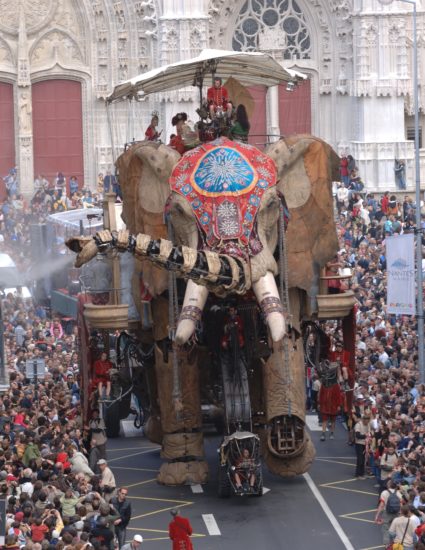
In May 2005, the company unveiled a 11-meters high “time-travel” elephant. On this magnificent machine one could find the Indian sultan and his suite as the sultan was looking for the Little Giant (la Petite Géante) through the city. In this fantastical scenario, the pachyderm came from 1905 India just the meet the Giant. This first giant elephant comes from one episode of their Giants’ Saga. Nantes organized Jules Vernes’ centennial anniversary in 2005. As Jules Verne was born here and is the most famous “Nantais” in the world.
This event was planned in the style of Jean-Luc Courcoult, meaning that it was surrounded by mystery. The precise location and times were only communicated to the tens of thousands of spectators on the day of the visit. The event also generated major traffic disruptions in the city, as circulation and parking were exceptionally blocked across a large zone from the cathedral to Place Graslin—on top of the traffic chaos already caused by the arrival of the Elephant the previous night.
This Elephant was truly the first of its kind to walk across the city. And this spectacle marked not only a technical feat but also a symbolic moment: the convergence of artistic imagination and public strategy.
At an individual level, Jean-Luc Courcoult had collaborators to pilot Royal de Luxe shows; François Delarozière and Pierre Oréfice, founders of Les Machines de l’Île, were once among them. Pierre Oréfice was administrator of Royal de Luxe between 1995 and 1998. As for François Delarozière, he designed numerous creations, including the Sultan’s Elephant. They were also the ones who ordered the construction of its twin, known today as the Grand Éléphant de Nantes.
The diverging paths
There was a divergence in philosophies within the team, even if they shared common roots. This led to a separation between Royal de Luxe and Les Machines de l’Île that began in 1999 and became blatant after the inauguration of the latter in 2007, when Jean-Luc Courcoult emphasized the distinction between the two artistic companies in a letter to the people of Nantes. In it, the stage director insisted on the difference between his “popular theatre,” whose goal is to “make people dream,” and Les Machines’ “amusement park.” This statement was unfair to the intentions of François Delarozière, who also sought to create “poetic moments” for a mass audience.
The thing is: while the Grand Éléphant parades every day on the Île de Nantes, bringing joy to thousands of tourists (and locals alike!), its ancestor, the Sultan’s Elephant, now hides in a hangar in the north of Nantes. The latter will not see daylight again, as his master Jean-Luc Courcoult decided. This hidden elephant symbolizes the disagreement over the nature of public art and the institutionalisation of Nantes’ culture. In the 2010s, Jean Blaise, then managing A Journey to Nantes (Le Voyage à Nantes), wished to reconcile the two companies: “Why not have a new common show?” he suggested. Jean Blaise sadly passed away last year, and the reconciliation between Royal de Luxe and Les Machines never happened. In fact, Les Machines have led for more than ten years a full and successful live spectacle branch in Toulouse, where the company partially relocated in 2011. Gigantic mechanical structures representing tales and extraordinary worlds have regular performances here and there across the globe. This project, quite similar to Royal de Luxe’s, could not be financed by the city of Nantes, which was focused on the older theatre company. At that time, Nantes’ city council was facing harsh criticism about the cost and purpose of Royal de Luxe. It was then decided that Les Machines de l’Île would focus solely on urban planning, with the Herons’ Tree (L’Arbre aux Hérons) in sight.
Indeed, the organization of the company’s gigantic events comes with a price. And debates were intense about their profitability.
The huge support from the city council for Royal de Luxe has been justified since its settlement in Nantes by the emotional and social impact of its shows. Jean-Louis Jossic, deputy for culture between 1989 and 2014, underlined that Royal de Luxe creates events that gather “the notary’s daughter and the Batignolles worker, side by side watching the spectacle.” The crowds are always immense: after another successful show in 2011, an exceptional one in 2014 called Le Mur de Planck drew 300,000 people on the first day alone, with an estimated 1 million over the three days. “Every social layer, every condition, all ages” are represented in the crowd. It brings “emotion to the city,” Jean-Louis Jossic said.
But concretely, between 2009 and 2013, the city council invested 5.8 million euros in the company, in addition to the 2 million euros spent solely on the show Le Mur de Planck. It is hard to determine whether these investments were ultimately profitable for the city, and the council was subject to criticism from opponents.
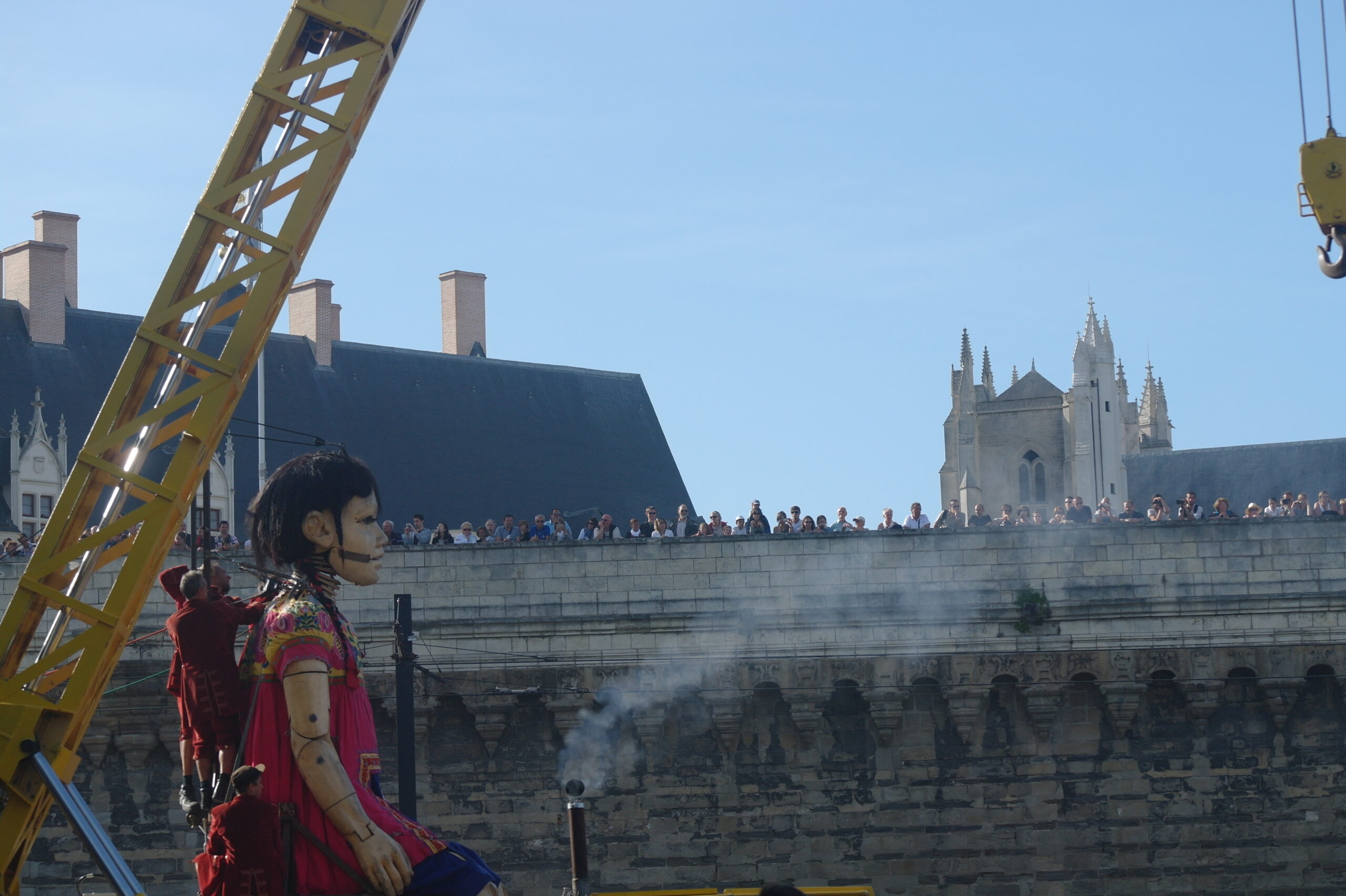
The Little Giant walking by the Castle in 2011
Besides, the Chambre régionale des comptes (the chamber in charge of auditing public financial expenses) pointed out in 2014 a “monopoly situation in the street art sector” of Royal de Luxe in Nantes. The city was accused of prioritizing the organization of “one massive and rare event” to the detriment of “smaller, more regular shows.” An opposition list to the mayor’s, called CultureS, regretted that Royal de Luxe, Le Lieu Unique, and the Grand Éléphant (of Les Machines) were the “sole forefronts of a cultural policy only interested in its image.” The municipality, however, defended its choice, arguing that it preferred to support Royal de Luxe as a professional company rather than having to issue calls for projects.
The changing role of Royal de Luxe
While Royal de Luxe was one of Jean-Marc Ayrault’s biggest prides in Nantes, his successor Johanna Rolland, elected in 2014 and reelected in 2020, has been quieter. Rather than aiming for global reach, she emphasizes the local anchoring that culture can create. This is one reason why Delarozière’s Herons’ Tree was abandoned in 2022 (justified by its high cost). It is also one reason why Nantes did not see a single Giant between 2014 and 2023, while the street arts troupe multiplied its international shows during that period (notably in Liverpool in the UK, Santiago in Chile, Guadalajara in Mexico, and Perth in Australia). In total, the Saga des Géants was seen by 24 million spectators all over the world. It eventually returned to Nantes with another show nine years later, in 2023. But Royal de Luxe had actually never left the city: they transformed their presence from rare but massive events to a smaller, daily presence in Bellevue, a “sensitive” district of Nantes. Still supported by the city council, the project launched in 2018 aimed to improve living conditions through creativity, bringing poetry and art in diverse ways (interactive sculptures and performances). The final event of this project, called Grand Bellevue, brought 400,000 people into the streets to witness a three-day race between two Giant dogs.
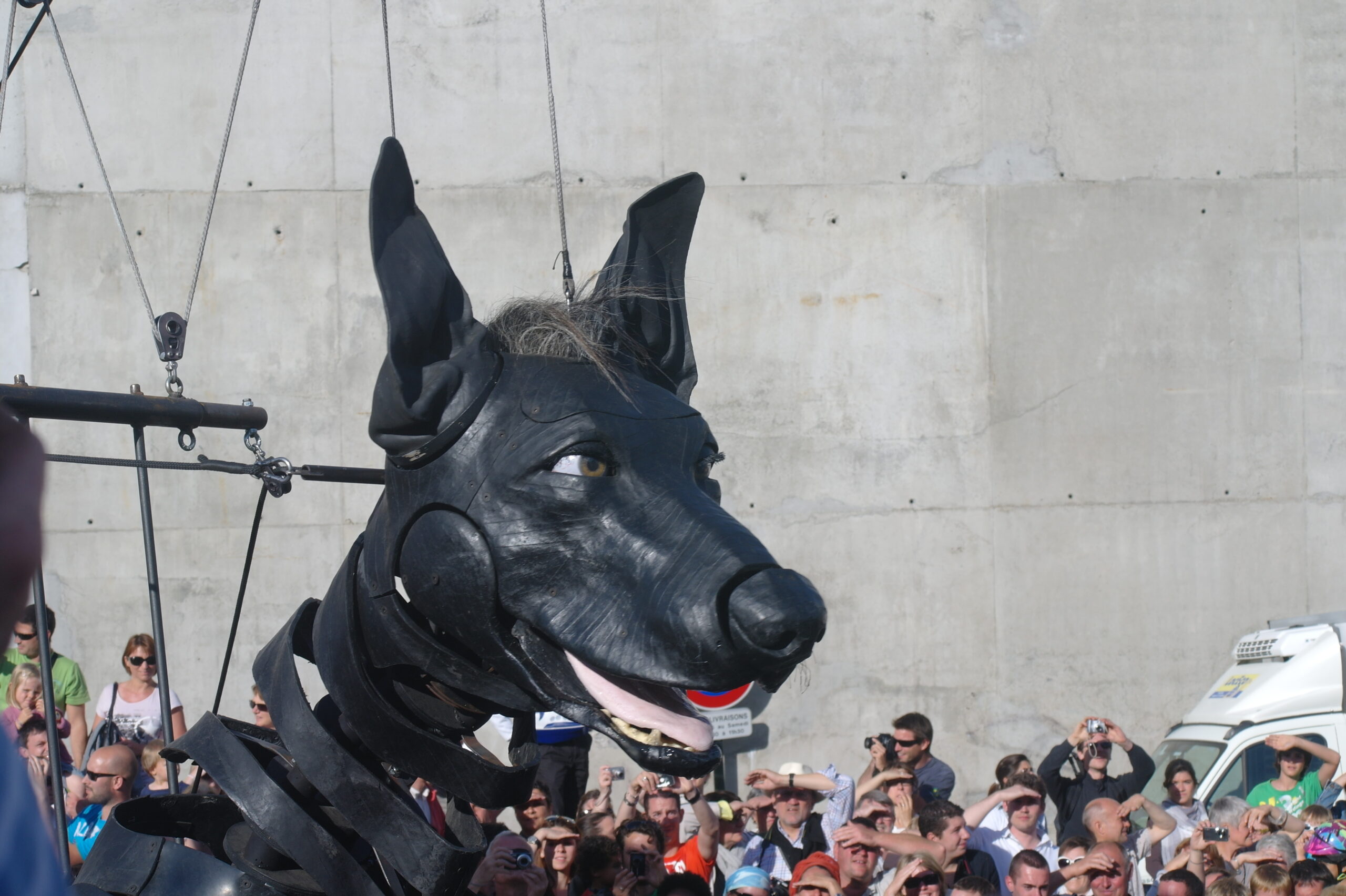
Xolo the dog, already there here in the show in 2011, came back in 2023
Today, Royal de Luxe still performs in the streets, with human-sized pieces. Less about gigantism, more about poetry, the company has sought to preserve that spirit in all of its creations.
Find more about the company on their website: https://royal-de-luxe.com
In the meantime, Les Machines in Toulouse expanded their spectacle branch and regularly perform abroad (China, Belgium, and beyond). Last year, their show in the city attracted more than 1.2 million spectators in three days. The Halles des Machines, where the giants are housed, have become one of the main tourist attractions in the “rose city” and a source of pride for the city council that chose to welcome them.
Get lost on their website to see their strengths: https://www.halledelamachine.fr.
The importance of two elephants
That Les Machines now thrive elsewhere only highlights how far the original vision has travelled, and how Nantes has been able to shape its strong identity. What Nantes shows is that a successful cultural strategy doesn’t require consensus. It held together contrasting approaches: one built on ephemerality and artistic genius (Courcoult’s), the other on engineered wonder and repeatable experience (Delarozière’s and Oréfice’s). Two elephants, walking side by side – one in the shadow of its legacy.
For more information about Royal de Luxe, watch this documentary directed by Jean-Michel Carré: https://www.youtube.com/watch?v=xWEZ4Mp9w7Q (2018).
Author and photographer: Josselin Cosperec
