Intimacy Coordination and Opera: The Last Frontier?
In an interview published on October 12, 2024, with the French outlet Brut, timed with the release of Gilles Lellouche’s now-blockbuster L’Amour ouf, actress Adèle Exarchopoulos explained that she had already worked with an intimacy coordinator while preparing sex scenes for Lena Dunham’s series Too Much. “It suddenly becomes a choreography,” she said, “so you’re no longer surprised when someone does something or takes a risk. And that actually makes you feel much freer.”
Similarly, earlier this year, Benjamin Voisin and Lina Khoudri spoke ahead of the release of Carême on Canal+, describing how an intimacy coordinator helped them feel more fluid, confident, and connected in their performances, especially in a series with so many intimate scenes.
While the topic has become increasingly common in the film industry in the wake of the #MeToo movement, it remains largely absent from the world of opera, an art form that, paradoxically, is built on the very same dynamics of intimacy, power, and staging. So why such a gap? Is it merely the reflection of opera’s well-known conservatism? A sign of society’s limited understanding of the repertoire, where the frequency of intimate scenes is often underestimated? Or perhaps a symptom of resistance within institutions and among stage directors themselves?
This “blind spot” in opera’s relationship with intimacy coordination raises pressing questions at a time when theatre and cinema are increasingly adopting such practices. To explore this issue, we will first look at how frequently intimacy, and even sexual violence, appears in opera, both in the original librettos and in modern productions that foreground nudity and sexuality. Then, we’ll examine how the introduction of intimacy coordination could work within an opera house, drawing on examples from North America, where the practice is more established. Finally, we’ll turn to the persistent resistance from within the institution itself, from professionals to critics, that may explain why opera remains behind its artistic counterparts.
Sex and Rape Scenes in Opera: An Underestimated Reality
Many still underestimate how often sexuality and nudity appear in opera. But a quick look at the repertoire reveals just how full this art form is of sexually charged or violent moments. Even within the librettos themselves, opera abounds with scenes of seduction, coercion, and assault.
Among the most famous examples is Don Giovanni by Mozart (1787), where the libertine title character, often portrayed as a sexual predator, attempts to rape Donna Anna in the very first scene, setting the entire drama in motion. Similarly, in Puccini’s Tosca (1900), Baron Scarpia tries to rape Tosca in exchange for sparing her lover’s life; Tosca ultimately kills him in self-defense. In Alban Berg’s Wozzeck (1925), Marie is seduced and abused by the Drum Major, a brutal depiction of social and sexual violence, adapted from Büchner’s play.
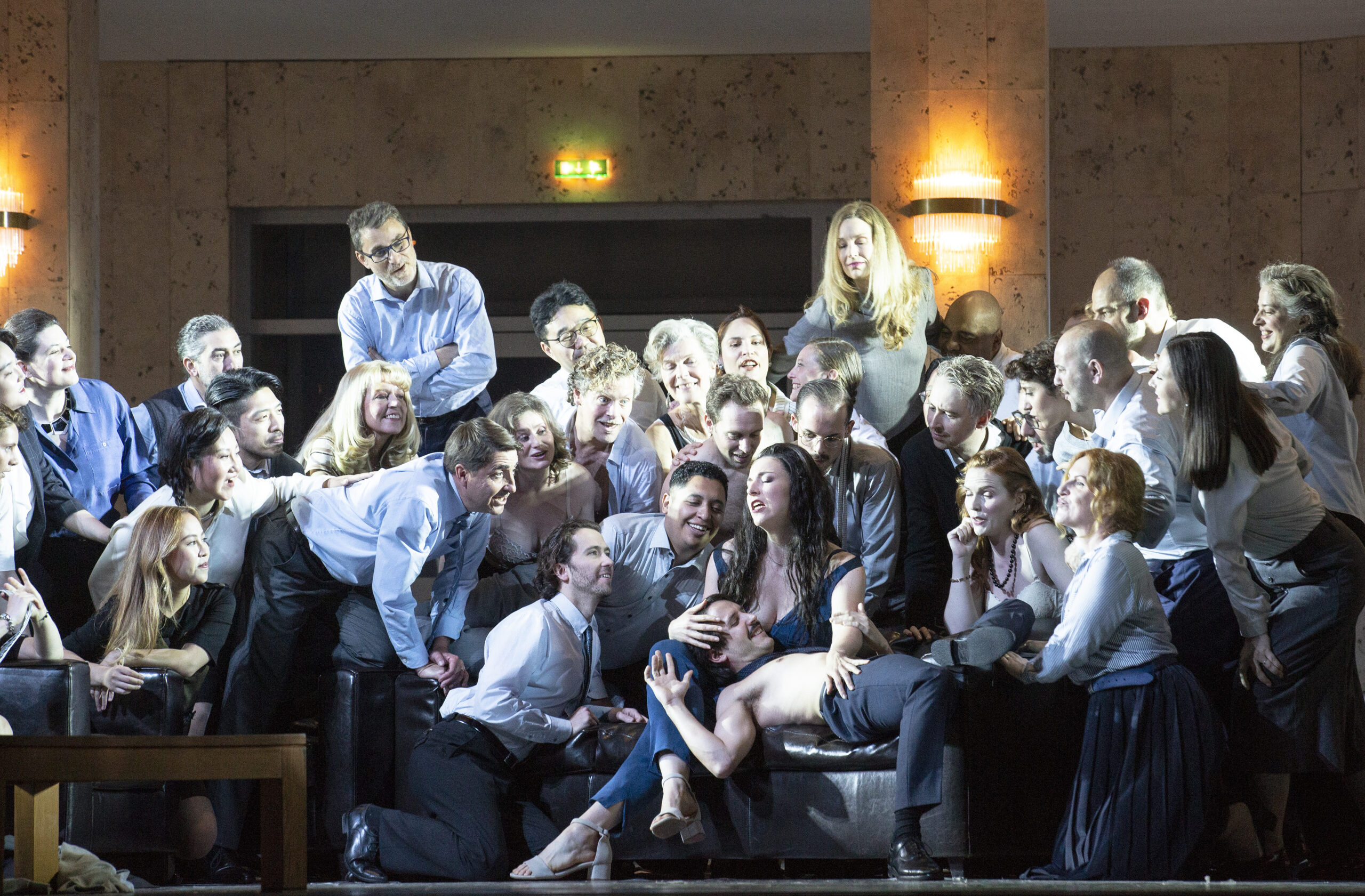
While these depictions of rape and sexual coercion were rarely staged explicitly in the 18th and 19th centuries, contemporary directors are far less restrained. Many now incorporate sexual violence, even when it’s not directly stated in the libretto. For instance, Dmitri Tcherniakov’s Carmen at the Aix-en-Provence Festival controversially added a rape scene just before Don José kills Carmen at the end of the opera.
Beyond scenes of rape, many operas also feature moments of sex or nudity that raise important questions about the need for intimacy coordination. Indeed, while debates on the matter are still ongoing, it seems increasingly clear that “intimacy” extends far beyond sexuality. It also encompasses anything involving the body, consent, and emotional vulnerability between performers. From this perspective, many contemporary opera productions contain scenes that clearly call for the presence of an intimacy coordinator.
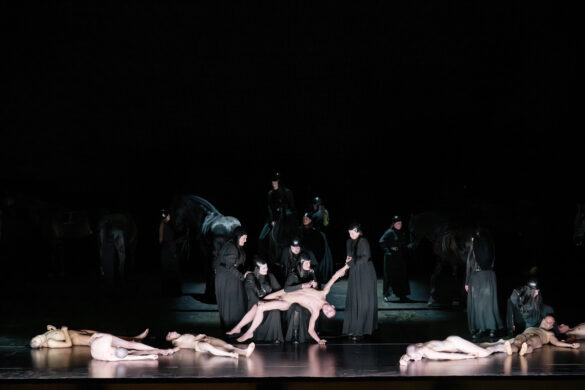
One striking example comes from the staging of the first two parts of Wagner’s Ring cycle at La Monnaie in Brussels, directed by Romeo Castellucci. For this production, the Belgian Federal Opera launched an open call seeking around a hundred extras willing to appear nude on stage. The announcement read: “Do you enjoy being naked on stage? Take part in Castellucci’s Rheingold! Selected participants will be asked to crawl and roll on stage and will be placed in close proximity to one another in a confined space. La Monnaie will provide flesh-colored underwear to simulate nudity. Applicants must be between 16 and 80 years old and available from October 24 to November 9, 2023.”
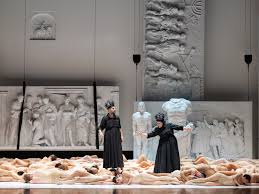
Here, nudity was justified as part of Castellucci’s pursuit of a stripped-down, minimalist aesthetic, a kind of visual purity meant to echo Wagner’s original artistic vision. Yet, even if the volunteers appeared to consent freely to their participation, their work was unpaid, raising further questions about power dynamics, consent, and the protection of performers’ well-being within the operatic world. This raises another issue: the often-limited attention paid to extras in the world of opera, who are sometimes treated as little more than “cannon fodder.” A telling example can be found in Dmitri Tcherniakov’s staging of Carmen, which includes an orgy scene in which a male extra performs a striptease in front of the entire ensemble, prompted by Carmen herself. For the performer involved, such a moment could easily be perceived or experienced as humiliating or degrading, highlighting once again the lack of safeguards and consideration afforded to non-principal performers in opera productions.
In Light of This, What Policies Can Opera Houses Adopt to Safeguard Artists’ Consent and Integrity? How Might the Introduction of an Intimacy Coordinator Change the Landscape?
During my internship at La Monnaie as a production assistant, I had the opportunity to discuss this subject with several artists. Among them was a well-known singer, who will remain anonymous, who confided: “I’ll admit, if I’d been asked my opinion, I probably would have refused outright to meet with an intimacy coordinator. I’ve managed without one my whole career, so why start now? But looking back, I realized it made perfect sense for the scene we were doing. Everything was choreographed, which removed any potential awkwardness with the other performer and freed up mental space to focus on the acting and the music.”
Despite such testimonies, European Opera houses still lag behind their counterparts across the Atlantic. In the United States, the role of intimacy coordinator has been officially recognized since 2017, with accredited training programs and around eighty certified professionals nationwide. In France, by contrast, there are only four official practitioners, most of whom work primarily on international productions. While HBO has required the presence of intimacy coordinators on all productions featuring intimate scenes since 2018, French productions involving them can still be counted on one hand.
Monia Aït El Hadj, a French intimacy coordinator, explains that she often works with foreign productions filmed in France, such as Emily in Paris or Les Liaisons Dangereuses. French professionals, however, remain hesitant to call on her services, fearing they might lose creative freedom in their staging. Yet, as she explained in an interview with France Culture on February 17, 2023, her work in no way undermines that of directors. On the contrary, it aims “to support the director and the actors in creating scenes involving nudity, simulated sex, or sexual violence.” As she describes it, this process begins as early as the script reading: “We talk with the director to see how to create the intimacy envisioned, while respecting everyone’s boundaries. Then we move on to rehearsals, to see how the director wants to choreograph the scene. Choreographing doesn’t take away from the authenticity of what audiences will see, just because we describe what we imagine in technical terms, like in a dance, doesn’t suddenly make it mechanical or less spontaneous. Not at all.”
Although the profession first took shape in film and television, it has slowly been making its way into the world of live performance, albeit with a noticeable delay, only beginning to gain ground in the early 2020s. In January 2022, the Royal Opera House in London brought in Ita O’Brien as intimacy coordinator for its production of Theodora, sending a strong message to the European opera world. A year later, in 2023, venues such as the Gran Teatre del Liceu in Barcelona also announced plans to work with intimacy coordinators, though still on a more occasional basis, for example, for their staging of Antony and Cleopatra. Across the Atlantic, however, the integration of these roles into the performing arts has been both earlier and more firmly established.
In 2022 at the Metropolitan Opera (New York), intimacy directors were engaged for no fewer than six productions, (Fire Shut Up in My Bones, Eurydice, Rigoletto, Don Carlos, Lucia Di Lammermoor, and Hamlet.) One of them, Doug Scholz-Carlson, an intimacy director at IDC, who is also an actor and the artistic director at the Great River Shakespeare Festival stated about intimacy direction, coordination, and choreography as they relate to opera: “What I see really often in opera, when I see opera performed, is the chorus all in a brothel and they’re all supposed to be people in a brothel, which means they need to be touching each other in a certain way. And what I see is a bunch of work colleagues touching themselves very, very politely and trying to, while touching each other very politely, simulate being in a brothel. And it really doesn’t work. And the reason that happens is because they are trying to protect each other’s boundaries without having had a conversation about what those boundaries are.”
While the need for intimacy coordinators now seems undeniable, the opera world has been notably slow to embrace the practice — especially compared to the film industry, and even more so within European houses. Why this hesitation? And who are the skeptics of such a policy?
One of the reasons most often cited by stage directors is the fear of losing artistic control, of adding to the creative process. As Siobhán Richardson, co-founder of Intimacy Directors International, noted in an interview with Opera Canada (May 31, 2019), this concern remains widespread. Others worry that choreographing intimate scenes could compromise their spontaneity or emotional truth.
Opera’s deeply rooted traditions also play a part. Rehearsal schedules are typically compressed, and singers often arrive only shortly before opening night, leaving little opportunity for open discussion around intimacy on stage.
Finally, cost is a significant factor. With state and local funding for the arts steadily declining, many opera houses are forced to make hard choices about where to allocate their resources. In that context, hiring an intimacy coordinator is still often viewed as a luxury rather than a necessity.
Written by Judith Laithier
Sources:
