Every winter during the Christmas season, the film « Love Actually » makes a limited return, holding high the most touching lines about true love and presenting dramatic yet perhaps real love stories. It is labeled as « heartwarming », « healing », and « about love », becoming a nearly default cultural symbol of Christmas. However, when a film repeatedly praised as a « paragon of true love » makes more and more viewers feel uncomfortable, confused, or even repulsed today, the question may no longer be « Is this film good to watch? » but rather: “What kind of « love » are we being moved by? Are all kinds of love worthy of being extolled? ”
In popular culture, love has never been a purely private experience. Whether in the West or the East, it has been constantly written, replicated and disseminated through literature, films and music, gradually forming a set of identifiable, imitable and even internalized emotional narratives. When « love » is repeatedly presented in a certain fixed pattern, it is no longer just an emotion itself, but becomes a cultural consensus – a value judgment that seems to need no questioning. « Love Actually » from 20 years ago was a typical sample in such a cultural mechanism, but now it has been subject to a different kind of scrutiny.

Romantic Films as Packaged Emotional Comfort Zones
In Western culture, Christmas often symbolizes reunion, tolerance and forgiveness. This warm festive context itself has a strong emotional guiding function. It imperceptibly lowers people’s vigilance towards the rationality of the narrative, making audiences more receptive to all emotional expressions packaged as « warm ». Conversely, this is precisely why people choose to confess their love during festivals and make certain choices and decisions at a certain zero o’clock moment.
In such a context, I personally believe that romantic films often do not serve as a guide to reality but rather act as a vessel for emotions. They do not attempt to resolve the conflicts in relationships but merely offer a brief and safe emotional illusion, allowing the audience to believe that « everything will have a good outcome » during the limited time of every second of the Christmas countdown, and to welcome a happy ending together with the countdown. When this function is superimposed with the cultural atmosphere of Christmas, the film acquires an almost « exempted » emotional privilege: certain relationships and behaviors that should be questioned and not well understood in daily life are repackaged as « understandable romance ».
Fragmented Narratives and the Stereotypical Love Template
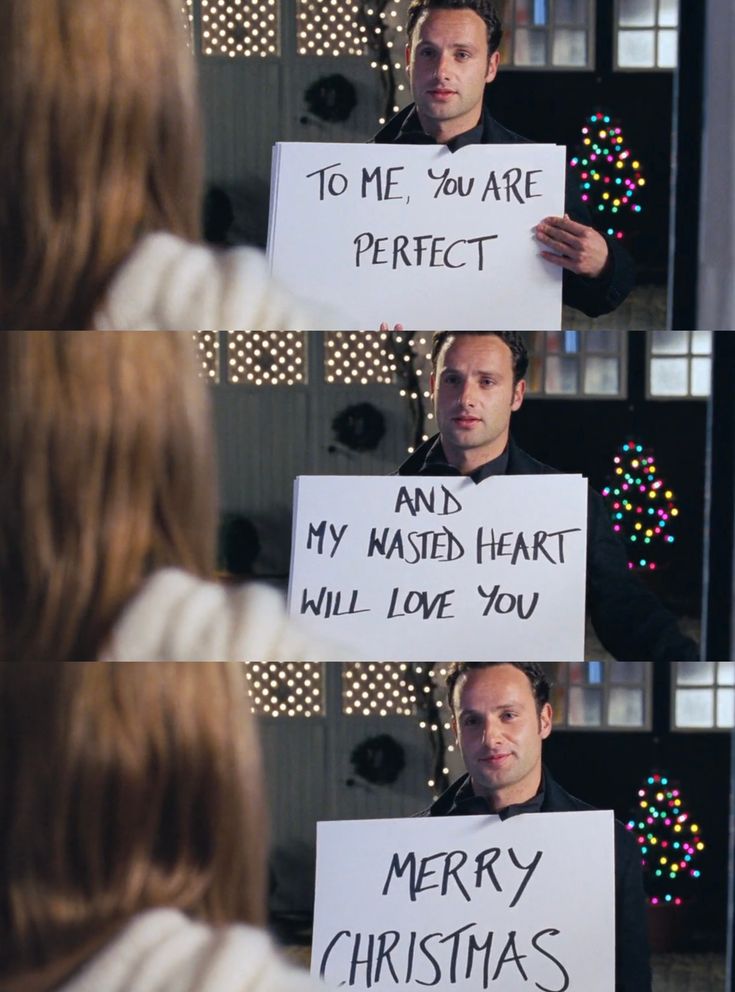
The visuals in « Love Actually » are undoubtedly beautiful. The first shot begins with ordinary people. « Whenever I feel frustrated with the world, I think of the scene at the entrance of Heathrow Airport. Many people say that we live in a world of hatred and greed. But I don’t think so. In my opinion, love is all around us. » This is the first narration of the film, which tells multiple love stories in parallel, seemingly presenting the diverse forms of love. However, the apparent richness does not necessarily mean true diversity. There seem to be extremely serious stereotypes and gender inequality.
In fact, a careful examination of these stories reveals that they are highly similar in structure and perspective to a love story: men have higher power and more stable social status, and they are often the initiators of emotions; women, on the other hand, are more often in the position of being gazed at, waited for, and responded to. The situations of betrayal, crossing boundaries, and ethical ambiguity are casually summarized as « the complexity of human emotions »; while the resulting harm is often masked by the festive atmosphere and gentle background music.
These stories are not haphazardly pieced together but rather repeatedly vary around the same romantic logic. Love here is reduced to an instant emotional resonance, rather than a relationship practice that involves taking responsibility, commitment and consequences, seemingly only considering the most extreme romantic love.
Gender Perspectives in the Narrative of « True Love »
When we further inquire about « who loves and who is loved », the issue is no longer merely about the plot itself, but rather the singularity of the narrative perspective. In the film, desire, action and decision-making are often in the hands of male characters; female characters frequently appear as « emotional responders » or « visual symbols ». The most classic scene in the movie is when the British Prime Minister falls in love at first sight with a secretary from a humble background. The so-called Cinderella story transforms from a fairy tale into a real love story, and in the future, the Prime Minister personally goes door-to-door to search for her. There are countless lines that mock the female character’s « fat » figure, even related to the power struggle and political relationship between two men. In addition, another scene in the film is when the writer Jamie moves to the countryside to focus on writing after discovering his wife’s infidelity. The landlord introduces him to a Portuguese nanny, but one time, due to carelessness, she drops Jamie’s manuscript into the lake. The camera follows a close-up of the nanny from her feet to her chest, along with Jamie’s changing expression. This is the climax and turning point of their relationship. The camera is both language and power. It should have emphasized that love can transcend national culture and language, but it was instead portrayed as a relationship between the viewer and the viewed. From these two stories, it reflects that women’s bodies are given symbolic meanings, becoming the carriers of power, desire and romance; their emotions more serve the self-confirmation and growth trajectory of male characters rather than their own choices and predicaments. The problem does not lie in whether sexiness exists, but rather that when « love » is always told from a single perspective, it gradually evolves into an unexamined cultural habit. In such narratives, « true love » is more like an emotional imagination from a male perspective, rather than a relationship state where both parties are equal participants.
The Fracture of Happiness – Where Does the Audience’s Discomfort Come From?
Therefore, when most female viewers watch « Love Actually », what they feel is not happiness but rather aversion, estrangement and discomfort. This is not because they « cannot understand romance », nor is it a denial of love itself. On the contrary, this discomfort precisely stems from the changes in the cultural context.
With the continuous renewal of gender awareness and social experience, today, 20 years later, audiences have become more sensitive to the perception of power structures and emotional inequality. Plots that were once regarded as romantic may now seem outdated or even distorted. When the old romantic model fails to respond to real-life experiences, emotional disconnection becomes inevitable.
This sense of discomfort is not the problem itself but a signal-it indicates that some narratives about « love » have reached a point where they need to be reexamined.
What kind of emotional narrative does a love film really need?
Just as Benjamin analyzed, the impact of films in the era of mechanical reproduction does not lie in whether the content is true or not, but in that through repetitive perceptual forms, it quietly shapes the way people understand the world and emotions. The issue has never been whether « Love Actually » is still worth watching, but whether we are still willing to accept the « version of love » it offers without reflection. Romantic films still have their significance, but personally, I believe that romance should not be a veil to cover up inequality and injustice. Love is not just a slogan on specific holidays, nor should it be simplified into a cheap emotional consumption that turns into impulsive behavior. Maybe the love in movies can be an impulsive passion, but when popular culture continues to shout « Love Actually », it should at least answer one question: Whose love is this? And at whose expense? “
If we place « Love Actually » within the broader spectrum of romantic films, what it represents might be a kind of love narrative centered on emotional moments: the act of falling in love itself constitutes the condition for the existence of love. In an interesting contrast to this is another classic love film, « The Notebook », which presents a different narrative model.
In « The Notebook », love is not a one-time emotional confirmation, but a process of relationship that is constantly chosen, rejected, and reconfirmed over time. The man and the woman do not simply fall in love; instead, they are repeatedly pulled between the pressures of reality, class differences, and personal will. Crucially, this relationship is not packaged as « romance that is taken for granted ». Although the male and female leads come from different classes and living environments, their love is always based on mutual choice, without gaze or metaphor. This narrative structure presents a relatively balanced gender position. The female character does not merely exist as an object to be pursued or moved; she has a clear right to hesitate, judge, and reject. Therefore, love here is not the unfolding of male will. Whether to leave or wait, to invite or reject, are all free choices of both parties.
This does not mean that « The Notebook » offers a more « realistic » model of love, but rather it suggests that romantic films can also choose to depict the complexity of relationships, not just the completeness of emotions. When love is understood as a continuous practice rather than an instantaneous emotional outcome, it is no longer just an immersive fantasy, but becomes a form of relationship that requires responsibility, communication and time.
If « Love Actually » from 20 years ago was the « Christmas love textbook » in the hearts of a generation, then the hesitation and awkwardness that today’s audience feel when watching this film is not because they no longer believe in love, but because we have different expectations for « how love should be told ».
Especially for today’s female audience, their perception of « romance » has long changed. They no longer simply buy into the passionate emotions, but rather value respect, boundaries, and the right to choose in a relationship. What was once praised as « bravely pursuing love » might now be seen as overstepping boundaries; what was once packaged as overly sweet « deep gazes » now gradually reveals the unequal power dynamics behind them.
This change has nothing to do with « love getting colder ». On the contrary, it is the result of modern people having richer life experiences and a clearer sense of self. In real-life intimate relationships, equality, communication, and mutual responsibility have become increasingly emphasized. Love stories that rely solely on one-sided devotion and excessive emotional manipulation naturally no longer resonate with us. The discomfort that viewers feel essentially stems from their unwillingness to accept such simplified and formulaic expressions of emotion.
So when we revisit these classic love films now, the key is no longer whether they can still evoke emotional resonance, but rather « whether the love logic they present can still align with people’s current understanding of intimate relationships ». Romance is no longer a dream to be mindlessly indulged in, but has become something that needs to be examined, compared, and redefined.
Revisiting these love classics that have been replayed over and over again is not to deny the emotions they once evoked, but to figure out what subtle changes have been quietly taking place within ourselves. When romance is no longer merely about celebrating festivals and passively waiting for emotional placebos to be fed to us, the kind of relationship we need to deliberate on and choose for ourselves has instead become the norm. The current attitude of the audience itself is a genuine cultural echo.