From Cleopatra to Elizabeth I, from Mary Stuart to Marie Antoinette, the names of great sovereign women evoke powerful myths of grandeur, beauty, and tragedy that nourish our imagination. But what remains of reality behind these narratives? Did Marie Antoinette really say, “Let them eat cake”? Was Cleopatra truly the most beautiful woman of the ancient world? History rarely concerns itself with certainties when it comes to queens: first and foremost, they are images, popular fables, and then objects of artistic fascination. The question then arises: can we truly write an objective history of great sovereign women, when their representations are filtered through ideology, the biases of sources, and the power of art?
History and Art as Ideological Construction
Since the 1970s, feminist criticism has shown that the history of art and political history are anything but neutral. In her foundational essay Why Have There Been No Great Women Artists? (1971), Linda Nochlin explains that if women seem absent from dominant narratives, it is not because they did not exist, but because the institutions of memory and knowledge were designed by and for men. Art historians such as Griselda Pollock remind us that women have long been muses and models, rarely creators or active subjects of visual history. Applied to sovereign women, this means that a queen is almost never studied for herself: she is either an ideal or a threat. Art and narratives do not seek to understand who she was, but to fix what she embodied.
This ideological construction is compounded by a concrete obstacle: the scarcity and one-sidedness of sources.
- For Cleopatra, nearly all accounts come from her Roman adversaries (Plutarch, Dio Cassius), whose aim was to justify Octavian’s war against Mark Antony, officially ending the Roman Republic. Cleopatra as enemy of the Roman Republic helped unite citizens. Propaganda against her allowed Octavian to justify seizing power and removing Mark Antony, who was seen as a traitor to his homeland.
- For Mary Stuart, chronicles differ depending on whether they come from Protestants (her political opponents) or Catholics (her supporters), in a context of rivalry for the English throne with her cousin Elizabeth I, compounded by religious conflict between Anglicans and Catholics.
- For Elizabeth I, official portraits were produced as instruments of propaganda: the famous Armada Portrait shows an invincible sovereign, far removed from real political dilemmas. Even when we have direct sources, their reception is biased. The correspondence between Mary Stuart and Elizabeth I reveals respect and even affection. But this female voice has been largely obscured in favor of the Manichaean narrative of a deadly rivalry, a narrative that served military and religious rivalries for the English throne.
Thus, historical objectivity seems illusory, but not entirely out of reach: it requires cross-referencing sources (archives, iconography, archaeological data) and, above all, adopting a critical stance that accepts recognizing areas of uncertainty. Writing the history of sovereign women also means accepting to say: “we do not know.”
The Archetypes Imposed on Sovereign Women
Rather than analyzing queens as complex individuals, historical and artistic narratives have classified them into archetypes. These categories reassure some (men) by simplifying, but distort reality.
Roman propaganda forged the image of Cleopatra as a queen-prostitute, using her charms to seduce Caesar and then Mark Antony in order to retain power. The implicit idea is clear: a woman cannot rule alone, especially not over a power like Egypt.
“By her charms, by her last favors, Cleopatra obtained from Caesar the kingdom and the death of Ptolemy. She was so passionate that she often prostituted herself; so beautiful that many men bought their existence for the favor of one of her nights.” Aurelius Victor, De viris illustribus urbis Romae, LXXXVI.
Orientalist art of the 19th century, followed by Hollywood in the blockbuster Cleopatra (1963) with Elizabeth Taylor, amplified this vision: Cleopatra became an object of artistic fantasy, more muse than sovereign. Her beauty and tragic death (suicide by asp bite, according to legend) are central, her political action erased. Yet reality is quite different. Here is a brief but more faithful portrait of the queen: Cleopatra was a polyglot, speaking nine languages, and the only one in her dynasty to learn and speak Egyptian fluently. A skilled diplomat, she managed to stay on the throne (despite coups by her brother, with whom she shared the throne at barely twenty years old) by forming an alliance with Julius Caesar, convincing him that it was better to have Egypt as an ally than as a colony. She was an economic strategist, restoring the value of the tetradrachm (Egyptian currency), whose value had been divided by three under her father’s reign. She innovated by displaying the fiduciary value on the reverse of bronze coins, thus curbing the inflation of bronze relative to silver. Cleopatra also claimed her pharaonic heritage, presenting herself as the embodiment of a cosmopolitan Egypt, changing her name from Cleopatra Thea Philopator (“Cleopatra, goddess who loves her father”) to Thea Neotera Philopatris (“new goddess who loves her homeland”).
Mary Stuart, for her part, embodies the archetype of the martyr queen. A Catholic queen facing a Protestant Scotland, she is seen either as a saintly victim of her faith (beheaded after a botched execution, the executioner having to strike three times) or as a traitor conspiring against England. Stefan Zweig’s literary biography Mary Stuart (1935) feeds this romantic myth: a queen intellectually brilliant, a pupil and muse of Ronsard, a recognized musician, but with a tragic destiny, sacrificed in struggles for power. Behind this image lies a more prosaic reality: a sovereign caught in religious and dynastic struggles, forced to abandon her one-year-old son, whose fate was less chosen than endured.In contrast, Elizabeth I illustrates the archetype of the “un-womanly woman.” To reign, she chose to marry herself symbolically to her kingdom and to embody the myth of the “Virgin Queen.” This political strategy shocked 16th-century society: to refuse motherhood was to refuse the very essence of femininity according to the mentality of the time. She is credited with numerous love affairs, now almost confirmed, including one with her childhood friend Robert Dudley, presented as the love of her life. This masculinization fuels rumors: some claim she was not really a woman. Articles (such as La vérité choquante sur le corps d’Élisabeth Ire que la famille royale a tenté d’effacer., on an unreliable site) present unverified hypotheses as top-secret royal facts just revealed to the public, and give into the sensational.
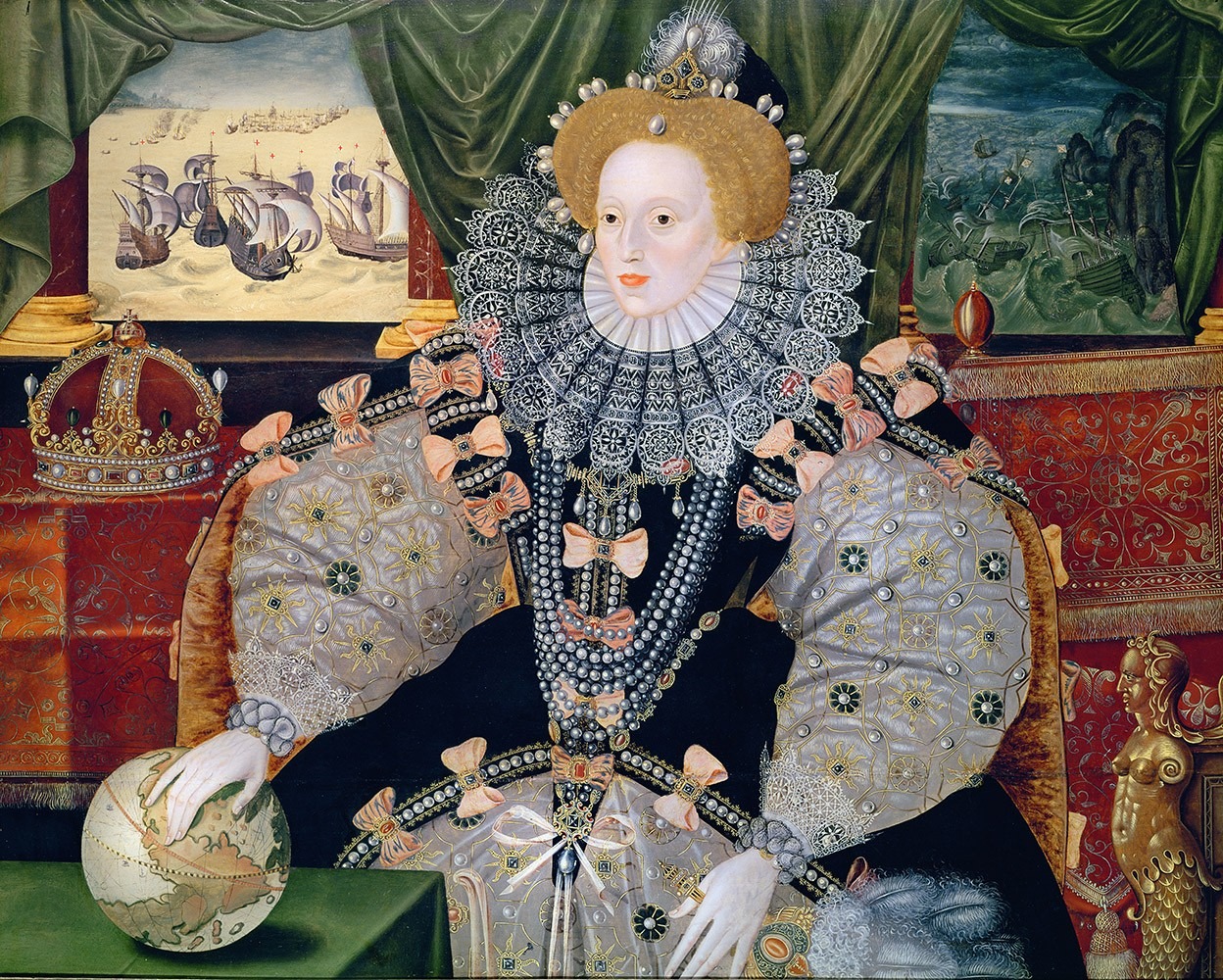
Portrait of Elizabeth I of England, the Armada Portrait, Anonymous, circa 1588, oil on panel, 110,5×127 cm, Woburn Abbey.
In France, Catherine de Medici is portrayed as a virago, manipulative and cruel, held responsible for the St. Bartholomew’s Day Massacre. A woman who loved her husband, who preferred her Diane de Poitiers, she was the queen mother who ruled in place of her three sons, who died one after the other without issue. A devotee of astrology, a science very much in vogue at the time, she was accused of frequently resorting to black magic and the services of Nostradamus. When a woman wields power, it must be explained: either she is not a “real” woman, or she derives her power from black magic.
Finally, Marie Antoinette embodies the archetype of the frivolous and spendthrift queen. Nicknamed “Madame Deficit,” she crystallizes popular hatred. Her supposed frivolity is summed up in the famous phrase “If they have no bread, let them eat cake” during the Women’s March on Versailles—a phrase she never actually uttered. Yet history reveals another facet: a young woman sent as a teenager to a foreign court, a patron of the arts, a mother devoted to her children. Her personal expenses were modest compared to the kingdom’s structural debts, but the archetype of a frivolous and guilty queen was more politically effective in the revolutionary context.
Attempts at Control and Contemporary Reception
Some sovereign women tried to control their image. Elizabeth I, through her official portraits (Rainbow Portrait, Armada Portrait), projected an image of power and chastity (which she was forced to reaffirm in the face of her detractors). Isabella of Castile based her legitimacy on piety and Spanish unity—a valued register during the Reconquista (1492, reconquest and reunification of Spain against the Byzantine Empire). Christina of Sweden, finally, blurred the lines by voluntarily abdicating and reinventing herself as a European intellectual during the Enlightenment, writing her memoirs to shape her posterity. But these strategies are rarely entirely effective: public opinion and art reinterpret according to the narrative serving best the country, with a hint of sexism in the process.Art does not seek to tell the truth or bear witness to historical reality, but to produce images. Paintings, sculptures, and then films fix archetypes. The danger arises when these visual myths are taken for truths. Hollywood is a striking example: Cleopatra (1963) or Mary Queen of Scots (2018) emphasize glamour and romance, reducing queens to love intrigues and spectacular dramas (in the Latin sense: things to be seen). Their image is all the more cinematic because both queens met tragic ends: Cleopatra committed suicide in 30 BCE following the defeat at Actium, to avoid becoming a war trophy of the Roman army; Mary Stuart, condemned to death for treason, saw her executioner take three attempts to succeed in beheading her.
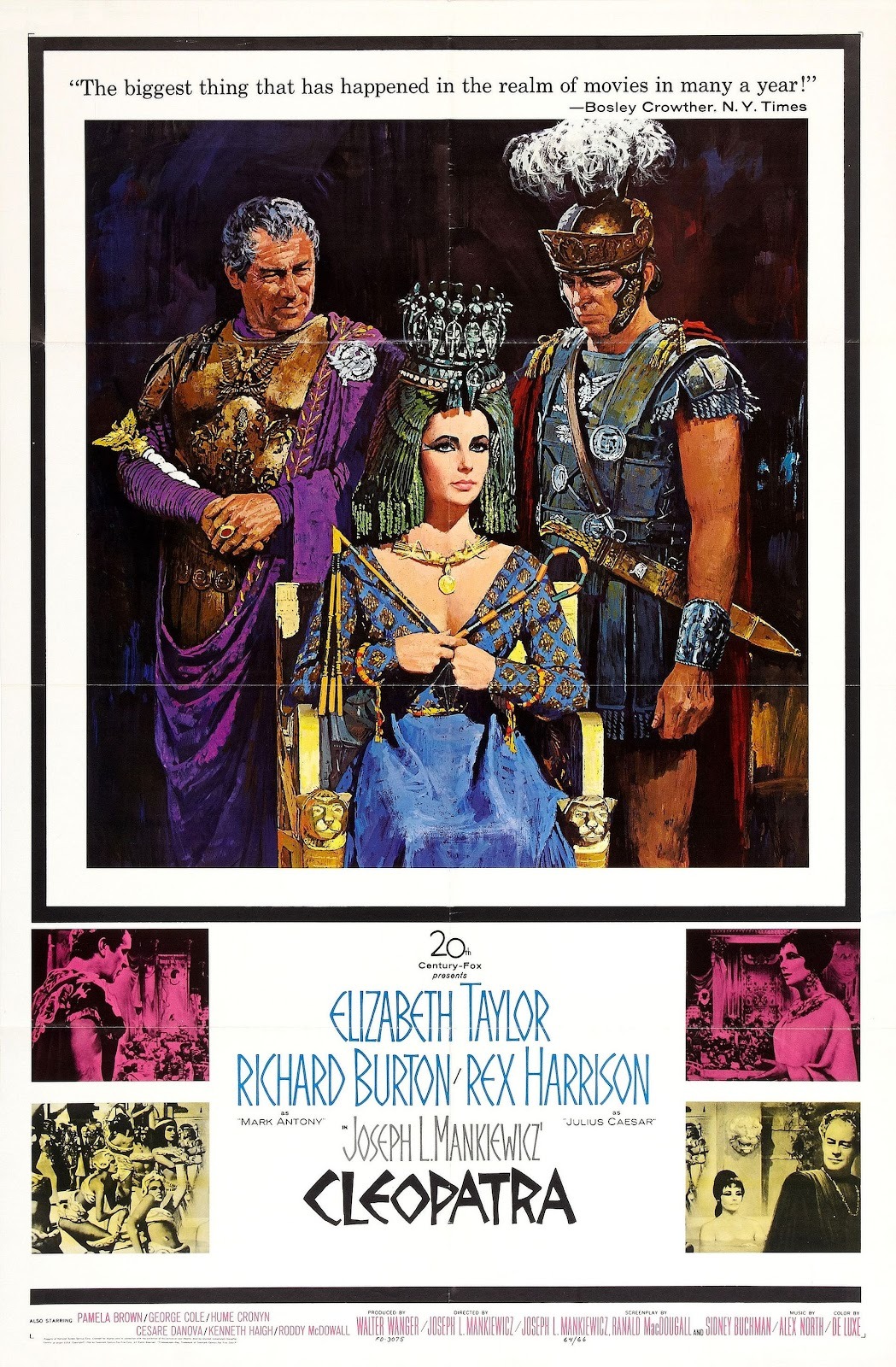
Poster of the Cleopatra movie, 1963, after Howard Terpning, public domain.
Recent academic research seeks to correct these biases. Historians such as Stacy Schiff (Cleopatra: A Life, 2010), Olivier Gaudrfroy (Cléopâtre l’immortelle, de l’Histoire à la légende, 2017), or specialists like R. Knecht (on Catherine de Medici) offer portraits stripped of clichés. We rediscover Cleopatra the strategist, Catherine de Medici the patron, Marie Antoinette the political figure. However, the problem persists. Contemporary female politicians are subject to similar mechanisms: Hillary Clinton is judged too harsh, Ségolène Royal is criticized for her dresses, Angela Merkel is reduced to her coldness. Moreover, women are regularly referred to by their first name, unlike their male counterparts, who are referred to by their surname (Kamala vs. Trump, for example).
Yesterday as today, female power continues to be perceived through and sometimes reduced to archetypes and sexist formulations.
Cleopatra, Mary Stuart, Elizabeth I, Marie Antoinette: all have been reduced to archetypes, the seductress, the victim, the virago, the frivolous woman, rather than being considered as complex individuals. If you wish to discover lesser-known queens, you can look into Zenobia of Palmyra or Boudicca, queens who opposed the Roman Empire, though we have little reliable (non-Roman) information about them.
Can we achieve total objectivity? Probably not, but we can approach it by cross-referencing sources, adopting a critical and gendered reading, and accepting the gray areas of history. Our contemporary responsibility is to distinguish between myth and historical reality and to ask ourselves, finally: in our media and current representations, do we draw a faithful mirror of women in power, or do we simply manufacture new myths ?
Written by Nine Letourmy
