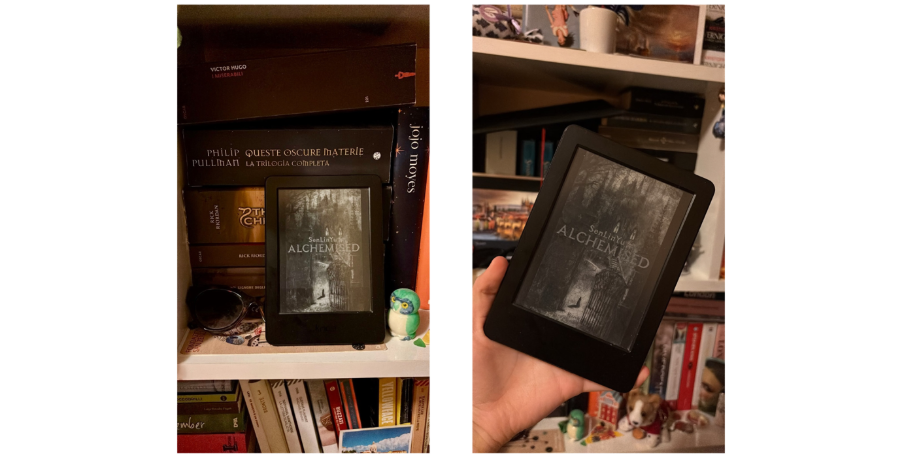
Alchemised by SenLinYu, Italian ebook edition. Photos by Giorgia Aurora Ragonese.
Before most readers could even buy Alchemised, Hollywood had already purchased its film rights.
On September 10th, 2025, thirteen days before the novel’s English-language release, news broke of a (reportedly) more than $3 million big-screen adaptation deal with Legendary Entertainment. An impressive welcome for a debut author! Except SenLinYu was arriving with something many first-time novelists spend years trying to build: an audience.
That audience had discovered the story in another form, under another title, with characters whose names needed little introduction. Before Alchemised, there was Manacled, a Harry Potter fanfiction.
The move from fandom to bookshops and Hollywood raises a question bigger than one publishing deal: what happens when an audience becomes part of what publishers and producers are buying—and part of how the next audience is persuaded to join?
A debut with a head start
Published online in instalments between 2018 and 2019, Manacled paired Draco Malfoy with Hermione Granger: “Dramione”, in fandom shorthand. Drawing inspiration from Margaret Atwood’s The Handmaid’s Tale, it placed familiar characters in a brutal alternative world shaped by war, captivity and reproductive coercion. This was a long way from Hogwarts homework.
Manacled’s following was substantial well before Alchemised appeared. A TODAY interview originally published in February 2024 reported around 84,000 likes on Archive of Our Own and 71,000 Goodreads ratings for the fanfiction. Those figures, capturing different forms of engagement, give a sense of how far the conversation had already travelled.
To turn Manacled into Alchemised, giving new names to the old protagonists was only the beginning. SenLinYu rebuilt the story around a world of alchemy and necromancy, with Helena Marino and Kaine Ferron taking centre stage.
But rewriting the story did not mean starting from scratch with readers. Alongside the manuscript came years of visible reader enthusiasm: people discussing SenLinYu’s writing, recommending it and coming back for more.
For publishers Del Rey and Michael Joseph, that was a valuable head start. They were introducing SenLinYu to bookshops, but thousands of readers needed no introduction at all.
New names, familiar faces
SenLinYu made no mystery of that history. Announcing the novel in February 2024, the author called it “a reimagined version of Manacled” and explained that both publishing teams understood the earlier work’s importance to its community.
The publishers also had good reason to mention the following. A July 2025 Penguin Australia preorder guide presented Alchemised as an original novel inspired by an enormously popular online work. The official book website highlighted more than twenty million downloads across SenLinYu’s online writing. The message to prospective readers is clear: this may be a new novel, yet its author has already captured readers’ attention on a remarkable scale. And millions of downloads make an introduction difficult to ignore.
Images offer another way to maintain the connection. Illustrations shared jointly by SenLinYu and artists Elithienart and Avendell shortly after publication feature a heroine with dark, curly hair alongside a strikingly pale-haired man. Viewed beside Dramione and Manacled artwork, those recurring features suggest a recognisable visual continuity.
The captions say “Alchemised”. Readers familiar with the earlier imagery may make another association.
From left to right: Dramione artwork by gildedshivers (via Tumblr); Manacled fanart by thekimchitrainart (via Instagram); Alchemised illustration by Avendell (via Instagram).
This is where visual allusion becomes interesting: a reference can remain legible even after the names disappear. Research on visual rhetoric in advertising suggests that recognising a visual reference can draw viewers in and encourage a more favourable response, provided they have the cultural knowledge to catch it. Hence, for fans who recognise the connection, familiar faces can make Alchemised’s new world feel less unfamiliar—a useful invitation when choosing a book means committing hours to a story you have yet to discover.
Will I actually like this book?
You can check the price. You can check the page count. You can even read the blurb three times while standing in a bookshop. None will tell you whether, two hundred pages later, you will care desperately about what happens next. That makes novels experience goods: much of what we want to know becomes clear through reading them.
And even finishing the book does not settle every question. “I loved it” may be easy to say. “How does it compare with other writing in this genre?” takes a different kind of judgment. This brings us towards credence, or trust, qualities: aspects of value that remain difficult to assess confidently even after consumption. That is where critics and readers we trust come in, helping us see where a book fits in the wider literary landscape.
So we look for clues: an author we already enjoy, a friend who knows our taste, a YouTube reviewer whose last recommendation kept us reading until three in the morning.
Over roughly the past six years, BookTok has turned these exchanges into a powerful discovery channel, alongside the established communities of Bookstagram and BookTube. In a 2022 Publishers Association survey of more than 2,000 people aged 16 to 25, 59% said BookTok or book influencers had helped them discover a passion for reading.
A book can now enter someone’s reading list long before it enters their local bookshop.
Creators help make that happen through market making, drawing attention towards particular titles, and sense making, helping readers understand their appeal.
“#enemies-to-lovers” tells you what kind of tension to expect. “#slowburn” warns you to be patient. A creator explaining why a character’s apparently terrible decision makes emotional sense may do more to interest you than a paragraph of promotional praise.
These communities help turn an overwhelming choice into a manageable one by setting expectations that newcomers can recognise. The formula is simple: find someone whose taste you trust, learn their vocabulary, and an unfamiliar book becomes easier to imagine enjoying.
In the case of Alchemised, some readers already knew SenLinYu’s writing through Manacled. For others, that combination of romantic tension and a long-awaited payoff promised by those labels might be enough to earn the book a place on their reading list.
A following worth investing in
Now look at that same conversation from a publisher’s desk.
An unfamiliar manuscript asks a business to imagine who might want it. A story with years of discussion behind it arrives with some of that audience already visible. Ratings, recommendations and fanart offer clues about whom to approach and what has captured their interest.
The intensity matters as much as the headcount. If following an account takes only a moment, drawing its characters, debating its chapters or persuading a friend to read a lengthy fanfiction takes considerably more involvement.
For a publisher, that activity can make a project easier to assess. It also provides material for the campaign: communities to reach, references they recognise and conversations the launch can build upon. The earlier enthusiasm gives the business somewhere to begin.
But there is still plenty of work between “people love this online” and a successful publishing campaign. Penguin Michael Joseph’s British campaign for Alchemised won the Book Marketing Society’s Adult Fiction award for the third quarter of 2025: the judges highlighted its planning, audience segmentation and digital marketing. Therefore, even an author with a substantial following benefits from a carefully planned introduction to the book-buying public.
The film deal extends the same commercial story. Legendary Entertainment committed before the novel reached bookshops—a striking expression of confidence in its potential. An audience already invested in the author and the earlier story offered an obvious commercial attraction.
We cannot see inside that investment decision, but we can see the sequence: readers make a story visible; publishers develop it for a new market; film producers see the possibility of reaching another audience.
What begins as participation becomes information that businesses can act on. The fan recommending a story to a friend is also, collectively with thousands of others, helping demonstrate that a market might exist.
When readers bring more readers
The value of that first audience goes beyond its own purchases. Its enthusiasm can travel.
Someone recommends Alchemised to a friend who would usually walk straight past the fantasy shelves. That friend posts a reaction. Another person notices the growing discussion and decides to investigate. A book’s popularity becomes part of what draws the next reader in.
A landmark study published in 2006 by Salganik, Dodds and Watts found that making other people’s choices visible increased both the concentration and the unpredictability of success in an experimental music market. They saw that a few songs attracted a larger share of attention, but which ones pulled ahead varied across versions of the market. Popularity could feed on itself without producing the same winners every time.
For publishers, this helps explain the attraction of an established fandom. An engaged community gives to a book people who can start the conversation—and reasons for others to join it. Each recommendation creates another opportunity for that conversation to spread.
This is where a head start becomes commercially valuable without becoming a guarantee. Publishers have evidence that interest exists and a community through which to build it. How far the enthusiasm will travel, and how many purchases it will generate, remain harder to predict.
Promotion and creator partnerships can help the book reach new readers. Those readers then contribute their own verdicts, shaping what happens next.
And a rewritten novel has an additional task: giving returning fans a reason to embrace its changes while offering newcomers a story they can make their own. Familiarity may persuade someone to open the book. What happens after that becomes part of the next conversation.
Who gets to start from zero?
By the time Alchemised reached bookshops, its commercial story was already well underway. The names and fictional world had changed, but the relationship between author and audience had years behind it.
For writers emerging from fandom, that is an extraordinary opening. Work first shared outside traditional publishing can attract readers, demonstrate its appeal and eventually help secure opportunities across industries.
But what about the writer who arrives with a manuscript and no crowd?
That question stayed with me after watching Ilenia Zodiaco’s video on how fanfiction and fandom are changing publishing, which helped inspire this article.
If an existing audience becomes increasingly valuable in investment decisions, authors without followers or established communities may face an additional challenge: proving their potential before anyone has helped readers discover them.
Of course, one novel cannot establish an industry-wide conclusion. But it raises a question worth asking: how much room does a market that values an audience in advance leave for writers whose readers have yet to discover them?
Publishing can turn an existing following into a much bigger audience. Its next discovery, though, may be a manuscript with no following at all. The challenge is to recognise the promise in both.
Article written by Giorgia Aurora Ragonese
