The release of Moulin by László Nemes on 28 October 2026, a film featuring fairly explicit scenes depicting the torture endured by the French Resistance fighter, prompted me to explore the vast question of what is morally acceptable to show on screen. And what better way to do so than by examining the historical event that has fuelled this debate more than any other since the end of the Second World War: the Holocaust. Hundreds upon hundreds of films have addressed the subject, directly or indirectly, each adopting radically different approaches. First, a brief recap is in order.
The Power of Images
As soon as the camps were liberated, the question of whether to broadcast the footage filmed by soldiers upon their arrival arose. Despite the shock caused by what they discovered, orders were given to collect as much evidence as possible in order to document the horrors of the Nazi extermination camps. This footage would notably be used during the Nuremberg trials. However, the amount of available footage was relatively limited, and its distribution across European countries was hindered by the unbearable nature of what was visible on screen. Only the least disturbing shots were shown from 1946–1947 onwards. It was not until 1956, with the release of Alain Resnais’s Night and Fog, that the general public was able to discover the full extent of this footage. Even then, moral questions arose, particularly in France, where certain shots were censored because they showed French gendarmes collaborating with the Nazis at the Drancy internment camp.
While these real images took time to reach the public, artists had not waited until 1956 to address the subject. Indeed, even before the end of the war, Hollywood filmmakers were already tackling the persecution of Jewish people, as Charlie Chaplin did in The Great Dictator in 1940. However, these works of fiction approached the Holocaust indirectly, as it was considered too traumatic a subject for American audiences. In Europe, few productions dealt with the subject head-on before the 1960s, a decade during which the question of how to represent this historical event truly came to the fore.
From Kapò to Schindler’s List: The Impossible Representation of the Holocaust
In the 1960s, the visual representation of the Holocaust was condemned and deemed morally impossible. It was Jacques Rivette who, in his thought-provoking essay On Abjection, theorised the impossibility of depicting the Holocaust through fictional cinema. He took Gillo Pontecorvo’s Kapò (1962) as an example, denouncing the film’s cinematic and aesthetic choices in its portrayal of a death camp. At the heart of Rivette’s criticism lies a scene in which a deportee, played by Emmanuelle Riva, commits suicide by throwing herself onto electrified barbed wire. A tracking shot then moves in to frame her corpse in an aesthetically pleasing composition. This pursuit of “beauty” under such circumstances is, in Rivette’s eyes, an act of “abjection”. He then invokes Jean-Luc Godard’s famous statement: “Tracking shots are a matter of morality.”
Kapò (1962), Gillo Pontecorvo, Emmanuelle Riva’s death scene
From that point onwards, French fictional films tended to evoke the Holocaust indirectly, keeping it in the background of narratives primarily concerned with the Occupation. Their public success and critical reception helped shape the collective memory of the Holocaust, approaching the tragedy in ways that encouraged reflection rather than direct confrontation.
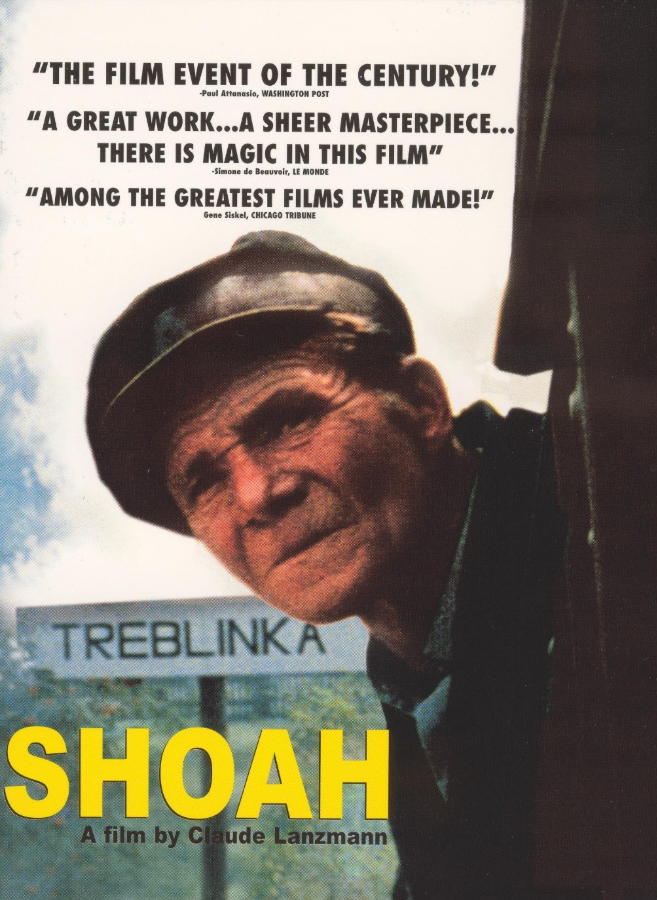
In 1985, Claude Lanzmann went even further with Shoah, a ten-hour documentary composed of testimonies from survivors and perpetrators, without a single archival image. Lanzmann asserted that the direct use of images depicting the Holocaust was impossible, claiming that such images “do not exist”, since, in his view, no footage of the actual extermination process had survived. All the existing footage of the camps, in this sense, dates from their liberation. The film had the effect of an explosion. Beyond its extraordinary length, it was the rigour of its approach and the authenticity of its images that profoundly shook both the press and the public. Simone de Beauvoir wrote, in a text that would serve as the preface to the book accompanying the film’s release: “Despite all our knowledge, the terrible experience had remained at a distance from us. For the first time, we experience it in our minds, our hearts, our flesh. It becomes our own.”
Yet the question of representation continued to fuel debate and controversy in the decades that followed, reaching a climax with the release of Steven Spielberg’s Schindler’s List in 1993. Although based on a true story, Spielberg fictionalises certain aspects of his narrative, particularly in a now-famous scene that epitomises precisely what Rivette had denounced: the shower scene. In this sequence, Jewish women are deported to Auschwitz and forced to undress in a room into which they are herded. In the collective imagination, the image of the gas chambers immediately comes to mind. What follows is a lengthy sequence of mounting tension in which the audience, aware of what lies ahead in ways the characters cannot be, watches helplessly as the women appear to face imminent death. Yet, at the height of the suspense, the room turns out to contain nothing more than ordinary showers. Upon the film’s release, this sequence was fiercely criticised by numerous critics and artists, including Lanzmann, who accused Spielberg of creating fictional suspense around the horrors of the Holocaust and turning the genocide into a form of entertainment. Film critic Louis Skorecki summed up this criticism by arguing that Spielberg filmed “Jewish deportees hunted down by the Nazis in the same way he filmed swimmers attacked by a shark in Jaws or children chased by dinosaurs in Jurassic Park”.
The shower scene in Schindler’s List (1993), Steven Spielberg
Towards New Ways of Filming the Unrepresentable
Now that we have traced the history of this debate surrounding the morality of representing the Holocaust, the question becomes how filmmakers can continue to tell stories about it. The duty to remember must be carried forward, and cinema has a role to play in ensuring that this memory endures. Several major filmmakers have already attempted to meet this challenge, including Roberto Benigni with Life Is Beautiful. In this film, the horrors of the extermination camps are “hidden” from a young boy by his father, who convinces him that everything happening around them is merely a game. Through comedy and by avoiding a direct depiction of the Holocaust, Benigni manages, to some extent, to circumvent the problem, although his film was not spared criticism from Lanzmann.
Even today, this contentious question continues to fascinate filmmakers, as demonstrated by two recent films that have succeeded in finding new ways to represent the subject on screen.
The first is Son of Saul, directed by László Nemes (yes, him again) and released in 2015. The film tells the story of a prisoner at Auschwitz who belongs to the Sonderkommando assigned to one of the crematoria. These groups of prisoners were kept strictly separated from the rest of the camp and, while constantly facing the prospect of their own imminent execution, were forced to participate in the cremation of victims and the disposal of their ashes. The film’s distinctive approach lies in its restraint and sensory dimension. Almost nothing is shown directly: the camera remains focused on the main character and follows his movements, leaving the horrors of the camp either partially off-screen or blurred in the background. The audience is left with sounds and fleeting images from which it must construct its own vision of the atrocities. The film was praised by Claude Lanzmann himself.
The second film, Jonathan Glazer’s The Zone of Interest (2023), takes an even more radical approach to filmmaking. It follows the everyday life of Auschwitz commandant Rudolf Höss and his family in an almost documentary-like, voyeuristic manner. Nothing of the camp’s atrocities is ever shown directly. The only elements betraying the presence of the largest Nazi extermination camp are the black smoke rising from the chimneys and the constant industrial noise in the background. The film’s radical abstraction creates a form of cognitive dissonance, mirroring that of its characters, who live right next to Auschwitz as though nothing were happening. It offers a chilling illustration of what Hannah Arendt theorised as the banality of evil.
The Zone of Interest (2023), Jonathan Glazer
Beyond ensuring that the duty to remember continues at a time when the last survivors of the Holocaust are gradually passing away, these two films demonstrate that it is still possible to innovate and find new ways of representing the unimaginable on screen.
Sources:
