On Wednesday 5 November, the Pays de la Loire National Orchestra (ONPL) gave its special student concert to mark the start of the season. The programme featured over an hour of classical music without an interval, exclusively for students who filled the concert hall at La Cité des Congrès, attracted by the chance to listen to these exceptional musicians for the very low price of 3€ per ticket. Each piece was accompanied by a detailed presentation, allowing even the most novice listener to understand the context in which the work was composed, what it is trying to convey, and how the composer conveys this message. The soloist also introduces us to her instruments, the alto and soprano saxophones, and explains how their inventor, the Belgian Adolphe Sax, conceived them at the end of the 19th century.
This year, the saxophone was in the spotlight with the participation of soloist Asya Fateyva, a young artist born in Crimea. She is very versatile as she can perform both original works for saxophone and arrangements of Baroque, Classical and Romantic compositions, and she showed it in the programme for this concert evening. Asya Fateyva opened the evening with a classical piece, the Concerto for Alto Saxophone and String Orchestra by Alexander Glazunov, a Russian composer from the late 19th century.
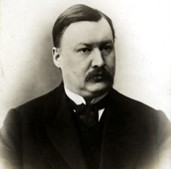
Alexandre Glazounov
Composed in 1934, Alexander Glazunov’s Concerto for Alto Saxophone and String Orchestra in E-flat major is a pretty unique piece. It was the last major work he wrote while living in exile in Paris, and he packed into its single fifteen-minute movement all the warmth, lyricism, and nostalgia of late Romantic music.
Glazunov takes on the saxophone with ease, turning it into a kind of lyrical singer with a smooth, slightly melancholic tone. The solo line flows naturally and feels almost vocal. It is a true mix of inspiration between his birth country and the one where he lives, Russian richness with French elegance, all supported by a bright string orchestra. The concerto moves continuously from one contrasting section to another: a dreamy opening melody, a livelier middle part, and a brilliant final coda where the saxophone shines one last time. With its refined harmony, the piece has become one of the gems of the saxophone repertoire.
Following this piece, it was the turn of the soprano saxophone, the higher-pitched little brother of the famous alto saxophone, to shine with the Fantasia for Soprano Saxophone by Heitor Villa-Lobos, a self-taught Brazilian composer from the early 20th century.
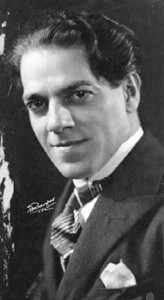
Heitor Villa-Lobos
Composed in 1948 for French saxophonist Marcel Mule, Brazilian composer Heitor Villa-Lobos’ Fantasia for Soprano Saxophone and Orchestra is a work at the crossroads of worlds — between European virtuosity and tropical flair. Villa-Lobos, a great ambassador of Brazilian culture, blends the influences of Bach, popular music from Rio and indigenous rhythms in a free and colourful style. In a single movement divided into three contrasting sections, the Fantasia highlights the chameleon-like character of the soprano saxophone: by turns singing, capricious, dazzling and dreamy. The instrument displays an ardent lyricism, supported by an orchestra that is both rhythmic and shimmering, where each phrase seems to breathe the warmth and freedom of Brazil.
After these two lesser-known orchestral works, the ONPL ended its concert with a more famous but equally magnificent piece: Robert Schumann’s Symphony No. 3, this time without saxophone.
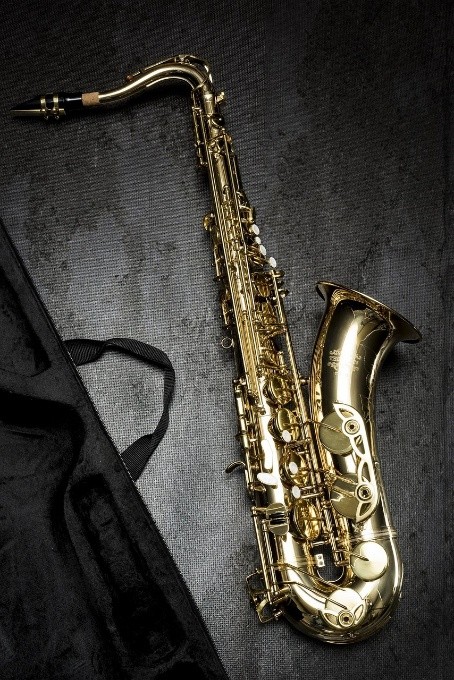
Alto Saxophone
Symphony No. 3 in E flat major, ‘Rhenish’, composed by Robert Schumann in 1850, is a work inspired by the River Rhine and the love of Schumann for the Düsseldorf region, where the composer had just settled. Despite being known for deep and tortured compositions, Schumann wrote this piece as a love letter to this region, making the Symphony No. 3 lighter than most of his works. Unlike classical forms, it has five movements, which follow one another like the chapters of a symphonic poem. It starts with a triumphant overture, followed by a folk dance with rustic accents, a slow movement of great tenderness, a solemn episode evoking a ceremony in Cologne Cathedral, and a radiant finale. With its balance of orchestral power, intimate lyricism and spiritual fervour, the ‘Rhenish’ stands out as one of the finest achievements of German Romanticism.
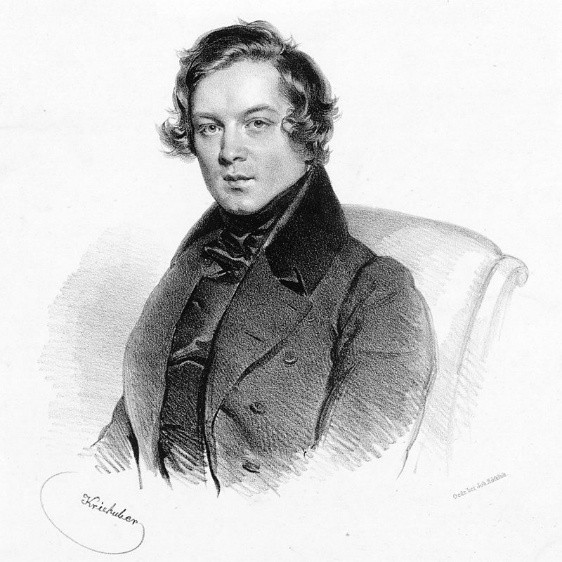
Robert Schumann
The saxophone: a classical instrument?
The absence of the saxophone from the classical scene can mainly be explained by the late date of its creation by Belgian instrument maker Adolphe Sax in the 1840s. Indeed, the Romantic orchestral formation was already well established at that time, which explains the difficulty of integrating the saxophone into it, whereas it enjoyed some success in military bands.
However, the saxophone lends itself very well to classical use. It was created for this purpose to fill a gap in the orchestra’s sound palette. Sax observed that the brass (horns, trumpets, trombones, etc.) and woodwinds (flutes, clarinets, oboes, etc.) lacked a real connection between their timbres. Brass instruments are powerful but rigid, woodwinds expressive but less sonorous. He therefore imagined creating an instrument capable of uniting these opposing qualities: the flexibility of woodwind and the projection of brass. Despite its metallic appearance, the saxophone has a much softer sound than brass instruments due to its single reed, similar to that of the clarinet. However, with the exception of a few composers such as Bizet, Debussy, Ravel, Prokofiev and Glazunov, who were able to take advantage of its versatility, it is not used in this role as a classical orchestral instrument.
So even though the saxophone is a popular instrument, it is thanks to its contribution to jazz music and not for its unique contribution in classical pieces. It is under a totally different light that the ONPL decided to show it to us last night.
Promoting classical music in the region
For many years, the ONPL has been organising concerts for students in Nantes and Angers, in collaboration with student associations from various schools and universities in the cities.
These student concerts are part of a range of cultural activities carried out by the orchestra. Among the most notable initiatives, the ONPL has been playing music for patients at Nantes University Hospital since 2008, with nearly 50 concerts and performances at patients’ bedsides each season. For the past three years, the orchestra has also been playing in the Le Ranzay-La Halvêque neighbourhood in Nantes and Grand-Pigeon – Saint-Exupéry neighbourhoods in Angers, notably through musical breakfasts, exchanges with musicians, stage talks, creative workshops, musical moments for young children and chamber music concerts as part of its Orchestre dans la Cité project. The ONPL has also been playing in prisons in the region for nine years now, explaining that access to culture is essential for rehabilitation.
‘Music helps build bridges, broaden horizons and promote the reintegration of beneficiaries.’
Breaking away from cultural elitism
These actions demonstrate the desire of a representative of institutional culture such as the ONPL to open its doors and break away from the cultural elitism so often associated with the world of classical music.
By choosing to include pieces by less famous composers written for an instrument that is almost absent from the classical repertoire due to its late invention, the ONPL is once again demonstrating its desire to bring people together. When it comes to these pieces, everyone is on the same level, whether they are classical music lovers or complete novices. Everyone discovers and marvels at the sounds of the saxophone accompanied by the orchestra, and everyone appreciates the technical explanations, historical details and presentation of the composers.
Another indication that may seem trivial but says a lot about the ONPL’s attitude towards cultural elitism is their approach to applause between movements of the same piece. This gesture of applauding between two movements may seem insignificant, but it is a real tool of social distinction. That makes those who applaud appear to be novices, while those ‘in the know’ show the extent of their cultural capital through their silence. This tradition, like many traditions, is relatively recent, because in Bach and Mozart’s time, applause and shouting during concerts were commonplace, even encouraged by composers. The emergence of this tradition demonstrates the sacralisation and ritualistic dimension that has developed around classical music. This raises the question of whether concert halls, during classical concerts, are not transforming into giant spectacles where, instead of appreciating the music, people come to consume this ritualistic and perfectly codified atmosphere.
This rule, normally unspoken, was explained verbally by the concert presenter, breaking one of the most important tools of social distinction in the world of classical music and, at the same time, the sanctification of music in favour the real appreciation of its quality and its unifying strength.
To summarize
By continuing this annual tradition of student concerts, the ONPL reaffirms its progressive vision of classical art, focused on sharing and discovery. This concert shows the saxophone in a different light, bridging the gap between jazz and classical music. The musicians also open the door to everyone without exception by presenting the codes and customs that litter the world of classical music in an explicit and critical manner, without which this concert would be just another moment of social distinction.
If you would like to take advantage of this opportunity to open yourself up to this genre of music, which can seem — quite rightly in many cases — rather exclusive, you should know that the ONPL offers students last-minute tickets for 3€. But even several months in advance, the reduced rates for young people make concert tickets very attractive.
Personally, and based on the work of Walter Benjamin, a German philosopher from the Frankfurt school who worked a lot on the concept of art, I believe that the more novices attend these concerts, the more orchestras will open up to this new audience, and the more the codes will be broken. As the reactionary ritualistic dimension of classical music will be destroyed, its progressive dimension of exposure will grow, and classical music will take on its role as music, which is to bring people together. So do not hesitate, go and discover this wonderful art and participate in giving it the magnetizing strength it has the potential to have!
Author: Gabriel MAGET
Sources :
https://onpl.fr/la-saison/action-culturelle-saison
Programmation Concert Symphonique pour les étudiants ONPL
https://fr.wikipedia.org/wiki/Applaudissement#Concerts_classiques
https://fr.wikipedia.org/wiki/Robert_Schumann
https://fr.wikipedia.org/wiki/Heitor_Villa-Lobos
https://fr.wikipedia.org/wiki/Alexandre_Glazounov
All pictures used are open source
