Writing, when it works, disappears into reading. — paraphrasing Roland Barthes thesis in The Degree zero of writing, 1953.
When faced with a stele covered in hieroglyphs, an ancient Chinese manuscript, or a Linear A tablet, something happens. Writing lies before us, familiar in its materiality : lines, strokes, columns, engravings, yet utterly foreign. We read shapes without reading meaning. It is in this suspended moment, between the legible and the illegible, that writing reveals its mystery: it ceases to be a simple instrument of communication and becomes an object of art, a pure sign, a calligraphy. Paradoxically, writing becomes calligraphy only when we no longer understand it, when it loses the very reason for its existence; only then does it reveal itself.
This seemingly minor shift poses a profound question: how do we understand the changing status of writing depending on whether we comprehend it or not? And above all, what does writing become when the key to it is lost? This article explores that border between meaning and appearance, between code and art: navigating through the mystery of the sign, the great adventures of decipherment from Champollion to artificial intelligence, the contemporary extensions of this fascination, from cryptography to artificial intelligence and the Art of Sign.
Writing and its shadow : semiology analysis of the duality of signs
In everyday use, writing appears transparent i.e.we move through it without seeing it. It serves meaning and erases itself behind the message it conveys (c.f. Roland Barthes’ quote above). To read is to forget that one is reading. But once the key is lost, a kind of magic occurs: writing becomes visible again, pure image. We have all experienced this : facing the calligraphy of an unfamiliar language, we no longer see words but forms. Curves, thicknesses, contrasts of ink become visual composition. The beauty takes over from the intelligible.
This paradox is illuminated by Roland Barthes’s semiology. Building on Saussure, Barthes recalls that every linguistic sign consists of two inseparable faces:
- the signifier (the sensory form: sounds, letters, strokes)
- the signified (the concept, the meaning the sign refers to).
The link between the two is arbitrary: nothing in the sequence of letters t-r-e-e naturally evokes the object it denotes. Writing functions only because of a shared convention that unites them.
Barthes extends this logic to all of culture (clothing, images, gestures, artworks) everything becomes potentially readable as a system of signs. In daily life, we no longer see writing; we read it. We pass instantly from signifier to signified, ignoring form. But before an unknown script, hieroglyphs before Champollion, Linear A, or Chinese oracle bones, that relationship breaks.
When convention collapses, when faced with a dead language or unknown symbols, the link dissolves. The signifier detaches from the signified. The sign becomes pure drawing. Writing ceases to be language: it becomes image, aesthetic object, mystery; a calligraphy.
In Mythologies (1957), Barthes shows that when sens is lost, a sign can become the sign of another sign : what he calls myth. For instance, Cleopatra in popular culture is no longer the historical queen (the first signified), but a symbol of another meaning: the fatal woman, exotic beauty, feminine power. This is exactly what happens with mysterious scripts: they cease to transmit a message and instead signify mystery itself, a visual myth of lost knowledge. They are not langage anymore but a symbol of langage.
Barthes helps us understand that when the link between signifier and signified breaks, writing returns to the realm of image. It ceases to be an instrument of sense and becomes a symbolic and aesthetic object, a mystery to contemplate before it is a message to decipher.
There are exceptions: in civilizations where writing is sacred, it can be both language and image. In ancient Egypt, the word hieroglyph (from hieros, “sacred,” and glyphē, “engraving”) already contains this duality. These signs were not meant for all: they were the language of the gods, reserved for priests and initiates. Writing was not a means but a rite. To write was to participate in divine creation. This sacred dimension arises precisely because the sign is incomprehensible to the many. Mystery protects, fascinates, elevates. The opacity of language becomes both power and art.
The great enigmas of decipherment : from Champollion to AI intervention
The moment a mysterious sign recovers its meaning marks a triumph of reason, but also the end of enchantment: art becomes text. Three examples illustrate this transformation.
When Champollion deciphered hieroglyphs in 1822 through the Rosetta Stone, he gave back its voice to ancient Egypt. The sacred figures, long seen as religious ornaments, suddenly revealed their linguistic nature. Image became speech. That shift was foundational; what had been mysterious art returned to language. And ancient Egypt could finally be understood, as hieroglyphs are engraved everywhere.
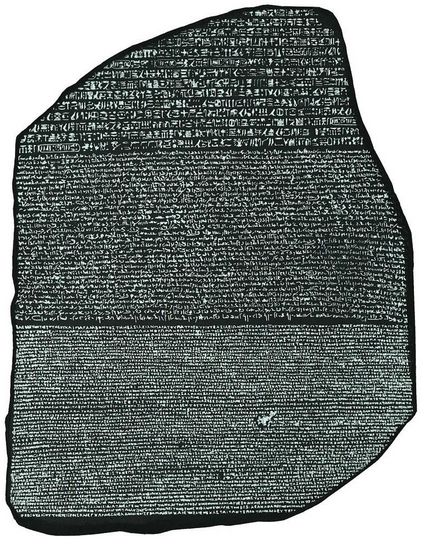
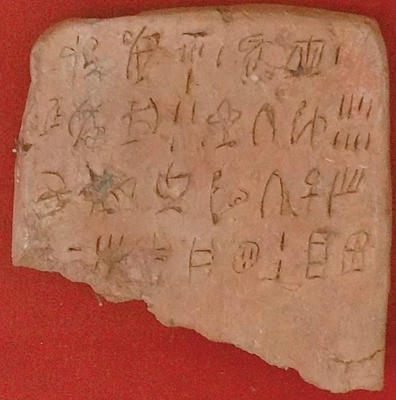
The same happened with Linear B, deciphered in 1952 by Michael Ventris and John Chadwick. Long undeciphered, it turned out to be an early form of Mycenaean Greek. The mystery closed: beneath the signs were inventories, accounts, lists of oxen and offerings. Writing, once a calligraphy (beautiful engraving), fell back into the prose of administration. Its elder sibling, Linear A, however, remains silent. Discovered in Crete and used by the Minoan civilization, it remains undeciphered to this day. Here, writing remains pure art, visible yet unreadable. Each sign, each stroke, becomes a work of visual composition: an alphabet of mystery.
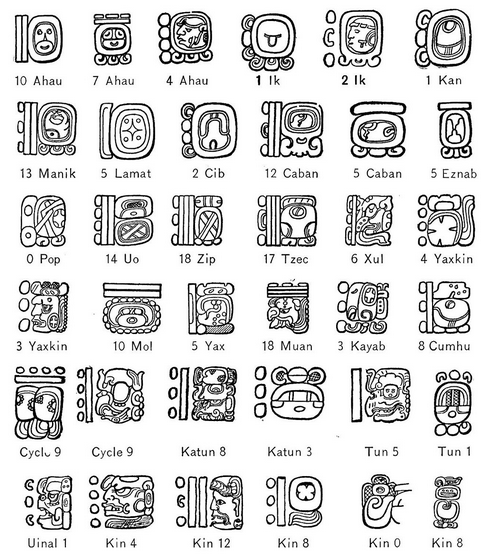
Similarly, Maya script, long regarded as decorative, was reinterpreted in the 20th century as a complex logo-syllabic system. Decipherment transformed perception once again: from aesthetic motif to narrative text. Yet some inscriptions still resist. The ambiguity endures: art or language? image or word? Raising a question : can we completely understand a writing system and its meaning without knowing the culture that used it ?
If some writings became enigmatic through oblivion, others were made so by design. A quick comeback on the invention of cryptography.
As early as the 5th century BCE, the Spartans used the scytale, a simple yet ingenious military device. A strip of leather was wrapped around a rod of a precise diameter, the message written across it, then unrolled: the letters appeared meaningless. Only one with an identical rod could read the message. The first known method of transposition, the scytale already embodies the essence of cryptography, concealing meaning within form.
Centuries later, Julius Caesar refined the art of secrecy with his famous substitution cipher: each letter replaced by another, typically shifted three places along the alphabet. Thus VENI becomes YHQL. Simple yet conceptually revolutionary, the visible text was no longer the message. Writing became a mask, a deliberate mystery.
These two principles (transposition and substitution) would remain the twin pillars of cryptography until the 20th century.
With Enigma, writing entered the mechanical era. Combining both methods, each keystroke turned a set of rotors, changing letter correspondences. Millions of possible combinations, all betrayed by the routine of signing messages “Heil Hitler.” Its decryption by Alan Turing and his team at Bletchley Park (famously dramatized in The Imitation Game, 2014) was both a mathematical triumph and a metaphor: the struggle between transparency and opacity, between the will to read and the will to conceal.
Today the mystery persists, no longer in temples, but in data laboratories. Since the Spartans scytale, cryptography evolved and artificial intelligence has now entered the field of decipherment. Here are three examples.
Researchers such as Manoj and Perono Cacciafoco (2023) explore machine-learning approaches to identify correspondences between Linear A and Linear B. Neural networks compare sign frequencies, word structures, and phonetic analogies. The Melbourne Data Analytics Platform even trains deep learning models on Linear B to test hypotheses about Linear A. The results? Emerging patterns, possible links, but no definitive translation. AI does not explain; it proposes. It reveals form, not yet meaning.
In China, the Oracle Bone Script, more than 4,500 characters engraved on turtle shells and ox bones from the Shang dynasty, is the subject of joint research combining computer vision and generative modeling. Scholars (Guan et al., ACL 2024) use diffusion models to generate visual correspondences between these ancient symbols and modern characters. Of 4,500 signs, only about 1,600 are understood. AI classifies, compares, suggests, but the human eye still interprets.
The same applies to Maya writing. Now about 80% deciphered, it continues to be studied through image datasets (Maya Glyphs Image Dataset). Vision algorithms (CNNs, transformers) learn to recognize and cluster variants of signs. AI assists the human gaze, accelerating analysis without replacing interpretation.
In all these cases, artificial intelligence does not dissolve mystery, it maps it. It navigates the realm of the signifier (the visible form) without fully penetrating the signified (the meaning). It explores that liminal space where writing is no longer merely language but aesthetic structure.
Our computers, phones, and daily communications are themselves saturated with secret writing. Every message, every bank transaction, every password depends on encryption. The mystery has simply changed scale: from clay tablets to quantum algorithms, humanity continues to write in order to conceal. Facing lines of code, most of us would see it as calligraphies, unable to understand to signified behind them. Ironically, AI, which key we do not possess, helps us deciffer writing we do not understand based on a writing we do not understand.Writing again becomes double: visible and invisible, text and code, communication and enigma.
Amid this proliferation of coded systems, certain artists reclaim writing as pure form. Among the Lettrists, writing became abstraction. In Cy Twombly’s scribbles, traces recall fragments of lost language; in Xu Bing’s Book from the Sky, thousands of imaginary Chinese characters are invented, perfectly plausible, yet utterly meaningless. These works replay the paradox: they look like writing but say nothing. They remind us that before being a tool of communication, writing is a form: a trace, an energy, a presence. When meaning vanishes, the eye takes over.
This article has sought to show that writing is never neutral. Transparent for some, opaque for others, it oscillates endlessly between tool and mystery, between language and art. When we understand it, it disappears; when we lose it, it reveals itself.
From sacred hieroglyphs to World War II ciphers, from Cretan tablets to modern algorithms, writing persists through time as both instrument and enigma. Artificial intelligence today continues that quest, striving to pass from sign to sense, from visible to intelligible; while itself being made of coded language.
Perhaps the true power of writing lies precisely in this duality: to be both message and mystery. It is in this interval, between signifier and signified, between form and meaning, that its beauty resides. Writing fascinates because it reminds us that understanding is not always seeing, and that sometimes, simply seeing is enough to inspire wonder.
Author: Nine LETOURMY
