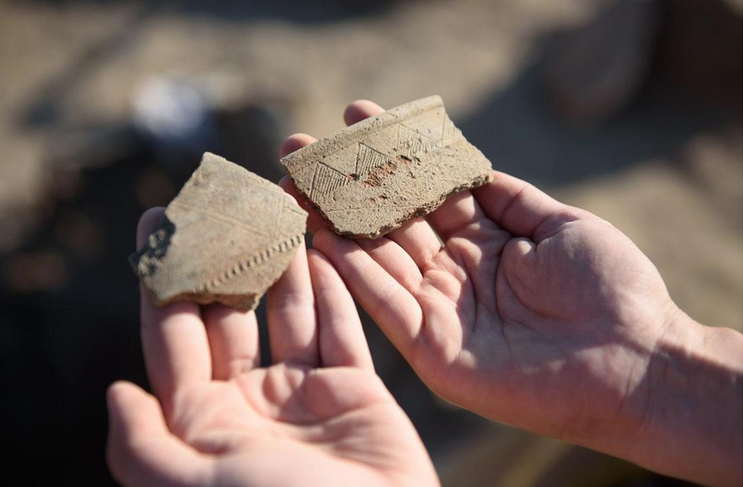
When we think of war, we think about destruction. However, there is often a silent war against memory. The conflict that ravages Syria since 2011 has not only tragically displaced and killed millions, but has also erased a good part of Syrian’s historical heritage, that is to say the cradle of civilization. This allowed the existence of a network of looting and trafficking, transforming millennials of history into cash for terrorist organizations. What is worse, this trade requires a market. While the stealing takes place in the war zones of the Middle East, the destination for these blood antiquities is the very nice and polished galleries of Europe, the United States, and the Gulf. There is consequently a disturbing connection between armed conflict and the art market, allowing groups like Daesh to industrialize the pillage of numerous sites. Prestigious European institutions, through real negligence or voluntary blindness, became the financiers of terror.
The industrialization of pillage: an empire built on ruins
Between 2014 and 2017, the Islamic State (Daesh) consolidated control over parts of Syria and Iraq, a territory presenting at least 4500 archaeological sites. Among these were nine UNESCO World Heritage sites, where first ever signs of urbanization and writing were discovered. For the terrorist organization, looting those places represented a dual opportunity: destruction of polytheist symbols, and clandestine pillage for financial gain. Since the beginning of hostilities in 2011, over 320 archaeological sites have been irreparably wounded, looted, or obliterated. For instance, the ancient cities of Mari, 3rd millennium BC, and Ebla, renowned for their royal archives, have been bombed and destroyed. Other sites, Dura-Europos, often named the « Pompeii of the Desert » and the legendary greco-roman city of Palmyra have suffered complete erasure of the map. To categorize those action, Waleed Khaled al-A’sad, former director of Syrian antiquities uses the words « cultural genocide« . This shows that the very identity of a people is getting voluntarily and systematically deleted. Satellite images from late 2014 revealed the extent of the issue: the site of Mari was scarred by over 1300 excavation craters, by bulldozers and heavy machinery, destroying a lot of precious paintings that were almost 6000 years old…
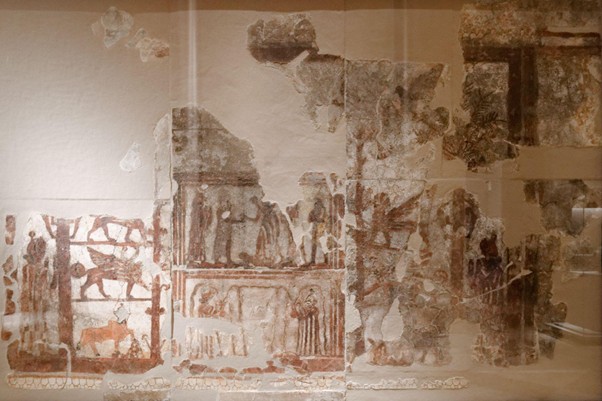
Investment of Zimri-Lîm, 1766 B.C., mural of Mari – now destroyed
The scariest part is how Daesh’s operations are highly hierarchized, in Diwans (departments). The terrorist organization established a « Diwan al-Rikaz », a department for natural resources, which controls the exploitation of oil, gas, and antiquities. On May 15th of 2015, a raid by the U.S. Special Forces on the site controlled by Abu Sayyaf, the financing chief of Daesh, showed intelligence that exposed how sophisticated the group’s administration is. Seized documents included receipts indicating that in just one province (Deir ez-Zor), the group had collected 265 000 $ in a tax called khums, perceived on local diggers. Following estimations, the total of trade in that province exceeded 1,3 million $.
The economics of terror: financing terrorism with artifacts
However, estimating the precise revenue generated by this illicit trade is very difficult due to the blurred nature of the black market: estimates vary significantly between intelligence agencies and international organizations. The high estimations made by the Russians asserted that Daesh generated up to 200 million $ annually from the antiquities trade. Then, in October 2015, Iraq and Interpol estimated around 100 million $ per year. However, French and American intelligence agencies offered more modest figures. The French Center for the Analysis of Terrorism estimated the 2015 revenue at approximately 30 million $, while the U.S. government estimated between 30 and 50 million $. Nevertheless, it does not matter the exact amount of money : what counts is the importance of this revenue in Daesh’s propaganda. Indeed, after being successfully raided by the UN, Daesh faced a big drop in oil revenue. In this context, antiquities became merely a vital « substitution resource » : history was sold to keep the machine running. For another example, artifacts stolen from Dura-Europos alone could be worth nearly 18 million $ on the art market. And if you think of the thousands of archeological sites still available, the financial potential is crazy.
The supply chain: laundering history
The journey of a stolen artifact before it arrives at a gallery or a museum in Paris involves a complex process of laundering, in order to blur the illicit origin of the artefact and integrate it into the legal economy. The primary passage for these artifacts are the porous borders of Turkey and Lebanon. Once across the border, the objects enter the informal grey market. Since many of these items come from illegal excavations, they have never been photographed or documented by official archaeologists. This is the most important moment, because they get invisible to databases like Interpol’s Stolen Works of Art register. But the journey is not finished : to sell antiquity at a good price in Europe, it needs good provenance, which means a documented history of ownership. Traffickers and dealers easily forge these documents. Commonly, they claim that a Syrian artifact belongs to an old family collection dating back to the 1970s (before the 1970 UNESCO Convention which prohibits the import of unprovenanced cultural property). And on top of that, the market is flooded with faux: up to 80% of Syrian antiquities seized in Lebanon are actually forgeries or have forged documentation. All of this is because of the important demand of European galleries and collectors, which complicates the work of law.
Institutional complicity: The Louvre scandal
For years, museums maintained little to no concern, acting very detached from the question. However, recent scandals revealed that even the most prestigious institutions are not that clean. The most known scandal hit in May 2022 around Jean-Luc Martinez, the former president-director of the Louvre Museum (2013–2021). He was a famous expert appointed as France’s ambassador for international cooperation on heritage, and was suddenly charged with « complicity in organized fraud » and « money laundering » for the Louvre Abu Dhabi. Investigators suspect Martinez voluntarily closing his eyes on the strange provenance of several Egyptian artifacts acquired for millions of euros. The centerpiece of this scandal is a pink granite stele bearing the name of Pharaoh Tutankhamun. The investigation revealed an international network of scammers. The stele was sold to the Louvre by a Parisian expert, Christophe Kunicki. Kunicki was already suspected in a similar trial in the USA, for a golden sarcophagus of the priest Nedjemankh purchased by the MET for 3,5 million euros. However, another investigation proved that the sarcophagus had been looted from Egypt in 2011 during the Arab Spring and smuggled out with forged papers. The Met was forced to give it back to Egypt in 2019. The implication of such famous experts proves that the precautions taken by major museums are not sufficient. This is a disturbing question: was this only negligence, or was it a deliberate maneuver to secure prestigious acquisitions? Despite multiple efforts to cancel the trial, the Paris Cour d’appel confirmed the guilt of Martinez in February 2023.
The response: law enforcement and state hypocrisy
Different institutions try to face this crisis. France has mobilized its specialized unit, the OCBC (Central Office for the Fight against Traffic in Cultural Goods). Established in 1975, it has police officers with expertise in art history and criminal investigation. The OCBC has been crucial in those cases, for example with the arrest of five prominent Parisian antiquity dealers in June 2020. They are the ones currently investigating the theft from the Louvre in October 2025. What’s more, the French customs also do a big job, intercepting a lot of shipments. To raise public awareness, the Louvre held an exhibition in 2021 displaying statues from Libya and Syria, destined for the black market but intercepted at the border. However, the political response often balances between tactless statements and uncomfortable realities. In 2014, Philippe Lalliot, the French ambassador to UNESCO, stated, « Even when the dead are counted in the tens of thousands, we must be concerned with cultural cleansing« . The majority of museums today do not really take précautions regarding this scandal, because let’s face it : in Europe, we’d rather finance terrorism and death of thousands than missing on the opportunity to appropriate a beautiful sarcophagus.
The shadow of colonialism
The real problem underlying here is the habit some museums took of stealing and taking ownership of their colonies’ patrimony. The Louvre’s department of oriental antiquities has over 150 000 objects, many of which were acquired during the colonial era. Under the French mandate over Syria and Lebanon (1923–1946), archaeological excavations were governed by the principle of « partage« : finds were divided between the country of origin and the excavating nation. This legal framework allowed thousands of objects from sites like Mari and Ras Shamra to enter French collections. It established a big European ownership over Middle Eastern heritage. Nowadays, the debate has finally shifted towards restitution. For instance, the return of the Mari tablets to Syria between 1996 and 2004 demonstrated that repatriation is possible, yet it remains an exception rather than a rule…
Towards a change ?
Terrifyingly, the connection between the “refined” world of European art galleries and the brutal war of Syria is real. The blood antiquities trade is not only a crime against property, but a mechanism that transforms human heritage into funding for terrorism. The scandals involving the Louvre and the Met demonstrate that the art market’s opacity is a systemic feature. It allows a form of laundering where the illegal origins of an object are erased by the reputation of a prestigious museum. As long as institutions prioritize possession over provenance, and as long as collectors view ancient artifacts as mere commodities, the pillaging of history will continue. Europe often positions itself as the guardian of universal culture. However, the evidence suggests that in its hunger for accumulation, it forgot that this heritage is no one’s property.
Author: Kenya Meziere
