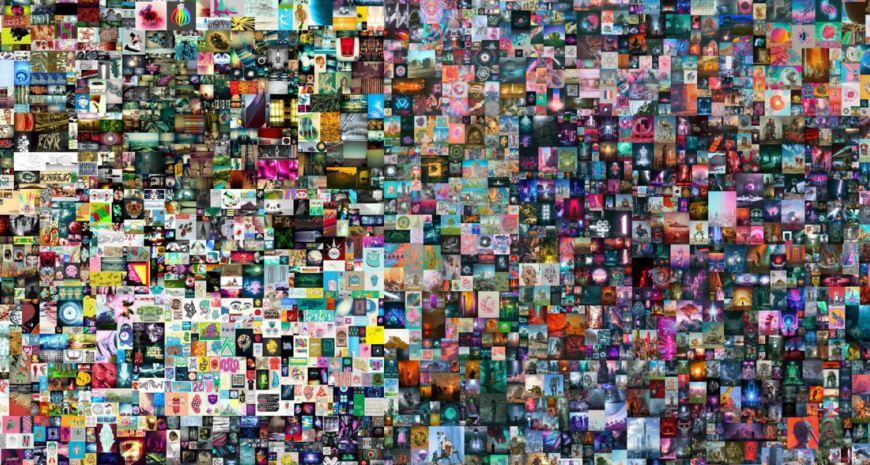
Beeple (Mike Winkelmann), Everydays: The First 5000 Days, 2021. NFT. ©Beeple
From Speculation to Infrastructure: The Genesis of a Regulated Cultural Web 3.0
The year 2021 was marked by a sudden and unprecedented explosion in the field of Non-Fungible Tokens (NFTs). This period was characterized by a level of speculative euphoria that remains difficult to fully comprehend today, highlighted by extraordinary records in the world of public auctions. One cannot discuss this era without mentioning the seminal work of the artist known as Beeple, which was successfully transacted for a sum exceeding 69 million dollars through the auction house Christie’s. However, when we look at the current landscape, a fundamental question arises : how many individuals within our contemporary society remain truly informed about the nature and purpose of NFTs today ?
The reason for this collective distancing is that, starting in 2022, this technology underwent what appeared to be a total and absolute collapse. Transaction volumes did not merely decline; they decreased by more than 90%, a downturn so severe that it led many observers to contemplate the fundamental incompatibility of the cultural and artistic sectors with the technological framework of Web 3.0.
Nevertheless, with several years of hindsight and perspective, we are now in a position to assert that this volatile phase was, in fact, a strategic necessity. It served as a critical testing ground to probe the ultimate limits of the technology and to act as a filtering mechanism designed to maximize its eventual utility. Projects that were fundamentally devoid of intrinsic meaning or long-term value were systematically discarded. This process made way for what major industry reports now describe as a state of “irreversible institutionalization.” We have moved past the era of speculating on digital images; the current focus has shifted toward utilizing blockchain technology for tangible assets. This shift allows for the construction of the legal and technological foundations that are essential for the establishment of a market that is both stable and fundamentally healthy.
For those individuals who may not be entirely familiar with the intricacies of blockchain technology, one can simply visualize it as a vast, decentralized ledger. This ledger systematically catalogs all information in a manner that is entirely transparent, accessible to every participant, and characterized by the absolute impossibility of modification or alteration. Within the specific confines of the cultural world, blockchain provides several critical utilities:
- Total Traceability: It enables a system of comprehensive traceability that functions as an immutable digital certificate of authenticity. Every time a specific work of art undergoes a change in ownership, this information is indelibly recorded within the blockchain.
- Automated Procedures: It facilitates the implementation of automated procedures, which effectively eliminates the burden of administrative complications and removes the necessity for various intermediaries.
- Tokenization of Rights: It allows for the transformation of a specific right (here, for instance, we can utilize the ownership right of a physical painting as an example) into a digital asset known as a token. It is specifically through this process of tokenization that a single work of art can be subdivided into thousands of distinct shares, all while providing a guarantee that each individual share remains unique and entirely secure.
Since the beginning of the current year, the global regulatory environment appears to be shifting strongly in favor of digital frameworks, thereby ensuring the existence of a healthy market, even for the cultural sphere. Within the European context, the official entry into force of MiCAR (Markets in Crypto-Assets Regulation) has fundamentally altered the entire operational system for cultural entrepreneurs. Whereas there was a profound sense of mistrust regarding tokens, viewing them as potential « scams » (an opinion I myself held only a few months ago), the new cultural projects being launched in nations such as France or Belgium can now be disseminated across the European Union with a robust sense of legal security.
Furthermore, companies are now mandated to demonstrate a high degree of transparent marketing, a requirement that effectively marginalizes and discards surrealistic promises of profit. Consequently, those individuals who choose to provide financing for cultural projects are fully aware that they are engaging in a long-term investment. This type of investment closely resembles traditional patronage, even though it retains the potential to generate a financial capital gain. Finally, the implementation of the DORA (Digital Operational Resilience Act) imposes strict requirements on financial institutions and their various partners to guarantee a high level of resistance against cyberattacks. This factor, while complex, addresses what was previously a significant deterrent for those wishing to enter this innovative space.
Currently, however, what appears to be capturing the attention of the most serious investors is no longer merely the digital realm in isolation, but rather the tokenization of Real World Assets (RWA). This specific phenomenon seems to carry significant and far-reaching strategic opportunities for both commercial enterprises and public cultural institutions by digitally fragmenting the legal ownership of physical cultural works.
We are therefore justified in questioning why this particular subject is so inherently interesting and why it represents such a critical strategic stake. A work of art, regardless of its specific nature or medium, can now be subdivided into several thousand digital shares. In an era marked by a significant and persistent decline in public subsidies, cultural institutions are no longer forced into a position where they must separate themselves from their heritage or struggle to find a single, massive donor. Instead, they have the capability to tokenize their real assets by offering fractional investment opportunities to the general public. This development implies several transformative consequences:
- A significantly larger number of individuals can now choose to participate in the financing of a work of art, which serves to diversify the available sources of funding.
- The art market, which has historically been characterized by its difficulty in sales and the resulting liquidity problems for cultural enterprises, can now benefit from transactions that are nearly instantaneous. This allows for the maintenance of a more robust and substantial cash flow.
- As previously established, the blockchain remains accessible to all participants. Once information has been entered into the system, it cannot be modified. It thus becomes an indispensable tool for ensuring the absolute traceability of artworks and for guaranteeing a high level of ethical standards.
Nevertheless, the successful democratization of this model presupposes a majority adoption by the community of collectors, who are often perceived as being detached from new technological developments. However, while it is true that senior collectors demonstrate an interest in digital assets of only approximately 14%, we are on the precipice of an immense transfer of wealth toward the younger generations. Approximately 50% of these new, incoming collectors are deeply interested in fractional investment models. They have understood that blockchain is not merely a technological artifact, but rather the essential machinery of a new cultural market that is inherently more equitable and transparent.
From Patronage to Investment
The fundamental landscape of cultural financing is currently undergoing a complete and total transformation. We have all been educated under the premise that the support for culture rested upon two essential pillars: public subsidies and traditional philanthropy. In both of these historical cases, the underlying assumption was that one had to accept « losing » money for a symbolic purpose or a fiscal benefit. This is no longer the reality of the situation, thanks to the emerging possibility of realizing fractional cultural investments.
One might be inclined to think that this specific approach bears a resemblance to crowdfunding. Indeed, crowdfunding effectively initiated the concept of public participation in specific projects. However, it presents clear limitations insofar as there is generally no financial return on investment for the participant, despite the presence of various symbolic rewards. The tokenization of real-world assets fundamentally changes this equation. This is because the holder of a token possesses a genuine financial share of the underlying asset. This reality is significantly more interesting for professional investors and allows for a substantial increase in market liquidity. If an investor chooses to purchase a token at the start of a week and subsequently wishes to resell it by the end of that same week, this is entirely possible. It is a financial placement in the truest sense.
This democratization of financing does not concern art alone; it also encompasses high-value assets across various sectors. Nonetheless, for cultural organizations, this represents a strategic stake in governance, particularly regarding the reduction of their long-standing dependence on public subsidies.
Furthermore, the sheer magnitude of the change that is currently unfolding is projected to be immense. The market for the tokenization of illiquid assets is expected to reach a value of 16 trillion dollars by the year 2030. According to the Boston Consulting Group, this would represent approximately 10% of the total global GDP. These projections serve to confirm that the cultural sector is simply aligning itself with the broader movement of the global economy. The historical barriers to blockchain accessibility are currently falling away due to the implementation of new regulations. Consequently, what was previously reserved for a narrow financial elite (such as the ownership of masterpieces) is simply becoming an accessible savings product. These products may very well offer a financial yield that is superior to the historically low rates currently provided by traditional banks. This does not, by any means, signify the end of philanthropy or human generosity; rather, it signifies that we are arriving in an era where culture, which was previously perceived merely as an expense or a deficit, can now generate true financial value.
Case Study: From Pioneer Project Towards a New Standardization?
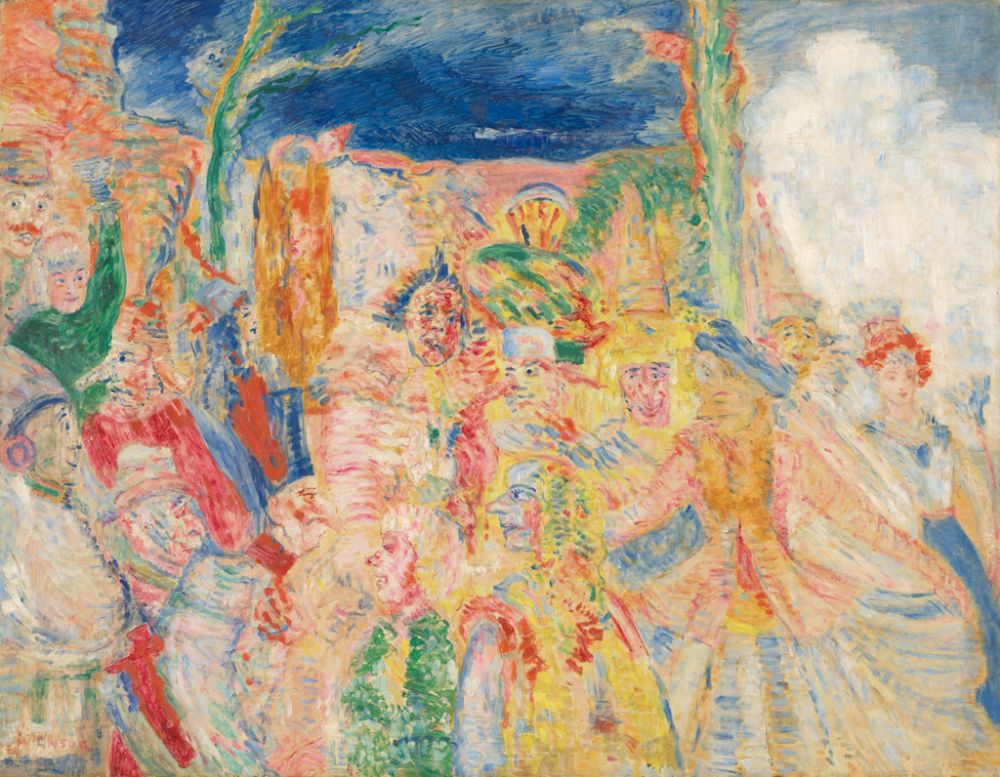
James Ensor, The Carnival of Binche, 1924. ©KMSKA (Royal Museum of Fine Art Antwerp)
Now that the theoretical foundations of this evolution have been established, we can turn our attention to a concrete case study: that of the Royal Museum of Fine Arts Antwerp (KMSKA). This model is widely considered to be a pioneer in the field, although it must be noted that it remains an exceptional case within an environment that is currently in a state of profound mutation.
In the year 2022, the KMSKA became the first major museum in Europe to financially fragment a work of art: The Carnival of Binche by James Ensor. This operation was conducted with the specialized assistance of the Rubey platform. Through this mechanism, investors were able to purchase Art Security Tokens, which successfully raised 1.4 million euros from 250 interested participants. The entry price, or « ticket, » was set at 150 euros, making the investment significantly more affordable for the general public. This allowed for the creation of a dedicated community of partners. Consequently, the museum was able to secure a long-term loan of the work, which had previously belonged to private collections — an achievement that would undoubtedly have been difficult, if not impossible, through traditional financing channels.
However, it is critically important to observe that the Antwerp model does not yet represent the industry norm due to several persistent hurdles:
- The Principle of Inalienability: This legal principle governing public collections asserts that works acquired by the State belong to the public domain. The State is not the « owner » in a private sense, but rather the custodian, and therefore cannot sell or give away these artworks.
- Implementation of Regulations: Policies and regulations are only just beginning to be implemented, which leaves a perception of greater risk for those cultural institutions that are not yet prepared to take this technological leap.
- DORA Act Constraints: The requirements of the DORA Act imply the need for massive financial investments to protect against cyberattacks, an expense that the majority of cultural institutions cannot currently afford.
While the tokenization of tangible assets remains complex, institutions are nonetheless attempting to implement strategic technological measures. One notable example is the Musée d’Orsay, which, since 2024, has utilized blockchain technology to generate “Digital Souvenirs.” This specific initiative allows for the identification of the visitor as a member of a community rather than an anonymous passerby, with the ultimate goal of fostering long-term loyalty.
Cultural institutions are beginning to understand that blockchain is not merely a simple experiment, but rather the essential infrastructure for the projects of tomorrow. It is a core component of a new global financial standard that is both transparent and highly regulated. Evolving alongside technology is not merely a question of image for cultural organizations that are generally perceived as being archaic; it is a genuine necessity for ensuring their long-term sovereignty. The tokenization of real-world assets is a vital tool for achieving financial independence by transforming traditional donations into structured investments. It also allows for the attraction of a new demographic of young investors who are deeply interested in transparency and the fractional nature of financing.
The transition is certainly complex, and perhaps even impossible to implement for smaller organizations, at least for the time being. The challenges regarding widespread adoption are numerous and span legal, technical, and cultural dimensions. Accepting the idea that our collective heritage can be fractioned or managed as a financial asset necessitates a profound change in mentality within the very heart of museum directorates. Nevertheless, profound changes always require time and a strong collective will.
The goal is certainly not to replace the profound emotion we experience when standing before works of art with cold algorithms, but rather to utilize these algorithms to facilitate the meeting between the public and the works themselves. In a world where the art market is often polarized and reserved for a narrow elite, despite various attempts at democratization, it is fundamentally important to make our collections accessible to the greatest number of people. If the situation appears somewhat unclear today, I am firmly persuaded that the cultural institutions that will survive future budget cuts and political shifts will be those that have successfully managed to diversify their operations through the strategic use of technology.
Written by Léana Seguin
Glossary:
Blockchain: A secure, decentralized technology for storing and transmitting information. It operates
as a shared digital database where content is verified and secured through cryptographic methods.
Once validated by network users, the information becomes permanent, transparent, and immutable.
DORA (Digital Operational Resilience Act): An EU regulation imposing strict digital resilience standards on financial institutions and their partners to ensure systems remain secure against cyberattacks.
Inalienability: A legal principle stating that works in public collections belong to the public domain. They cannot be transferred, sold, or donated by the State, which serves as their custodian.
MiCAR (Markets in Crypto-Assets Regulation): The European Union’s legislative framework designed to regulate digital asset markets, providing legal certainty for issuers and enhanced protection for investors.
NFT (Non-Fungible Token): A unique, non-interchangeable digital token issued on a blockchain, used to certify the ownership and authenticity of a digital or physical asset.
RWA (Real World Assets): Physical assets (such as real estate or artwork) that are digitized on the blockchain to facilitate exchange, management, and fractional ownership.
Tokenization: The process of converting real-world rights (such as ownership) into digital tokens on a blockchain, enabling an asset to be split into multiple financial shares.
Bibliography:
Boston Consulting Group. (2022). Relevance of on-chain asset tokenization in ‘crypto winter’. BCG Global. https://www.bcg.com/publications/2022/relevance-of-on-chain-asset-tokenization
Deloitte, & ArtTactic. (2023). Art & Finance Report 2023 (8ème éd.). Deloitte Tax & Consulting SARL.
Musée d’Orsay. (2023, 19 septembre). Le musée d’Orsay s’allie à la Fondation Tezos pour explorer les applications de la blockchain. Communiqué de presse. https://www.musee-orsay.fr/fr/actualites/le-musee-dorsay-sallie-la-fondation-tezos
Musée Royal des Beaux-Arts d’Anvers (KMSKA). (2022). Become a co-owner of a Masterpiece: James Ensor – Le Carnaval de Binche. https://kmska.be/en/become-co-owner-masterpiece
PricewaterhouseCoopers (PwC). (2026). PwC Global Crypto Regulation Report 2026: Navigating the Global Landscape (4ème éd.). PwC LLP. https://www.pwc.de/de/unterlagen/pwc-global-crypto-regulation-report-2026.pdf
Rubey. (2022). Case Study: Art Security Tokens for the Royal Museum of Fine Arts Antwerp. https://www.rubey.be/casestudies
