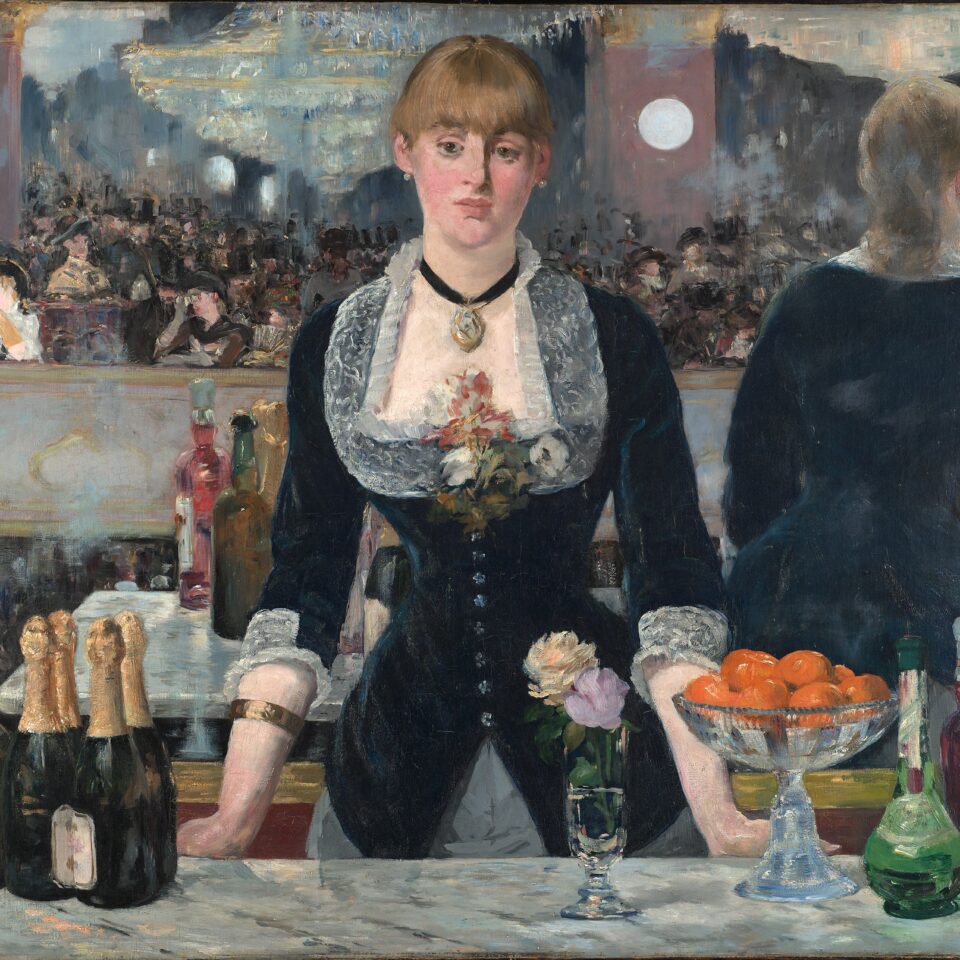
We often come across the expression male gaze on the internet and in the media. It refers to the act, in arts, of depicting women and the world from a heterosexual male perspective. This perspective represents women as sexual objects, for the pleasure of the heterosexual male audience. The concept of male gaze was first articulated by the British feminist film theorist Laura Mulvey in her 1975 essay, « Visual Pleasure and Narrative Cinema ». This theory also refers to historical precedents. For example, in the European oil paintings from the Renaissance period, the female body was, most of the time, idealized and presented from a voyeuristic male perspective. However, the concept of male perspective had already been studied a long time before 1975.
In fact, in 1882, the impressionist painter Édouard Manet presented his new painting Un bar aux Folies Bergère (in English: Bar at the Folies Bergère), which is an analysis of male perspective in arts, and more generally, in society. In 1979, the photographer Jeff Wall creates the picture Picture for Women as an answer to Manet’s painting. This conversation between Manet’s work and Jeff Wall’s one shows us how male perspective has been discussed through the last centuries.
Presentation of A bar at the Folies Bergère
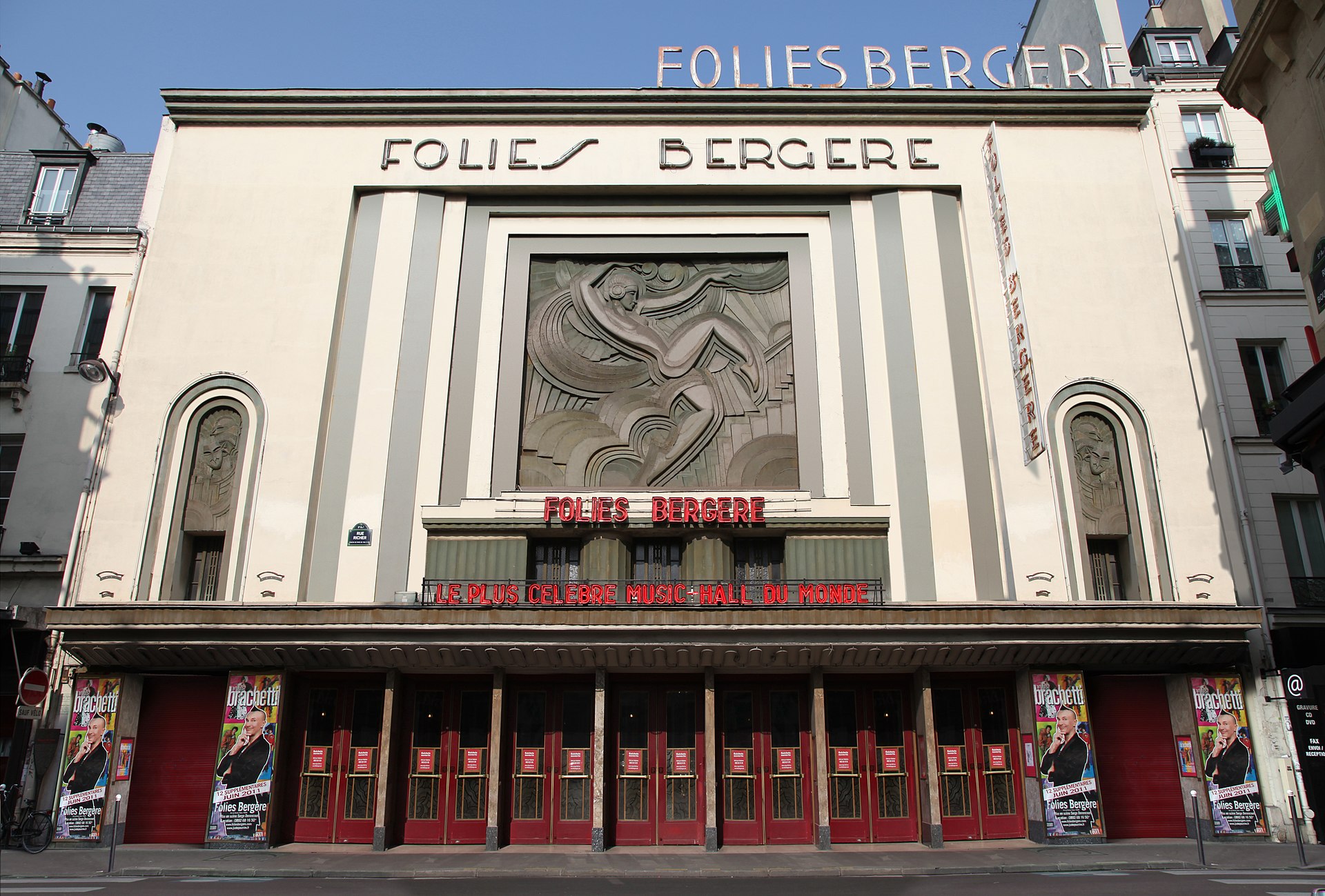
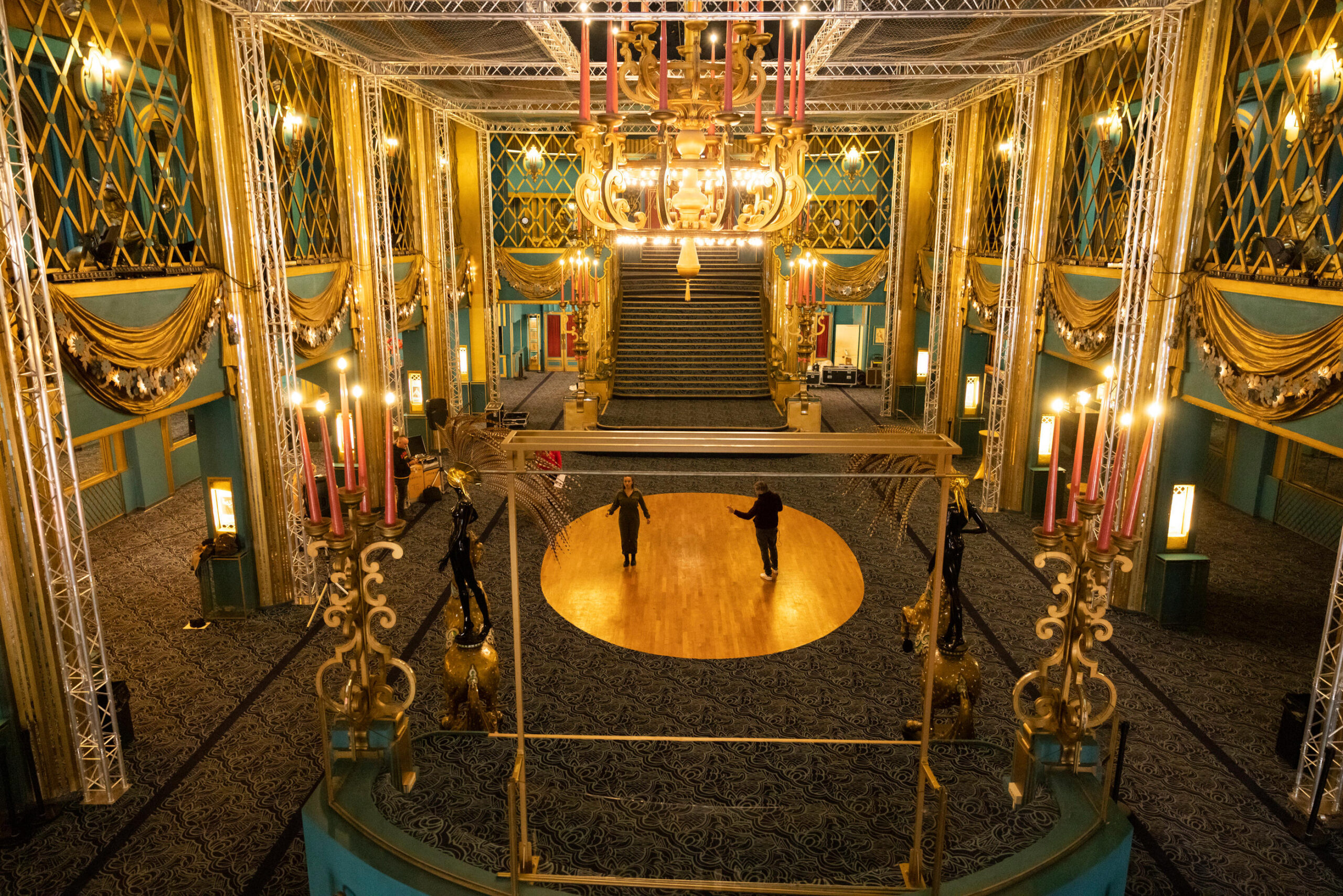
The Un bar aux Folies Bergère painting represents the Folies Bergère concert hall, an iconic place of leisure in Paris that has always been famous for its shows and parties. At the center of the picture we can see a woman behind a bar, who is clearly the bartender. We can easily notice her absent and suffering stare, which can be surprising for a barmaid. She is surrounded by alcohol, drinks and other leisure objects such as fruits and flowers. Behind the barmaid is a mirror. The particularity of this painting is that, except for the forefront – which are the barmaid and the bar – the rest of the painting is the mirror. Which means that most of what we see is a reflection of what is actually in front of the barmaid.
The purpose of the mirror is to give us depth and context about the passive and jaded attitude of the barmaid. In the reflection, we can see a typical scene of a party. In fact, the room is really crowded, everyone is well-dressed and some people are drinking. We can even see the feet of an acrobat. But the most important thing is the reflection of the barmaid’s back, and we can notice that she is actually talking to a man standing in front of her. The mirror allows us to understand that the barmaid has this attitude because of the man she is talking to. She is looking at him. This makes us – the viewer – as if we were this man. Who is he? What is going on?
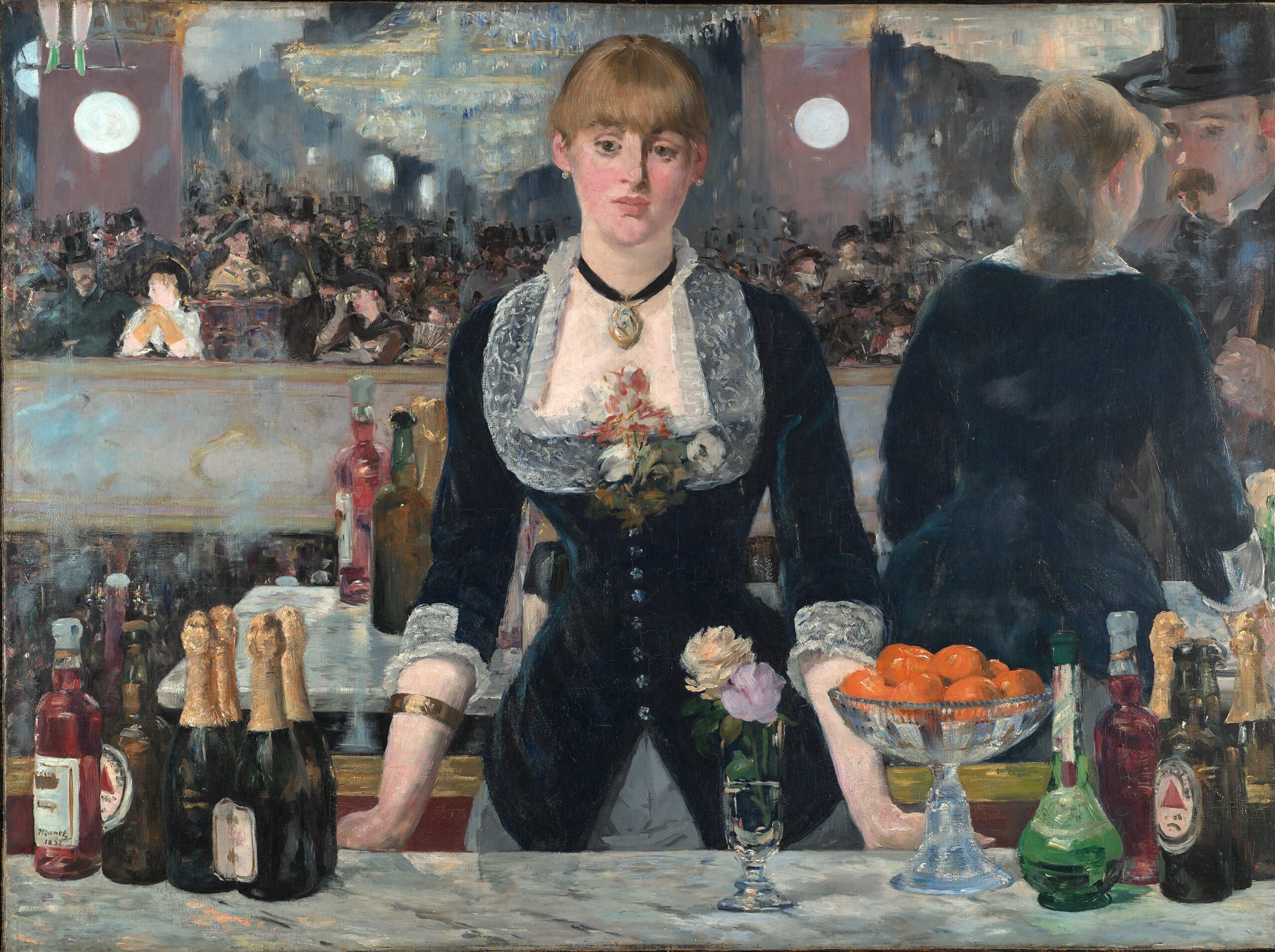
The purpose of the painting is to see the party, and more specifically, the barmaid, from the man’s point of view. At this point, we can realize that, even if she is working, she is completely passive. She is clearly suffering but she has to stay neutral. If we look at her outfit, we can notice symbols of erotism, like the flower on her chest. She is a product, like the drink she sells. Being a product is part of her job, and maybe, being the product is the main part of her job. In this big party, there are plenty of entertaining elements, like the drinks and the acrobat. But the most important element is actually the barmaid’s body. And even if she doesn’t want to, she has no choice. The barmaid must stay silent and play this entertaining role.
The Un bar aux Folies Bergère painting is a reflection about male’s perspective in society. More specifically, it makes the viewer think about how the female body is used as a product in so many sectors, and how women are forced to silently accept it.
Presentation of Picture for Women
Picture for Women is a photographic work by the artist Jeff Wall made in 1979. Jeff Wall is a Canadian artist born on September 29th of 1946. He has been a key figure in Vancouver’s art scene since the early 1970s.
Picture for Women is a key early work in Wall’s career. One edition of this picture is in the collection of Centre Georges Pompidou in Paris. When the Centre will re-open, do not hesitate to go there and see it! There is also an artist’s proof in Wall’s personal collection.
Jeff Wall created Picture for Women to answer Manet’s painting. In fact, the photographs’ compositions often allude to historical artists like Diego Velázquez, Hokusai, and of course Édouard Manet. Along with an earlier work called The Destroyed Room (1978), Wall considers Picture for Women to be his first success in challenging photographic tradition. This picture is also a key photograph in the shift that took place in the 1980s in art photography and museum exhibitions, from small-scale black and white photographs, to large-scale colour photographs.
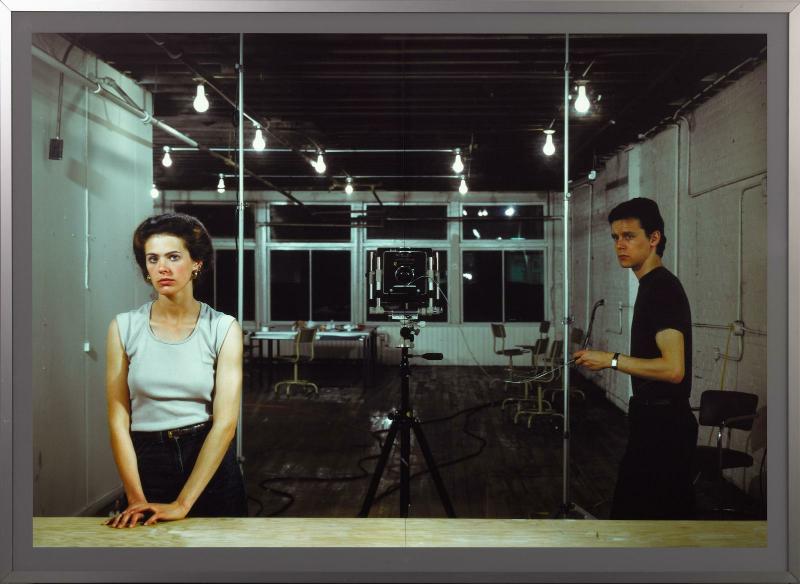
This picture, as many others, is staged. It was photographed in a borrowed studio in Vancouver in winter 1979 and printed on two separate pieces of film which are joined using clear tape. We can notice a cinematic dimension, due to the choice of lights and colors.
On the left slide of the foreground, we can see a woman laying her hands on a table. She has the same blue eyes as the barmaid in Manet’s painting. Her outfit also reminds us of the protagonist of Manet’s painting because of the grey/purple color of her shirt. On the right side of the middle ground, there is Jeff Wall himself. But this is actually a mirror reflection of him taking a picture of her. In fact, like in Manet’s work, there is a mirror behind the woman.
Jeff Wall, indeed, used the same mechanism chosen by Manet. In fact, except the woman and the table, everything that is shown in the picture is a reflection given by the mirror. As Édouard Manet did, Jeff Wall used the mirror to give depth and context to his painting. What is reflected here is Wall’s studio. The scene is surprisingly empty, except for the big camera in the middle of the room, taking the picture of the woman. We can assume that Jeff Wall and the woman are looking at each other, but through the mirror.
Everything except the woman and the table is quite dark and a little blurred. The only sources of light are the lamps and the woman. This also reminds us of the Un bar aux Folies-Bergère painting. Another mechanism that reminds us of Manet’s painting is the fact that the first thing that we notice is the female character, while the male character is darker and blurred.
Analysis of Picture for Women
This picture can firstly be seen as a representation of Jeff Wall’s process in creating his pictures. This would explain why the camera is in the middle, meaning that the camera symbolizes the photographer’s process. In this case, Wall would give us here an occasion to look at what is “behind the scenes”. There is a voyeuristic dimension here, as if we weren’t supposed to see what is going on. Furthermore, the light shed on the woman can be interpreted as if she was the future work of art. The question suggested is, what is behind a work of art?
But let’s go more in depth of what is going on in this picture. It is made by a complex web of viewpoints. Jeff Wall has realized, with his work, a sort of deconstruction of Manet’s painting. The quest of male pleasure here is shown in its whole process.
The point of view in Manet’s picture is a male one, such as in Wall’s picture. Jeff Wall is clearly revealing to us that artists actually choose, most of the time, to take the male’s point of view. And it is not just about taking heterosexual male’s point of view, but also about pleasing them by sexualising women’s bodies. Picture for Women comes as a sort of confirmation: yes, the point of view of Manet’s picture – and most of artworks – is a male’s one, there is indeed a male behind the camera, or holding the brush.
The power relationship between the male artist and the female model is particularly shown by the passivity of the woman. This confirms us that the barmaid was passive. The staging dimension of Wall’s picture suggests that women are often forced to play a role to please heterosexual men’s perspectives. In his empty studio, Wall takes away all the party scenography. The people, the acrobats, the alcohol, are all out. The fake happiness is gone and everything is quiet. We can also notice the quietness by the fact that the woman is holding her hands. This quietness and emptiness permits us to reveal completely the mechanism of how a work of art is made.
Tate Modern exhibited Picture for Women during the Jeff Wall Photographs 1978-2004 exhibition, from 2005 to 2006. As the exhibition’s text explained, the issues of the male gaze, and more specifically the power relationship between the male artist and the female model, such as the viewer’s role, are implicit in Manet’s painting ; but Jeff Wall chose to update the theme by positioning the camera at the center of the work. In this way, he captures the act of grasping the image, through the scene reflected in the mirror, and, at the same time, looks straight at us.
Jeff Wall invites us to find out the creation process in every artwork that we see. He suggests asking ourselves “What is the point of view here?”, “Is there a male gaze?”. Most of the time, the answer is, yes. Édouard Manet and Jeff Wall show us that the male gaze is the most common point of view of what we see, and most of the time we aren’t even aware of it. Male gaze is an unconscious norm. To conclude, I would like to invite you to go further and ask yourself how the male gaze in arts influences our way of behaving in society. Do we dress, talk, act as we want to, or as we are told to ?
Written by Lucia Pelos
