Italian cinema has always possessed a rare gift: the ability to turn life itself into a spectacle, and the spectacle into a meditation on life. From Il Sorpasso to 8½, from La Dolce Vita to Cinema Paradiso, Malèna, and La Grande Bellezza, we travel through more than half a century of Italian history and yet, beyond time and style, we follow a single vanishing line: that of desire, beauty, and the emptiness that hides within them. Each film becomes a mirror held up to a nation constantly oscillating between grace and disillusionment, between sensual excess and existential void. In these works, beauty often serves as a bandage, a luminous facade concealing the wound of a lost innocence, a nostalgia for something that perhaps never truly existed.
The 1960s: Speed, Life, and Vertigo
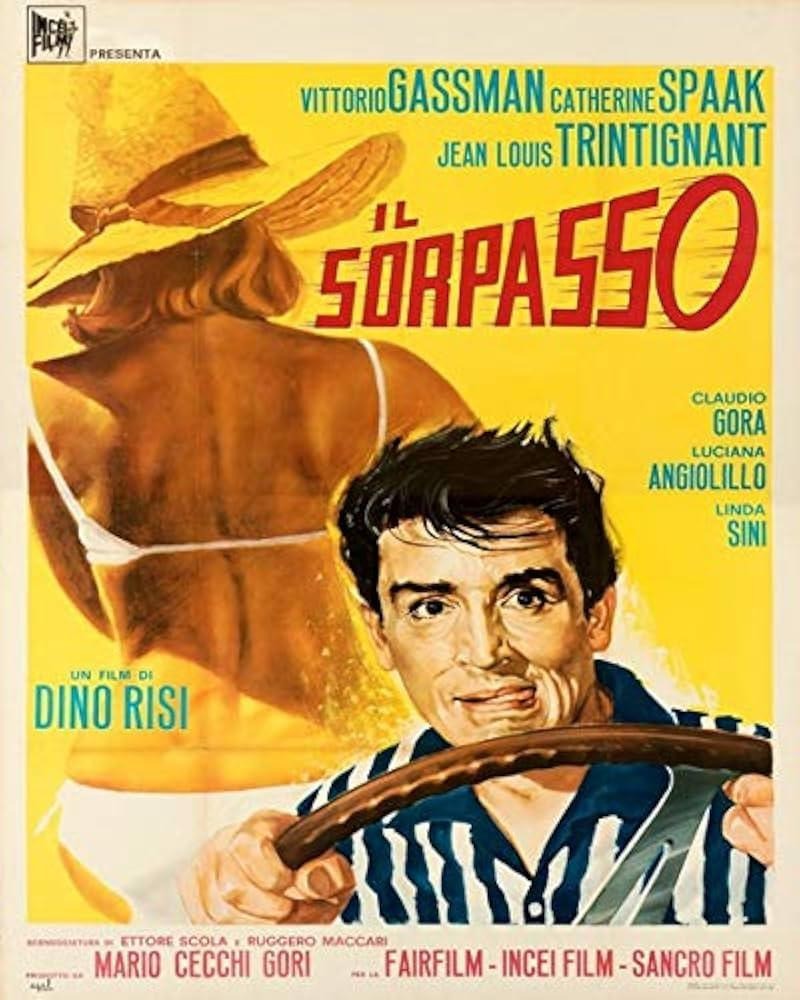
In Il Sorpasso by Dino Risi (1962), Italy races down the open road of its economic miracle. Shot with a restless handheld camera and drenched in the harsh Mediterranean light, the film captures a country in motion: impatient, euphoric, and reckless. Vittorio Gassman’s charisma becomes a metaphor for the speed of the times: his laughter roars like an engine, his freedom feels intoxicating, and yet every acceleration hides a growing void. The editing mirrors that frenzy : sharp cuts, sudden shifts, a rhythm that refuses to settle, echoing a generation discovering both mobility and moral disorientation. Italy is learning how to live again, seduced by the car, the coastline, and consumerism. But in the rearview mirror, innocence is already fading.
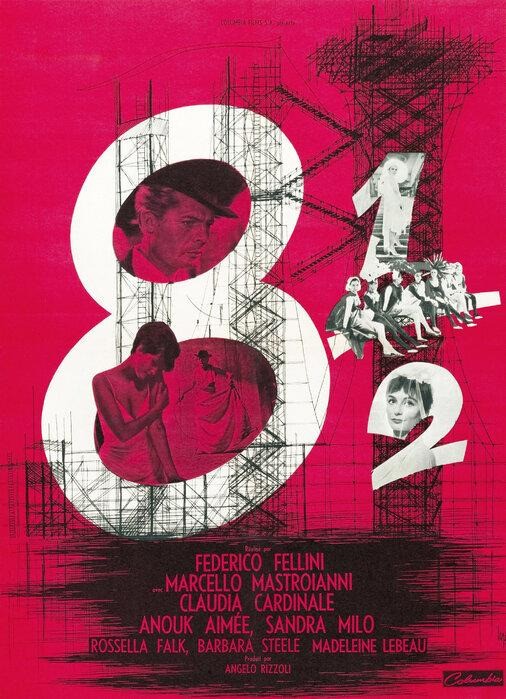
A year later, Fellini explores a different kind of vertigo the dizziness of creation itself. In 8½ (1963), the camera no longer runs forward but circles inward, orbiting the mind of Guido, the director trapped in his own imagination. Fellini’s mastery of mise-en-scène turns confusion into art: the floating camera movements, the dissolving boundaries between dream and reality, the dazzling use of high-contrast black and white: all conjure a world both intimate and surreal. The technical brilliance mirrors the film’s theme: cinema as both liberation and imprisonment. The optimism of postwar Italy, the so-called economic miracle, gives way to a crisis of meaning. The music swells, the spectacle continues, but the dance becomes circular. An eternal carnival masking an existential void.
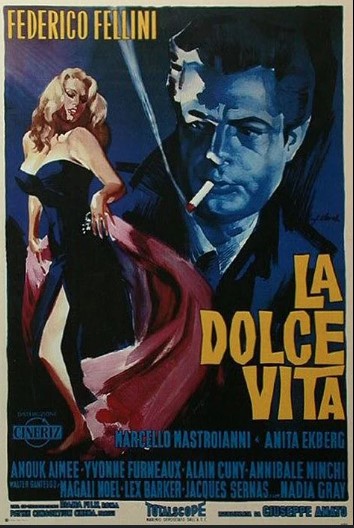
With La Dolce Vita (1960), Fellini had already captured the perfect image of this drift. Rome transformed into a dazzling stage where souls burn out beneath the glare of flashbulbs and the fever of endless nights. Marcello Mastroianni wanders through it all, immaculate and lost, suspended between faith, desire, and a profound boredom that no pleasure can erase.
Technically, Fellini invents a new cinematic language to express moral vertigo. His camera glides through crowded parties and silent dawns with dreamlike fluidity, refusing the stability of classical framing. The long takes evoke both freedom and entrapment, while the chiaroscuro lighting turns every nightclub and street corner into a confessional. The soundtrack half sacred, half profane blurs the boundary between ecstasy and melancholy.
More than a film, La Dolce Vita is a diagnosis of a civilization intoxicated by its own reflection. Italian cinema becomes a mirror for a country asking itself a haunting question: how can one still live, still believe, when everything seems possible and nothing truly matters? Fellini’s Rome is both paradise and purgatory, a city where beauty and decay dance in the same frame: a vision that still defines the poetry and tragedy of modernity.
The 1980s–2000s: Memory and Melancholy
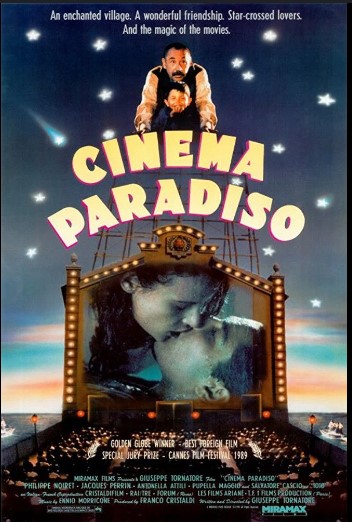
When Cinema Paradiso was released in 1988, Italy had grown older. The fever of the postwar years had cooled, and Giuseppe Tornatore turned his camera toward the tenderness of what had been lost. His film is a love letter to a vanished world, a time when cinema bound together towns, generations, and hearts. Through Ennio Morricone’s soaring score and Tornatore’s warm, amber-lit images, memory becomes both comfort and wound. Every frame breathes nostalgia: the flicker of the projector, the glow on children’s faces, the dust dancing in the beam of light. Tornatore crafts his mise-en-scène like a ritual of remembrance : long tracking shots that caress the past, crossfades that mimic the hazy flow of memory. Cinema Paradiso is not only a homage to childhood and the screen as a window onto the world, but also a farewell. Italian cinema, here, looks into the rearview mirror, aware that it has lost something simple and pure. The collective magic of watching and believing together, slowly disappearing.
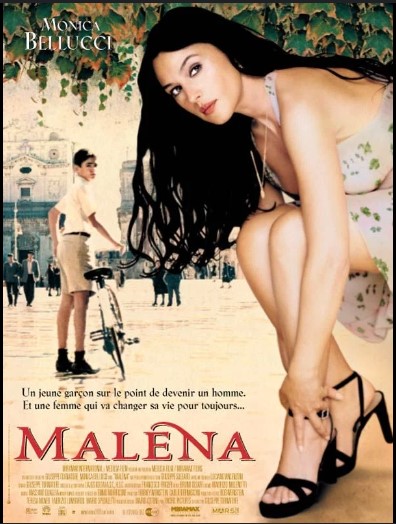
Twelve years later, Tornatore returned to the realm of memory with Malèna (2000). Yet this time, the nostalgia darkens. The gaze of an adolescent boy becomes a cruel mirror reflecting a town’s hypocrisy and desire. Monica Bellucci embodies both the splendor and the curse of beauty, a woman revered and destroyed by the same eyes that worship her. Shot in soft, golden tones that contrast with the brutality of judgment, Tornatore’s direction exposes the moral fractures of rural Italy: cruelty disguised as propriety. The camera lingers on glances and silences, revealing a society haunted by its own repression, souls consumed by the residue of war and by the endless projection of their forbidden desires against their rigid moral codes.
Under the surface of its fable-like beauty, Malèna reveals the violence of a culture unable to love without condemning. Together, the two films trace the melancholy of a nation gazing backward, regretting not just its past, but its capacity for innocence.
The 2010s: Beauty as the Last Refuge
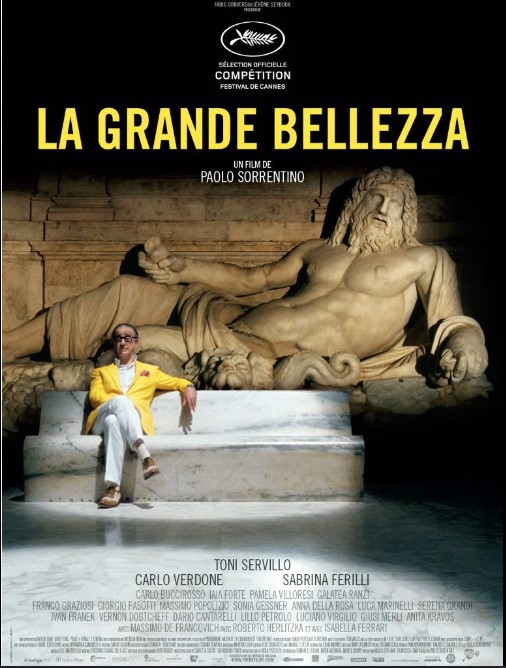
With La Grande Bellezza (2013), Paolo Sorrentino picks up the Fellinian torch and carries it into the 21st century. Jep Gambardella, the aging writer and socialite, gazes at Rome from his terrace like a spectator of his own decadence. Elegant, ironic, and quietly broken. The palaces, the parties, the Roman light : everything brightens with unbearable beauty, and yet everything rings hollow.
Sorrentino turns excess into poetry. His camera glides through amazing banquets, empty churches, and nocturnal wanderings with choreographed grace, composing each frame as if it were a baroque painting come alive. The editing dances to the rhythm of silence and music, electronic beats fading into sacred choirs, capturing a world drunk on its own spectacle. Behind the luxury of surfaces lies a deep exhaustion: the lack of meaning in an age oversaturated with images.
Where Fellini once filmed the birth of modernity, Sorrentino films its aftermath. La Grande Bellezza becomes both homage and requiem. A symphony of melancholy expressed by celebration. Beauty remains, but only as a last refuge, a fragile shield against the void.
From La Dolce Vita to La Grande Bellezza, the circle closes: the party never truly ended, but no one believes in it anymore.
Written by Jules Malard