From The Hollywood Reporter Hazbin Hotel Creator Vivienne Medrano on A24’s First Animated Series
Introduction: What is the Hellaverse?
At first glance, Hazbin Hotel and Helluva Boss seem to be nothing more than irreverent animated series with catchy music and colourful characters. HOWEVER, to limit oneself to their deliberately provocative tone would be to miss out on a universe of unexpected richness, where every laugh hides a wound, where absurdity and satire actually serve as a springboard to explore our fears, our flaws and our most human desires.
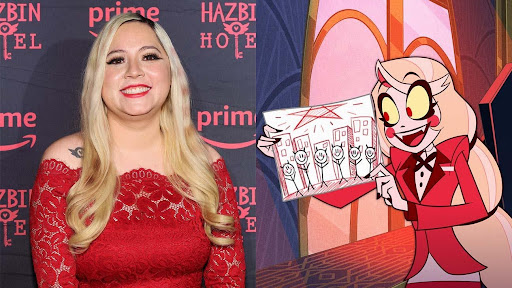
Created by Vivienne Medrano, also known by the pseudonym VivziePop, these series stand out for their unique journey in the world of modern animation. Hazbin Hotel was launched on 28 October 2019 on YouTube, with a pilot episode self-produced by the creator and largely supported by crowdfunding via the Patreon platform. It is the only episode that exists in the space of four years, and yet VivziePop has made a lasting impression, the audience is already hooked, and 92 million views in 2019 mark the birth of a universe in its own right: the Hellaverse. Today, the series is currently streaming on Prime Video after being spotted by A24 and animated in partnership with Bento Box Entertainment. Its first season of eight episodes has been available since 2024, and a second season is scheduled for October 2025.
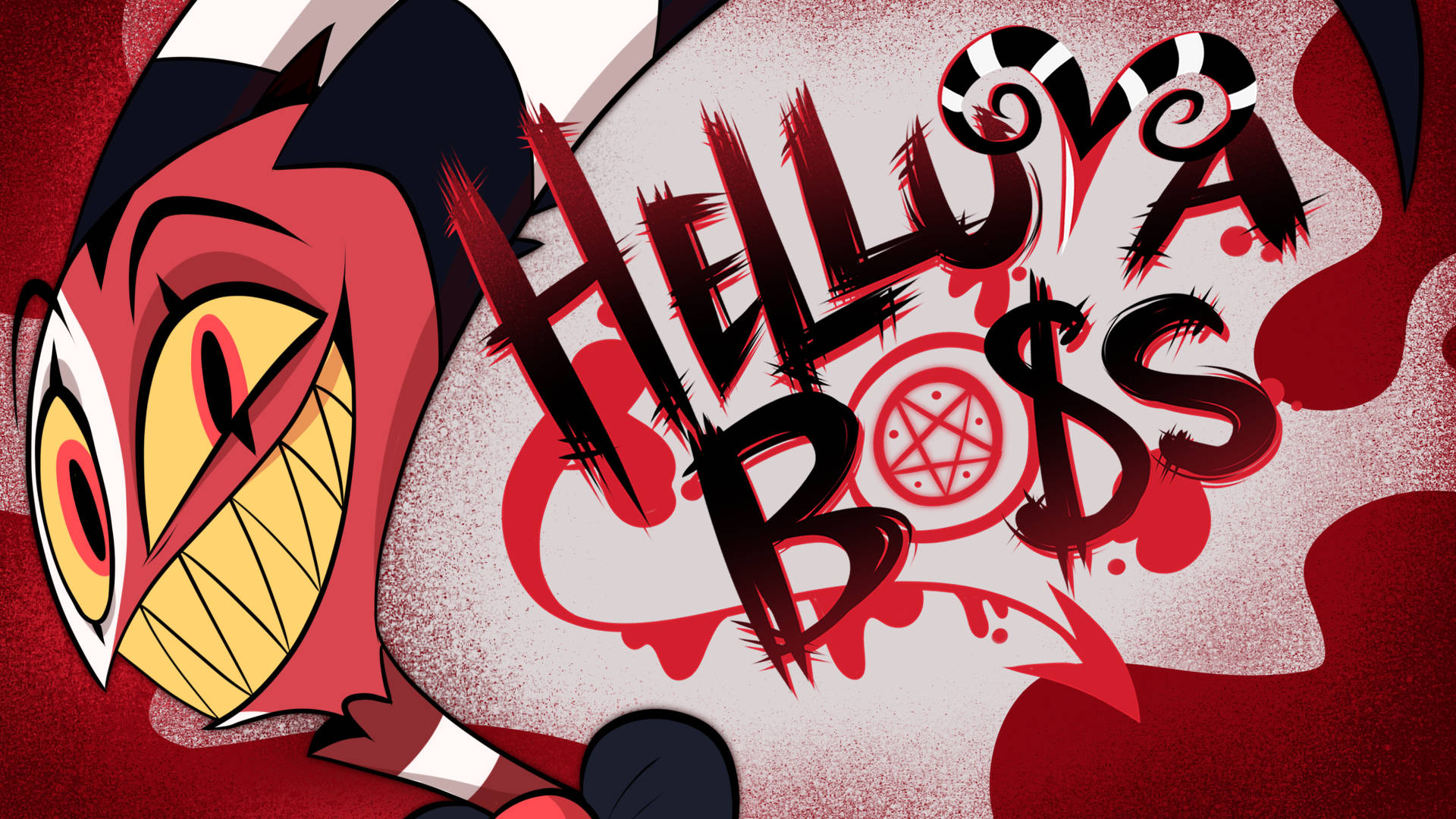
But Hellaverse also includes Helluva Boss, the ‘little sister’ series, which arrived with panache on the web a month after Hazbin Hotel, on 25 November 2019. Its story takes place in the same universe but with different characters and plots: the completion of a world under construction that crystallises the public’s enthusiasm and imagination. This series remains faithful to YouTube and SpindleHorse Toons, the studio founded by Vivienne Medrano, with two seasons already online and a third in the works.
Both series began as independent projects on YouTube, supported by a dynamic online community, before conquering the world of international animation. However, reducing these universes to their purely technical aspects would be to overlook the essential: behind the dark humour, incisive dialogue and musical performances, these series profoundly question human nature through an allegory of Hell. They explore the contrasts between cartoon aesthetics and serious themes such as loneliness, depression, redemption, abuse, and the quest for love and recognition, in order to highlight the complexity of characters who, beneath their grotesque exteriors, touch on universal wounds.
Welcome to the Hellaverse, the universe of VivziePop, in which the series Hazbin Hotel and Helluva Boss, each in their own way and with their own characters, question the codes of animation, the place of independence in the face of major studios, but also and above all our intimate relationship with vulnerability, forgiveness and self-construction.
Universe and themes
a) Hazbin Hotel
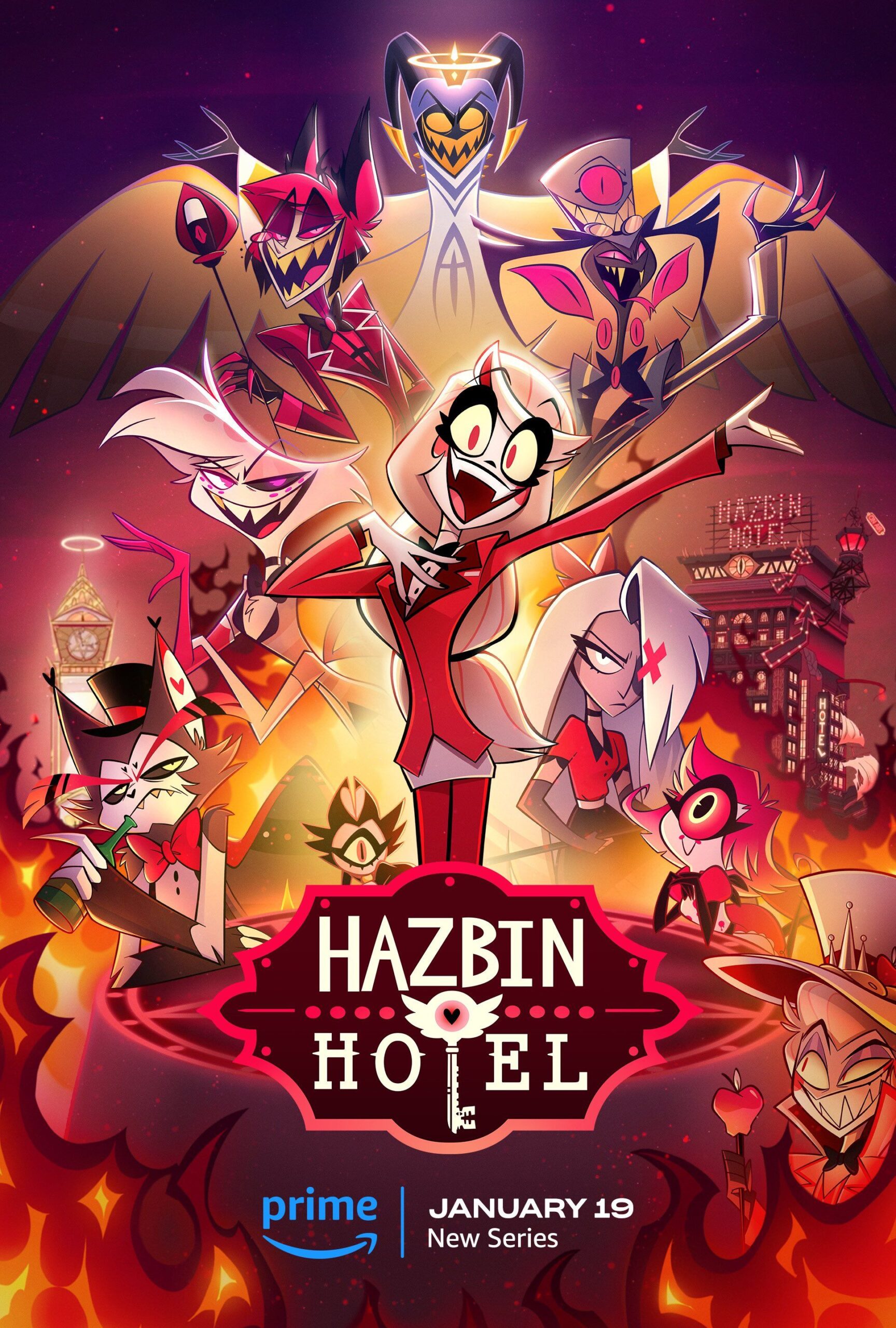
We find ourselves plunged into the first circle of Hell, the Pride Circle, where all sinners are sent once they die. On a tall tower in the centre of the infernal city, a clock marks the end of a countdown: the day of extermination has come. An army of angels descends from the heavens to the bowels of the earth, all-powerful, to ‘reduce’ the number of sinful souls living in the Pride Circle, a final solution that takes place once a year to appease Heaven’s fear of a potential infernal revolution. The day ends, the angels return to the Silver City, and the corpses of thousands of Sinners litter the streets – the clock’s countdown displays 365, the number of days until the next attack.
https://tse4.mm.bing.net/th/id/OIP.62tv35JV1nmFlNK0Olt1QgHaHa?rs=1&pid=ImgDetMain&o=7&rm=3
Witnessing this massacre, Charlie, the princess of Hell and daughter of Lucifer, mourns the tragedy that has befallen her people, condemned to see them fill up and be exterminated every year. Deeply gentle and loving, she cannot bear to see souls suffer, even if they are the souls of hateful and evil people who deserve Hell. This time, Charlie Morningstar is determined to take action! She decides to create a hotel to rehabilitate damned mortal souls. Can a soul condemned to eternal Hell ever deserve Paradise? No one knows, but Charlie wants to believe it, and give herself the means to try and succeed. Accompanied by her girlfriend Vaggie, radio demon Alastor, bartender Husk, and residents Angel Dust and Sir Pentious, the princess of Hell will do everything she can to believe in redemption by offering a second chance to idle souls at her Happy Hotel (renamed Hazbin Hotel by her powerful and cynical patron Alastor). A touching utopia within a violent system, where exclusion and the law of the strongest reign supreme.
b) Helluva Boss
Another series, another story, same universe. While Hazbin Hotel deals with human souls confined to the first circle of Hell (Pride Circle) and Paradise, Helluva Boss develops a whole narrative about life in Hell. We discover its seven circles, each representing the Deadly Sin that rules it, with its inhabitants, the ‘Hellborn demons’ born in Hell (Imps, Succubi, etc.).
https://wallpapers.com/images/hd/helluva-boss-character-blitzo-i22bmncy447xyvuz.jpg
We follow the adventures of the imp Blitzo (the O is silent), boss of a company of demon hitmen, his employees Moxxie and Millie (probably the only functional heterosexual couple in the Hellaverse) and his adopted daughter Loona, a Hellhound. Their company, I.M.P. (Immediate Murder Professionals), is based in the Pride Circle, seeking out human souls who want to see someone from the living world die, whether out of revenge, grief, or other less than benevolent reasons. You pay, I.M.P takes care of the killing. To do this, Blitzo must obviously go to Earth, which is forbidden to Hellborn demons. However, he manages to get around this rule thanks to his intimate relationship with the Goetic prince Stolas. He then manages to get his hands on a magic grimoire that allows him to travel to Earth to carry out his missions.
Over the course of the two existing seasons, several storylines and developments have emerged. While initially focusing on trashy and outrageous adventures, where bloody killings are mixed with gags and perverse dialogue, the series’ themes are much more dense and profound. It depicts dysfunctional families: Blitzo and his adopted daughter Loona; Stolas with his divorce and the distance that has grown between him and his daughter Octavia. It deals with profound loneliness, depression, the search for love and recognition, but also emotional and drug dependence, and identity crises. The comic and vulgar aspects of the series are the salt and pepper of a narrative gem that surprises us as much with the explosiveness of its characters as with the depth of its messages, which touch us all equally.
Hazbin Hotel and Helluva Boss are two series that take us on a journey through tears of laughter and sobs of existence, with exceptional sensitivity, liveliness and humanity.
The characters are more complex than they appear
We find ourselves in Hell, where demons rule every corner of this realm and the souls of sinners live out their new lives of damnation amid the violence of the cities of the first circle. And yet, we are far from the Dantean characters of the Divine Comedy. Sinners and Hellborn demons alike, all of VivziePop’s characters have a depth of character, a depth of soul if you will, that makes them truly human. They have their flaws, their ‘many’ faults, but also a very human sensitivity.
In Hazbin Hotel, Charlie Morningstar is a young idealistic woman, very naive but undoubtedly sincere and fair. She embodies the symbol of an alternative vision of Hell, where hope and kindness are still possible. This stems from her childhood, raised with much love by her parents Lilith and Lucifer. However, she saw her father sink into a deep depression and withdraw into himself after his fall from Heaven. She therefore grew up without really knowing him, idealising this father figure who was driven only by sadness. We also learn that her mother left several years ago, which greatly affected the young princess. All of this has made Charlie a very tender and empathetic person to the extreme, devoted to others and her people, while nurturing a lack of confidence that she seeks to fill through the validation of others. Her girlfriend Vaggie, a woman with a stronger character and sincere love for her, currently offers her the comfort and armour she needs to face the world and realise her ideals.
Some characters are written with such depth that they strike a chord with viewers. Without giving too much away and spoiling the experience for our readers, let’s mention a few other protagonists: Angel Dust, Blitzo and Stolas.
Angel Dust is the first resident of the Hazbin Hotel. He is a Sinner who arrived in Hell in the form of a pink humanoid spider and became the archetype of the exuberant, overly sexualised character who hides a history of trauma, exploitation and addiction. In this new hellish life, he becomes a major actor and celebrity in the porn industry. Colourful, mannered and always very confident, he hides behind his haughty smile his anxiety attacks and anger caused by his contractual submission to his boss, who abuses his body and mind on a daily basis. He takes refuge in alcohol and drugs, and it is by finding friends like Charlie and Husk that he glimpses a way to escape this life that has become a living hell.
On the other hand, in Helluva Boss, emotional and dramatic tensions are equally prominent. Although Blitzo is the main character in the series, his relationship with the Goetic prince Stolas becomes a recurring theme, and even central to the plot’s development. Blitzo is a trashy and vulgar clown on the surface, born into a poor family in a circus in Hell, sold as a child by his father, and responsible for the accident that caused his mother’s death and his best friend’s disability. He has built himself up on a strong sense of abandonment, guilt and fear of rejection, desperately seeking affection while being unable to form healthy and stable relationships. Stolas, on the other hand, is part of the demonic aristocracy. He never really knew parental love, and as a child his only friend was Blitzo, whom he met at the circus and with whom he fell in love. Forced to marry an aristocrat in order to produce an heir, his marriage turns into a disaster, with a tyrannical wife and a desperate daughter. He is an ambiguous figure, both comical and pathetic, but who shows a strong inner loneliness, despite his power and responsibility. Sex and antidepressants are his only means of escape and of continuing this existence, maintaining a “normal” family pattern and feigning a semblance of stability in order to protect his daughter as best he can, as she is what he cherishes the most in his life.
Reception and cultural impact
The reception of Hazbin Hotel and Helluva Boss goes far beyond the simple broadcasting of a series: these works have become true cultural phenomena. Born from an independent initiative and driven by digital technology, they have won over a huge community of fans thanks to this atypical model. As a reminder, Hazbin Hotel went viral despite the presence of a single pilot for several years! The truth is that, as soon as they appeared, these works brought together an extremely active global community, which expresses itself through a wealth of creations: detailed fan art, musical covers, cosplay, online analysis and debates. The meetings between VivziePop and the dubbing team with the public are also great moments of sharing and enthusiasm. This excitement testifies to the evocative power of the universe created by VivziePop, capable of inspiring creative extensions far beyond the screen to become a collective space of imagination and shared emotions.
Music plays a central role in this success, forming the backbone of the aesthetic of both series. It is not merely accompaniment, but rather theatrical scenes set to song, capable of leaving a lasting impression on viewers. Between burlesque irony (Hell’s Greatest Dad ; 2 Minutes Notice) and tragic lyricism (More Than Anything ; All 2 U), each piece gives the characters an extra dimension, strengthening their connection with the audience. This is undoubtedly one of the reasons why these series stand out from traditional adult animation: they manage to combine musical spectacle, corrosive humour and raw emotion.
This appeal also lies in the diversity of audiences they attract. Some viewers come for the visual extravagance and provocative humour, but many stay and become long-term fans thanks to the psychological and emotional depth that gradually reveals itself behind the gags and violence.
Finally, one of the great victories of VivziePop and his team is to have brought to the forefront an unapologetic, authentic and central LGBTQ+ representation: complex queer characters who escape stereotypes and find their place in plots where their identity is not reduced to a decorative role, but becomes a narrative driver. Let’s be realistic, almost all of the main and secondary characters escape the heteronormative spectrum, and this gives the work a great freshness. Without a doubt, these series have served and continue to serve as a model for many queer people who can finally allow themselves to dream and identify with fictional characters they feel close to, through their adventures, trials and tribulations, and loves.
Beyond adult entertainment
Beyond the laughter, blood and provocation, Hazbin Hotel and Helluva Boss tell deeply human stories. They highlight universal themes: loneliness, the quest for love, redemption, the search for meaning in a chaotic world. Hazbin Hotel asks a direct question: is change possible, even for the ‘worst’ individuals? Helluva Boss, for its part, explores the intimate wounds and contradictions of characters trapped in violent social structures such as social status, relationships, and family. These stories are also a critique of our own societies, a grotesque and disturbing mirror of our power relations and inequalities.
However, the significance of VivziePop’s work goes beyond its message. These series also reflect an evolution in the cultural sector: independent animation can compete with major industrial productions, offer bold artistic forms and appeal to a global audience. Hellaverse is living proof that it is possible to create outside the confines of industry giants (such as Disney, DreamWorks and Netflix) and still achieve international recognition. In this sense, Hazbin Hotel and Helluva Boss are not just entertainment: they embody a new way of thinking about and producing adult animation, combining inventiveness, sincerity, inclusivity and emotional power.
That’s why I wholeheartedly RECOMMEND these two series. Autumn is approaching, spirits are out and about, so why not treat yourself to a little road trip to Hell? Get ready, Hazbin Hotel is returning to Prime Video for a breathtaking season 2 on 29 October 2025, just in time for Halloween!! 🎃
Useful links:
Hazbin Hotel Pilot : https://youtu.be/Zlmswo0S0e0?si=QqHqTqylUDgGMGNb
Helluva Boss Pilot: HELLUVA BOSS (PILOT)
VivziePop’s YouTube channel: https://www.youtube.com/@SpindleHorse
Written by Enzo Cavezza