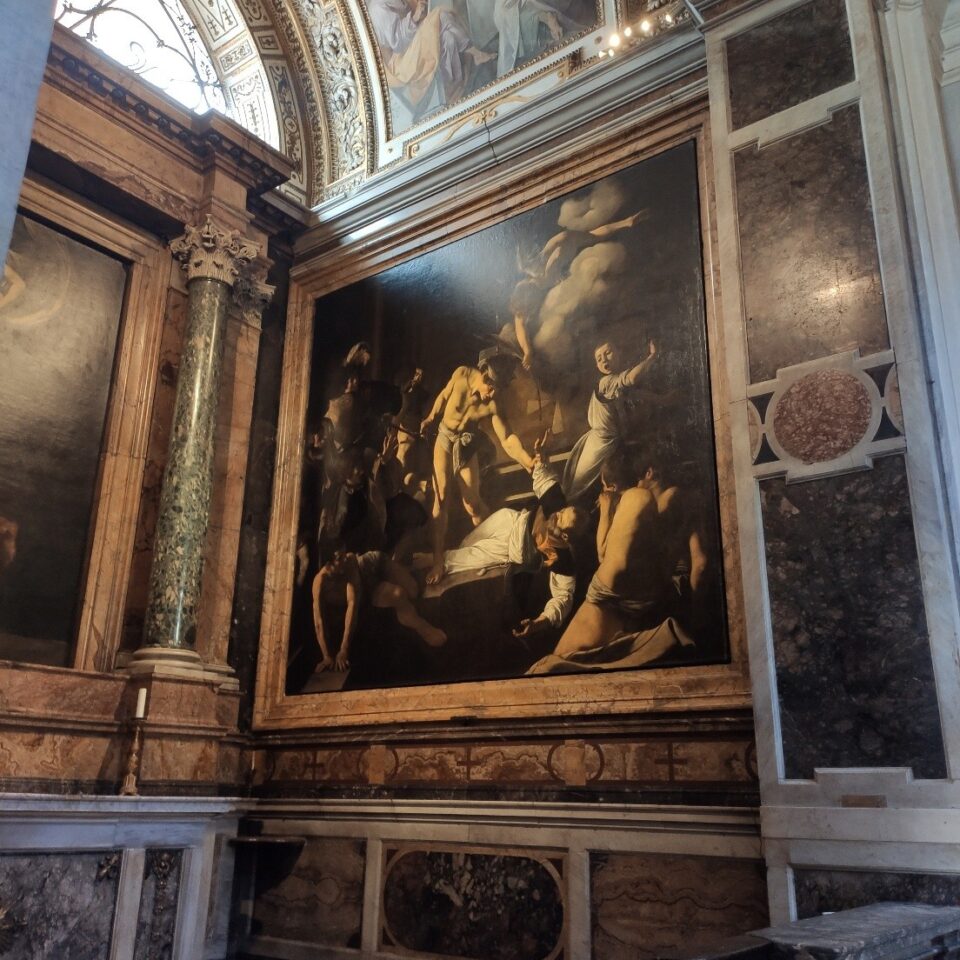
Located between the Pantheon and Piazza Navona, the Church of San Luigi dei Francesi (Saint Louis des Français) is one of Rome’s most significant French landmarks. It was built as the national church of France in Rome and this is immediately obvious, simply by looking at its façade, decorated with French monarchs and saints. It is inside, however, that it is possible to find the real treasure of this church. The Contarelli Chapel houses three paintings by Caravaggio, works that influenced the representation of sacred themes and secured his reputation as a revolutionary figure in art history. Moreover, in front of the Chapel, in the right nave, there are the tombs of French artists and patrons who came to Rome in order to study and work at the local French Academy.
I visited the church for the first time this summer, when I was attending a French preparatory course at the Centre Saint-Louis located next to it. Unfortunately, I don’t remember much from the course but I have a vivid memory of the moment when I entered it. The noise of the cars vanished immediately, replaced by a religious silence, sometimes interrupted by tour guides or by visitor’s reactions to the beauty before them.
The foundation of San Luigi dei Francesi dates back to 1518, when Cardinal Giulio de’ Medici, later Pope Clement VII, commissioned its construction to Jean de Chenevières. However, after the Sack of Rome in 1527, the construction stopped and the church was only completed in 1589 under the guidance of Giacomo della Porta and Domenico Fontana. The church was intended as a national sanctuary for the French community in Rome, a space where French pilgrims, diplomats, and residents could gather for worship.
As mentioned above, the façade, in classical late-Renaissance style, reflects this French identity. Among the famous figures of French history represented there are: Charlemagne, King Saint Louis (Louis IX), Saint Clotilde, and Queen Jeanne de Valois.
Inside, the plan follows a typical layout of Roman churches of the period, with three naves flanked by side chapels. Several French patrons contributed to decorating these chapels, commissioning works of art that reflect both religious devotion and national presence in Rome. Nowadays, the church remains under the responsibility of the Pious Establishments of France in Rome and Loreto, maintaining its function as the French national church.
In my experience, as soon as I entered, my expectations were so high that I just wanted to go straight to the famous chapel. Even the soft light from the windows seemed to guide me to it. But the church in its integrity is a gem very difficult to describe. The path that leads to the famous paintings is rich in marvellous pieces of art that are as capable as the chapel at hypnotising the visitor. For people like me who want to read every plaque before moving to the next painting or statue, the visit can take a really long time. I recommend admiring the canvases last, in order to just increase the wait and the consecutive reaction. Even the position of the chapel, located at the end of the left nave, encourages the visitor to appreciate it as the last element of his or her visit.
This space was dedicated to Saint Matthew and founded by Cardinal Matthieu Cointerel (Contarelli when translated in Italian). After his death in 1585, the commission to decorate the Chapel was entrusted to Michelangelo Merisi da Caravaggio, a rising but controversial figure in Rome’s art world at the time. Between 1599 and 1602 Caravaggio produced three canvases that remain among his most famous works: The Calling of Saint Matthew, The Martyrdom of Saint Matthew, and The Inspiration of Saint Matthew. This was considered his first major public commission and established him as a master of a radically new style. This was considered his first major public commission and established him as a master of a radically new style. Beyond San Luigi dei Francesi, other Roman churches also preserve Caravaggio’s masterpieces, such as the Church of Sant’Agostino with the Madonna of the Pilgrims, or Santa Maria del Popolo, where his Conversion of Saint Paul and Crucifixion of Saint Peter still hang in their original chapels. These places remind us that Rome itself can be seen as a vast open-air museum, where art of immeasurable value is freely accessible. These churches don’t require a ticket to enter, and I think that few other cities in the world allow such an immediate encounter with masterpieces of this kind.
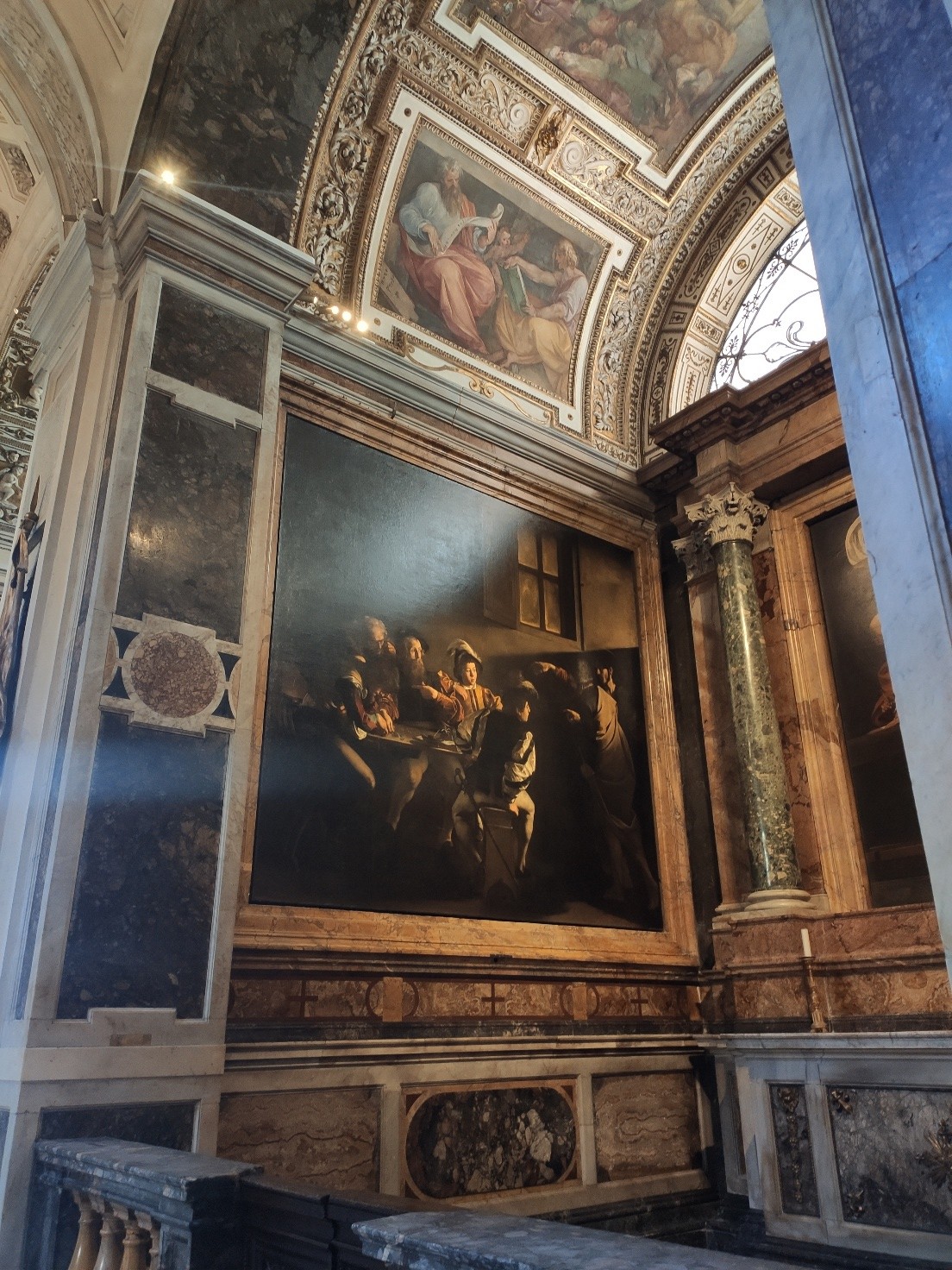
On the left wall of the chapel, it is possible to admire the first painting that Caravaggio made, The Calling of Saint Matthew. It depicts the moment when Christ calls the tax collector Levi, who will become the apostle Matthew, to redeem him and invite him to join the apostles. Caravaggio decided to set the scene not in a biblical setting but in what looks like a tavern, filled with ordinary men dressed in contemporary clothing. A shaft of light cuts across the composition, illuminating Matthew’s surprised face as he gestures toward himself in disbelief. The famous chiaroscuro effect is here used magnificently and it turns the scene into a dramatic encounter between the sacred and the everyday.
This is by far my favourite painting of the three. I think that the setting is what I appreciate the most. The choice of representing such important moments in an everyday context is what really distinguishes Caravaggio. The way he painted saints, kings, prostitutes and every character as part of the same real, lively world, one which his contemporaries could recognise in Rome. In fact, Caravaggio has always preferred to use as models people from the poorest layers of society (peasants, shoemakers, workers) in order to give to his masterpieces a more realistic and authentic touch.
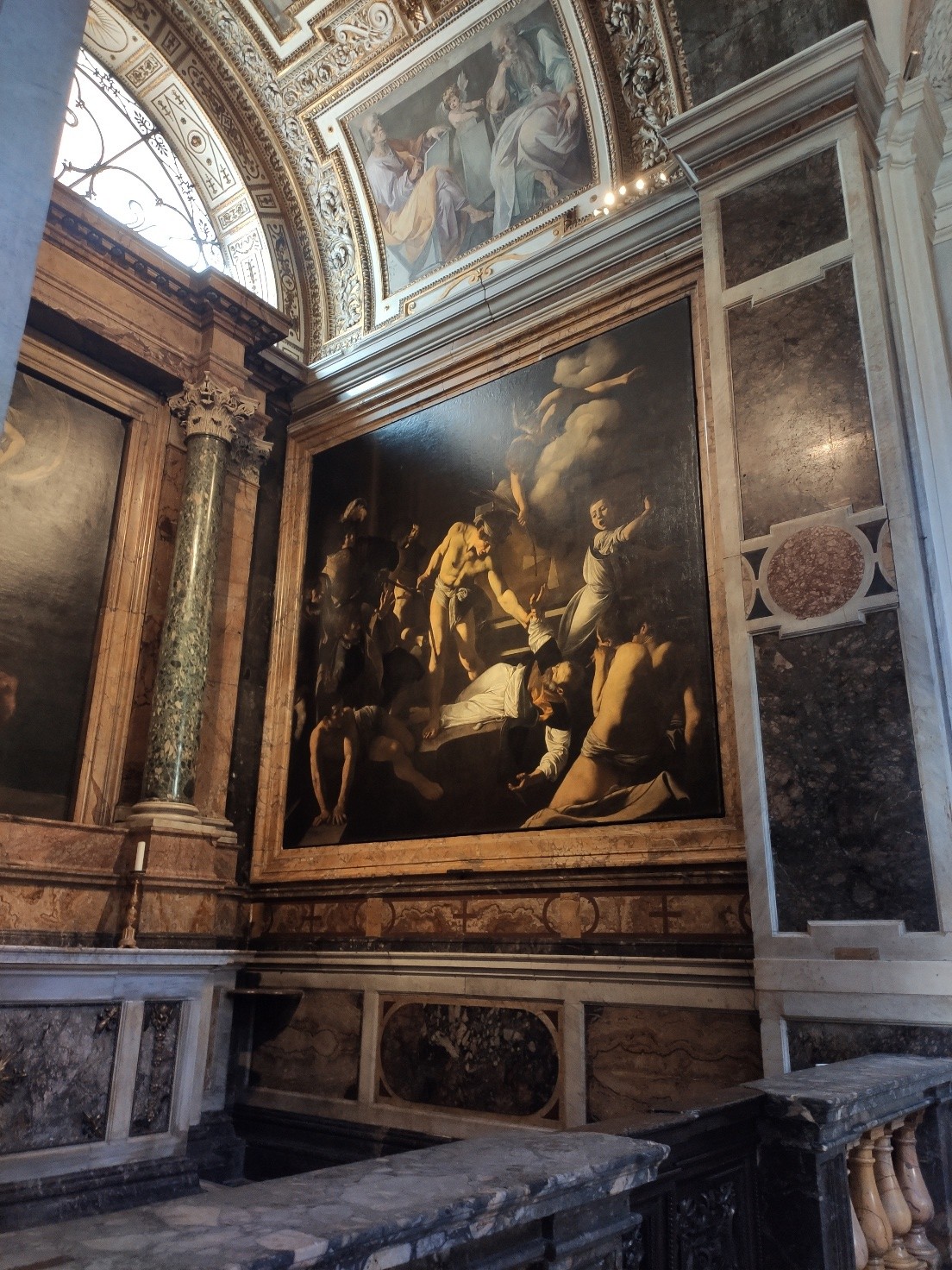
On the opposite wall, The Martyrdom of Saint Matthew presents the final moments of the life of the Saint, when he was murdered by the soldiers of the wicked king of Ethiopia. He is attacked while celebrating Mass, struck down in a violent and chaotic moment. The executioner dominates the canvas, ready to strike with his sword at the saint, while an angel descends from above. The composition is dense and tumultuous, reflecting the brutality of the event. Once again, light plays a decisive role, highlighting the drama and guiding the viewer’s eye.
The last canvas made by Caravaggio is The Inspiration of Saint Matthew located above the altar of the chapel. The artist made a first version of this subject, known as Saint Matthew and the Angel, that was rejected for being too unconventional and that was unfortunately destroyed during WWII. In the final version here located, Matthew sits at a desk, pen in hand, while an angel gently guides him while he’s writing the Gospel. The Saint appears humble and his pose is uncertain: he leans his arm against the table and his left leg is on a stool in an unstable balance, highlighting his uncertainty about what he’s writing.
In these three paintings Caravaggio rejected the idealized forms of Renaissance tradition, opting instead for realism, ordinary models, and intense contrasts of light and shadow. These works, that shocked his contemporaries, propelled him to fame and secured further important projects in Rome.
San Luigi dei Francesi also serves as a place of memory. As mentioned above, over the centuries, many French artists, writers, and patrons connected with the French Academy in Rome were buried here. Their tombs testify to the deep ties between France and the Eternal City. They are located in the right nave, and among those commemorated are figures such as Cardinal de Bernis, a diplomat and patron of the arts, and Pauline de Beaumont, a writer and friend of Chateaubriand.
But not all the tombs are located here. In fact, scattered throughout the church, there are other tombs dedicated to French soldiers that, on several occasions during the centuries, fought in Rome. For example, there is a tomb dedicated to the French soldiers that fought during the short life of the Roman Republic, between 1849 and 1850.
I always find these monuments fascinating to analyse in depth. Seeing a real testament to the people who lived or fought for this city makes me feel more connected to the roots of the history of the place where I live. Looking at their tombs, I wondered if they too had once walked through the streets of Rome: what it was like at the time, how the landmarks were experienced, what living there meant to them, and whether they missed their homeland. This reminds me that this church is both a gallery of masterpieces and a memorial to cultural exchange. In a way, it reflects what I, like many other exchange students, am experiencing at Audencia and in Nantes: we are suddenly immersed in a new country, sometimes with our thoughts still at home, while at the same time engaging with this new culture and learning through encounters with people from all over the world.
San Luigi dei Francesi is a remarkable example of how art, history, and identity converge in a single space. Visiting the church today is therefore more than an encounter with beautiful paintings. It is an immersion into a centuries-old dialogue between France and Italy, faith and art, memory and creativity.
Author and photographer: Fulco ANZALONE
