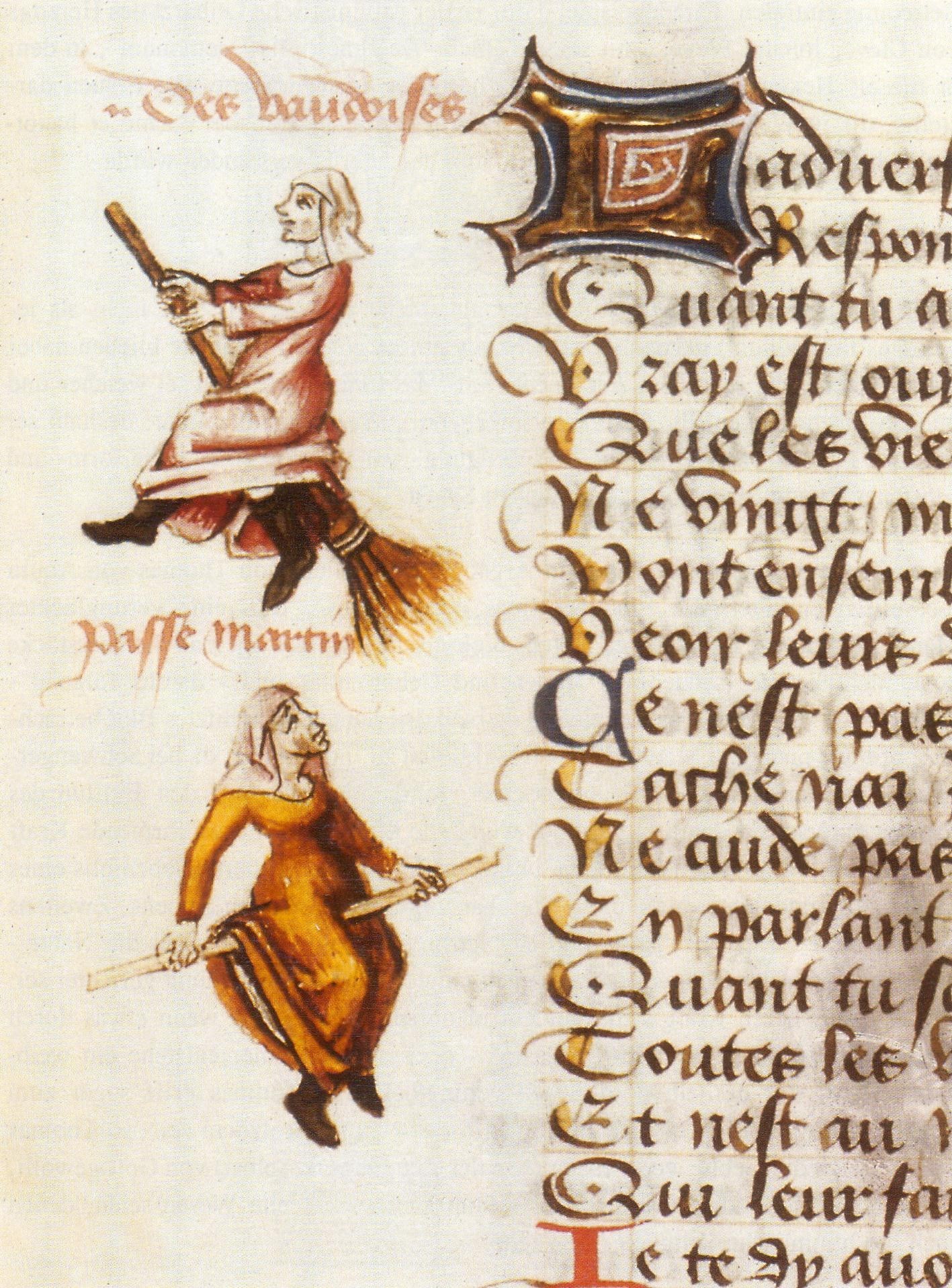
If you thought witches are only good for scaring children in Grimm tales or making brooms fly in Harry Potter, it is time to review your classics. Until June 28, 2026, the Château des Ducs de Bretagne in Nantes invites us to a dizzying dive into one of the darkest and most fascinating periods of our history with the event exhibition: “Sorcières” (Witches). Get rid of the image of the witch with a hooked nose. This exhibition is serious, and pure history, but served with an immersive scenography. Before rushing into the Nantes dungeon, let’s take a moment to dust off our grimoires, and really understand all the historic veracity behind the word “Sorcière”.
Antiquity, or the golden age of sorceresses
In Antiquity, the female figure linked to magic is not necessarily evil, it is ambivalent. Think of Circe or Medea. Sure, it was not good to cross their path if you had the misfortune of upsetting them, but they embodied a form of power and knowledge. They were the mistresses of thresholds, the ones who knew the virtues of plants (the pharmakeia), the lunar cycles, and the secrets of life and death. Magic was an integral part of the cosmos; it was feared as much as it was respected. The woman « who knows » was not yet the woman « who is burned ».
The Middle Ages and the great misunderstanding
Contrary to a tenacious legend, the Middle Ages was not the golden age of the stakes. For long centuries, the Church even considered the belief in witchcraft as a… pagan superstition. The Canon Episcopi (a text of canon law from the 10th century) stated that it was illusory to believe that women could fly at night with the goddess Diana. At that time, the Church worried more about heresies (Cathars, Waldensians) who challenged its theological dogma than about countryside healers. However, the wind turned insidiously at the end of the medieval period. Successive crises (black plague, The Hundred Year’s War, famines…) create a fertile ground for anxiety. Society needs guilty persons. The Devil, until then a theological figure, invites himself into daily life. People start to whisper that the misfortunes of the times are not divine punishments, but the work of the devil himself. The shift happens: popular magic becomes learned demonology.
The Renaissance, or the retreat of women’s rights
Paradoxically, it is during the Renaissance, the era of humanism and discovery, that the witch hunt explodes. The 16th and 17th centuries are the true centuries of the stakes. This is precisely what makes the period so disturbing: at the very moment when European thought was celebrating Reason, championing the individual, and redrawing the boundaries of science and philosophy, it was also burning women by the thousands. How to explain such a contradiction? In the background, the same intellectual revolution that gave rise to Erasmus and Leonardo da Vinci also created a brutal system for controlling female bodies. The Malleus Maleficarum (The Hammer of Witches), written in 1487 by the Dominican inquisitors Heinrich Kramer and Jacob Sprenger, was made widely available thanks to the printing press, which is hailed as the great means of advancement and knowledge dissemination. This guide to the ideal inquisitor explains in great detail why women are more likely to make a deal with the Devil by nature: they are morally unstable, intellectually weaker, and carnally insatiable. The book is reprinted numerous times and becomes a bestseller throughout Europe. A collective psychosis is about to begin. Acts are no longer judged, but nature is. It’s already suspicious to be a woman. There is a structural explanation for this paradox: significant social change also occurred during the Renaissance. Strong fears were brought on by the rise of centralized states, the redistribution of economic power, and the Reformation’s upheavals. Widows, healers, and elderly women living alone were examples of women who lived outside of male authority and became the lightning rods of a society in crisis. The role of the midwife and the herbalist, those wise women who had for centuries held knowledge of the body, was directly threatened by the very advancement of medicine, which tried to prove its authority over bodies and healing practices. Additionally, persecuting them weakened the legitimacy of their knowledge and seize it for the benefit of an institutional, lettered, male-only science. For tens of thousands of them, it did not end well. The German-speaking territories, Scotland, and Lorraine, characterized by political division and fierce religious battles between Catholics and Protestants, were where the stakes burned the highest. The witch hunt was not exclusive to the Inquisition; Protestant magistrates and secular tribunals also participated in it. Fear, local criticism, and the systematic use of torture to coerce confessions that implicated other accused were the main causes of this social phenomenon, not a religious anomaly. In a deadly spiral, each trial led to more.
Nowadays, the witch reinvents herself
The return of the witch is rooted in a rigorous intellectual and militant approach, far from being merely a fashion effect or a « witchy » aesthetic trend for social media. The figure has been resurrected as a symbol of opposition to patriarchy since the 1970s, thanks to movements like W.I.T.C.H. (Women’s International Terrorist Conspiracy from Hell) in the US and Xavière Gauthier’s magazine Sorcières in France. The contemporary witch is the one who liberates herself rather than the one who submits. She is the embodiment of the woman who defies male authority, lives on the periphery of familial conventions (marriage, pregnancy), and asserts complete control over her body and mind. This is by no means a surface-level reappropriation. Since the 2010s, it has permeated popular culture, literature, and even spirituality, extending far beyond feminist circles. Best-selling books, TV shows, and social media aesthetics now frequently feature characters like the witch, sorceress, or wise woman, but beneath this prominence is a much darker undertone. Many women now use the term « witch » to describe a real-life experience of being seen as too talkative, too self-reliant, too intelligent, or just too « other » to conform to social norms. Reclaiming the word means reclaiming the history of everyone who was silenced. This revival has been greatly aided by the theoretical writings of essayists such as Silvia Federici (Caliban and the Witch, 2004) and Mona Chollet (In Defense of Witches, 2019). Federici in particular presents a radical argument: the witch hunt was a foundational instrument of emerging capitalism rather than a historical accident or a symptom of religious fanaticism. The persecutions effectively destroyed a whole social fabric that opposed the new economic order by deliberately targeting women who possessed reproductive knowledge, engaged in communal healing, and upheld ties of solidarity outside of the market economy. According to this interpretation, burning the witch also meant destroying a society where women had real power in their communities, bodies were not commodities, and knowledge was shared. In a much wider sense, the witch now represents subversive female power. She is called upon in eco-feminist movements, which connect women’s subjugation to the devastation of the natural world. The same reasoning that allowed the exploitation of the female body, turning it into a resource for reproduction, also allowed the exploitation of the earth, turning it into a raw material. The witch becomes the symbolic ancestor of those who today oppose extractive capitalism and advocate for a different relationship between humanity and its environment because she upheld a profound, respectful, and living knowledge of the natural world. Thus, identifying as a « witch » in the twenty-first century is a claim to a history of disobedience. It affirms the ability to act (empowerment) in the face of conventional demands for youth, beauty, and submissiveness. It is turning a historical slur into a symbol of liberation. The witch continues to be a highly political figure in a society that still punishes women for knowing too much or making too many demands. She serves as a reminder that the persecution of the past was a system rather than an anomaly and that vigilance is still necessary.
The Nantes exhibition: a journey between shadows and lights
To serve this dense subject, the Nantes History Museum has deployed a museography that avoids the pitfall of sensationalism while being profoundly evocative. Immersion is the key word. The visitor wanders between collective imagination and occulted memory. The 180 works gathered are exceptional. We meet engravings by Dürer or Goya, showing how great artists participated in the visual construction of the witch myth (old, ugly, surrounded by monstrous creatures). We discover objects of popular protection (amulets, talismans) which testify to an omnipresent magical thinking. Multimedia devices punctuate the visit: animated maps allow us to visualize the contagion of trials across Europe (the « Catholic backbone » but also Protestant lands were touched). The sound design creates an atmosphere that is sometimes oppressive, reminding us that we are walking on the ashes of a historical tragedy. One does not come out unscathed from the section dedicated to interrogations, where the words of the accused, often extorted, resonate through the centuries. The exhibition puts into perspective the works of historians and essayists, such as Mona Chollet (In Defense of Witches) or Silvia Federici (Caliban and the Witch). This reappropriation is eminently political. It postulates that the witch hunt was not an accident of history, but a founding tool of nascent capitalism, aiming to enslave the female labor force and destroy community solidarities. Today, the witch becomes the archetype of subversive female power. She is summoned in eco-feminist struggles, linking the destruction of nature to the oppression of women. She symbolizes an alternative relationship to the world, based on the knowledge of the living, care, and the refusal of rational and predatory domination. Calling oneself a « witch » in the 21st century is claiming a heritage of disobedience, it is affirming a power to act (empowerment) in the face of normative injunctions of beauty, youth, and docility. It is transforming a historical insult into a banner of freedom.
In summary: should you go?
Whether you are passionate about history or a convinced feminist, this exhibition is made for you. It is intelligent, beautiful, sometimes hard, but always necessary. We come out a bit shaken, but mostly much less stupid. And who knows, maybe you will discover a modern witch’s soul in yourself when leaving?
Written by Kenya Mézière
