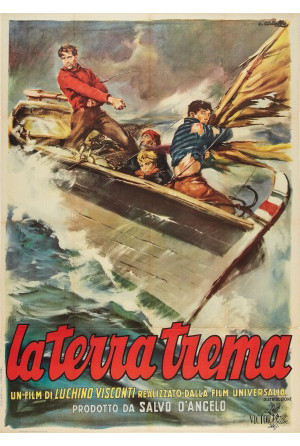
There are films that entertain, and there are films that uncoverreality.
The kind of films that make you forget the fiction and force you to face the world outside the theater. That was my experience when I discovered La Terra Trema (1948) by Luchino Visconti.Then, when I watched Ken Loach’s filmography it felt like the same cry was still resonating, decades later: the cry of those society refuses to see.
For this article, I chose to examine how Visconti and Ken Loach represent working-class struggles and how, despite distance in time and geography, their cinema shares the same mission. I focus on one Visconti film, La Terra Trema, a pillar of Italian Neorealism, and three films by Ken Loach: I, Daniel Blake, (2016) The Angels’ Share (2012) and Sorry We Missed You (2019).
Both filmmakers use cinema not as escape, but as a tool for visibility. They give a face, a voice, and a space to people who are usually pushed aside.
Luchino Visconti and Ken Loach: two cinemas, one social conscience
Visconti was one of the founders of Italian Neorealism. After World War II, this movement rejected studio artificiality and decided to film real life. Real streets. Real workers. Real poverty. La Terra Trema is the perfect embodiment of that philosophy: non-professional actors, real fishermen, and a brutal depiction of economic exploitation.
Ken Loach inherits this tradition and transposes it to present-day Britain. His cinema belongs to what is called British Social Realism, a genre that focuses on everyday hardships: underpaid jobs, precarious contracts, and hostile bureaucracy. Where Visconti films fishermen struggling against merchants controlling prices, Loach films delivery drivers and unemployed workers trapped in the neoliberal system.
Both directors grant dignity to working-class people through narrative and form: they film them not as accessories to a story, but as the story itself.
When systems replace humanity: two revealing scenes

One of the strongest examples in Loach’s cinema is the opening scene of I, Daniel Blake. Daniel, a carpenter recovering from a heart attack, tries to obtain state assistance. Instead of compassion, he encounters a rigid digital system that refuses to listen. Loach keeps the camera close to Daniel, nearly suffocating him in the frame, capturing rising humiliation and frustration. The job center becomes a labyrinth where rules matter more than people.
Link to the scene: https://www.youtube.com/watch?v=RoV-KZKT_Wk
Visconti approaches power from a different visual angle. In La Terra Trema, the fishermen try to sell their fish to merchants who dictate prices. Visconti uses large, distant shots; the characters become small in a vast space owned by someone else. The camera visually shows the imbalance: the fishermen are physically present, yet powerless.
Loach exposes the violence of bureaucracy on the individual,
Visconti exposes the violence of capitalism on the community.
Both reveal characters deprived of agency, trapped in systems that crush them.
The aesthetics of struggle: poetry versus raw authenticity
Visconti and Loach also diverge in their visual styles. Visconti’s film, La Terra Trema has a poetic and grand feel, with scenes of the Sicilian landscape that convey both beauty and hardship, but what struck me first was the quality and grain of the image, despite the fact that this film was released in 1948, which makes it extremely modern. Ken Loach, on the other hand, uses a simpler, raw approach that brings viewers closer to the everyday lives of his characters without aesthetic embellishment.

In The Angels’ Share, the scene at the whiskey distillery (link: https://youtu.be/lxwaPSrt0A4) shows how Ken Loach celebrates the humanity and hope of his characters, despite the challenges they face. Exploring the whisky barrels, Robbie and his friends display a childlike curiosity and excitement. Loach films them with a close, unobtrusive camera, capturing their expressions and sense of wonder. This moment of lightness between the characters reveals their ability to dream and escape from their difficult reality. It also underlines the importance of solidarity and perseverance, with a view to a better future.
Similarly, in La Terra Trema, Visconti uses his style to honor the dignity of Sicilian fishermen. In the scenes where they face the sea to pull in their fishing nets, Visconti’s camera lingers on their movements, teamwork, and determination. The wide shots of the vast ocean not only show the beauty of nature but also highlight the fishermen’s inner strength as they confront natural challenges and economic injustices. This poetic approach emphasizes their resilience and courage, turning their work into a noble struggle.
While these scenes are stylistically different, they show a key similarity between Loach and Visconti: both directors treat their characters with respect and compassion, highlighting their dignity even in modest, working-class lives. However, both directors aim to show the bravery of the working class and their ability to find moments of escape and solidarity, even in tough situations.
Characters as political acts: the individual vs. the collective

In Sorry We Missed You, Loach tackles the brutal reality of the gig economy. Ricky works as a self-employed delivery driver, supposedly “free” and independent, yet in reality trapped in a system that dictates every aspect of his day. Despite suffering a severe back injury, he continues to work, driven by pressure and fear of losing income. Loach films him up close, almost painfully close, letting us feel the strain in his body. His suffering is not metaphorical; it is visible, tangible, and relentless. Through Ricky, Loach shows how contemporary capitalism consumes bodies – not theoretically, but physically.
In La Terra Trema, the struggle takes a different form: the collective rather than the individual. The fishermen work together, pulling nets with a rhythm that reflects their solidarity and shared hope of breaking free from the merchants’ control. Yet when a violent storm destroys their boat, Visconti shatters this dream. The sea, which once symbolized possibility, becomes the force that pushes them back into the exploitative system. Their attempt to escape collapses, not by lack of courage, but because the world they live in leaves them no choice.
Loach films how capitalism breaks bodies.
Visconti films how capitalism breaks communities.
In I, Daniel Blake, Loach again focuses on personal humiliation as a direct consequence of systemic failure. One of the most distressing scenes occurs when Katie, a single mother, is caught stealing basic hygiene products at the supermarket because she cannot afford them. Her shame overwhelms her; she breaks down, and Loach refuses to cut or divert the camera. The spectator cannot look away, just as society should not look away from poverty. The scene is available online (link: https://www.youtube.com/watch?v=RoV-KZKT_Wk), and watching it makes the emotional violence of bureaucracy almost unbearable.
Visconti responds not through individual emotion but through symbolism. The storm destroying the fishermen’s boat becomes the visual representation of an entire social class sinking under the weight of economic exploitation. Different methods, same violence.
When all is said and done, through their respective works, Luchino Visconti and Ken Loach demonstrate the long-lasting power of social cinema to give visibility to those the world prefers to keep silent. Visconti, in La Terra Trema, films a collective tragedy, a noble defeat shaped by forces larger than any individual. His wide shots, his attention to the community rather than the isolated character, show how an entire group can be crushed by economic determinism. Ken Loach, on the contrary, chooses to focus on the individual, on bodies and faces under pressure, on the visceral urgency of the present. His camera stays close, never allowing the viewer to escape the emotional or physical consequences of precarity. Both directors expose systems that refuse to see the working class as human — whether that system is the post-war merchant economy or the modern gig economy ruled by algorithms.
In his Palme d’Or speech in 2016, (link: https://www.youtube.com/watch?v=6r4hYF71Atk) Ken Loach declared that cinema must remain a cinema of protest, a cinema that puts people against the powerful. This sentence could define both filmographies. By choosing to film fishermen, delivery drivers, unemployed carpenters, and young men one mistake away from social disappearance, Visconti and Loach never film fiction alone: they film the political. Their images carry the same conviction: that the working class has a voice, and that cinema can amplify it. They remind us that social struggles are not abstract themes but lived realities, imprinted on bodies and destinies.
The legacy remains alive. In On Falling (Laura Carreira) a film backed by Sixteen Films under Ken Loach’s aegis, we follow warehouse workers whose bodies are timed, scanned and quantified. Just as in La Terra Trema and Sorry We Missed You, workers are reduced to numbers until they reclaim their right to exist. The cry of the invisible does not fade; it transforms and returns, from Sicily in 1948 to the distribution warehouses of the 21st century. As Éric-Emmanuel Schmitt once wrote, “Why did we invent cinema? To show the visible what remains unseen.” In this sense, social cinema will never disappear so long as its essence remains to depict reality. When cinema listens to the invisible, they stop being invisible.
Written by Tess Michellon
