Theatre has long been considered a place of culture and refinement — but for whom, exactly? In recent years, concerns have grown about the ageing and social homogeneity of theatre audiences in France. Although demographic changes partly explain the ageing of cultural audiences, theatre seems to be affected in a particularly acute way. This trend, together with the persistent barriers linked to cost, education, and cultural codes, raises another question: has theatre become, or has it always been, an art for the few?
This article aims to explore the questions of theatre audiences and accessibility. To understand whether theatre has always addressed a particular socio-demographic group, it will first be useful to place the subject in its historical perspective. The discussion will then turn to recent research on theatre audiences and accessibility, contrasting public and private institutions. Finally, attention will be given to potential solutions for renewing theatre audiences and broadening both their age range and social diversity.
A Historical Overview of Theatre Audiences in France
Theatre and its audience have always been a dynamic and complex social phenomenon. To provide a coherent retrospective, I have chosen to begin my analysis in the 17th century, when theatre began to resemble what we know today: that is, performances held in dedicated buildings, with professional troupes performing for audiences who purchased tickets.
Of course, there were other theatrical forms before this period: farce, street performances, or plays in village squares in the Middle Ages, and even theatre as a religious tool in ancient times. While these earlier forms were very popular and interesting, they are difficult to compare to our modern conception of theatre, which has evolved into a distinctly commercial and social institution. It is therefore necessary to set them aside for the purposes of this historical perspective.
17th – 18th Centuries : Theatre as a Space of Social Mixing
In the 17th century, two forms of theatre existed, already reflecting a social fracture in access to culture: what historians call society theatre and public theatre. Society theatre referred to salon performances, which took place in the private apartments of nobles and patrons, with a homogeneous audience drawn from the wealthy social classes. Nobility, however, did not value society theatre and public theatre for the same reasons. Despite the existence of society theatre, they continued to attend public performances: “Very popular still, the Comédie is an opportunity for social display that promotes the art of appearances” (Escoffier, G.)
Thus, nobles and commoners attended for different reasons: the former to be seen, the latter to see the nobility and enjoy an entertaining spectacle. Seating also obviously constituted a form of social stratification: nobles and wealthy bourgeois occupied the boxes and galleries, while the third estate stood in the parterre, under the waxing candles. Yet, despite this financial and spatial separation, the theatre remained one of the few places where the nobility and the working class could coexist. Public theatre in the 17th and 18th centuries was, therefore, a rare space of social mixing. The working class did not feel out of place attending the theatre, it was a valued leisure activity, though an expensive one. A single ticket in the parterre could cost the equivalent of a full day’s wages for a labourer, yet people still went, driven by a shared desire to experience the spectacle.
19th Century: Theatre’s Civic and Educational Mission
Then, from the 19th century, the relationship between theatre and its audience went through a deep transformation. After having been, in the 17th and 18th centuries, a space of sociability shared between nobility and commoners, theatre shifted toward a civic mission. Far from being a simple social entertainment, it became a tool of national cohesion and republican education, notably through the movement of théâtre populaire (people’s theatre). Led by figures such as Romain Rolland, Firmin Gémier, and Maurice Pottecher, this movement defended the idea of an art accessible to all, capable of bringing together different social classes and renewing the bond between culture and community. The goal was “seeking to bring together the whole of society in the theatre” (Denizot, M.). This ideal was later taken up and institutionalized after 1945 by Jeanne Laurent and Jean Vilar (the latter appointed to head the Théâtre National Populaire), who transformed theatre into a true public service.
20th century: From Democratization to Elitism
However, the “cultural democratization” they envisioned gradually clashed with the social and economic realities of the 20th century: despite state subsidies, theatre became a place attended primarily by the educated classes. This divide was strongly denounced in 1968 in the Déclaration de Villeurbanne, written by the directors of popular theatres and cultural centres. They observed that “The mere dissemination of works of art […] is increasingly incapable of bringing about an effective encounter between these works and the vast numbers of men and women excluded from culture”, and affirmed that “on the one hand, there is the public, our public […] and, on the other, a non-public: a vast human mass composed of all those who still have no access to the cultural phenomenon.«
This shift, from people’s theatre to a theatre of the elite, illustrates the persistent tension between art as a common good and art as a social marker, a tension that continues to shape the place of theatre in our society today.
Public vs Private Theatre: Different Models, Similar Challenges
To better understand how this tension manifests itself in the present, it is necessary to make a distinction between public and private theatres. These two sectors, which differ in their missions and programming choices, do not necessarily attract the same audiences. Throughout this section, their respective roles and publics will therefore be compared to illustrate the dynamics of theatre attendance today.
Common Traits: a very urban audience
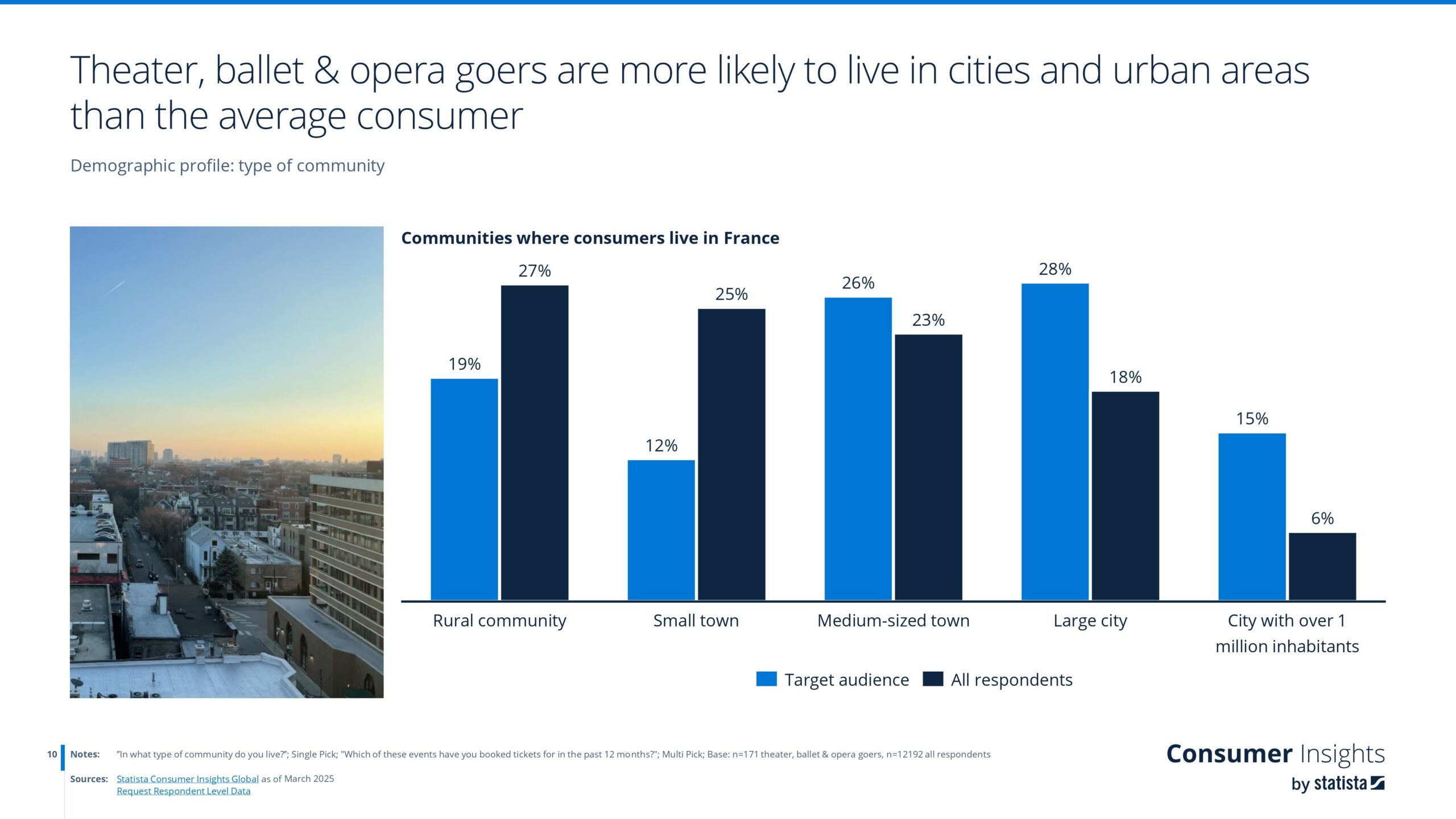
First, both share several characteristics in terms of audience composition. Public and private theatres tend to attract predominantly urban, and especially Parisian, spectators, which is logical to a certain extent because of the concentration of theatres and cultural infrastructures in metropolitan areas. Still, the numbers are quite striking: only 31% of the theatregoers live in small towns or rural areas.
Common Traits: a very educated and socially privileged audience
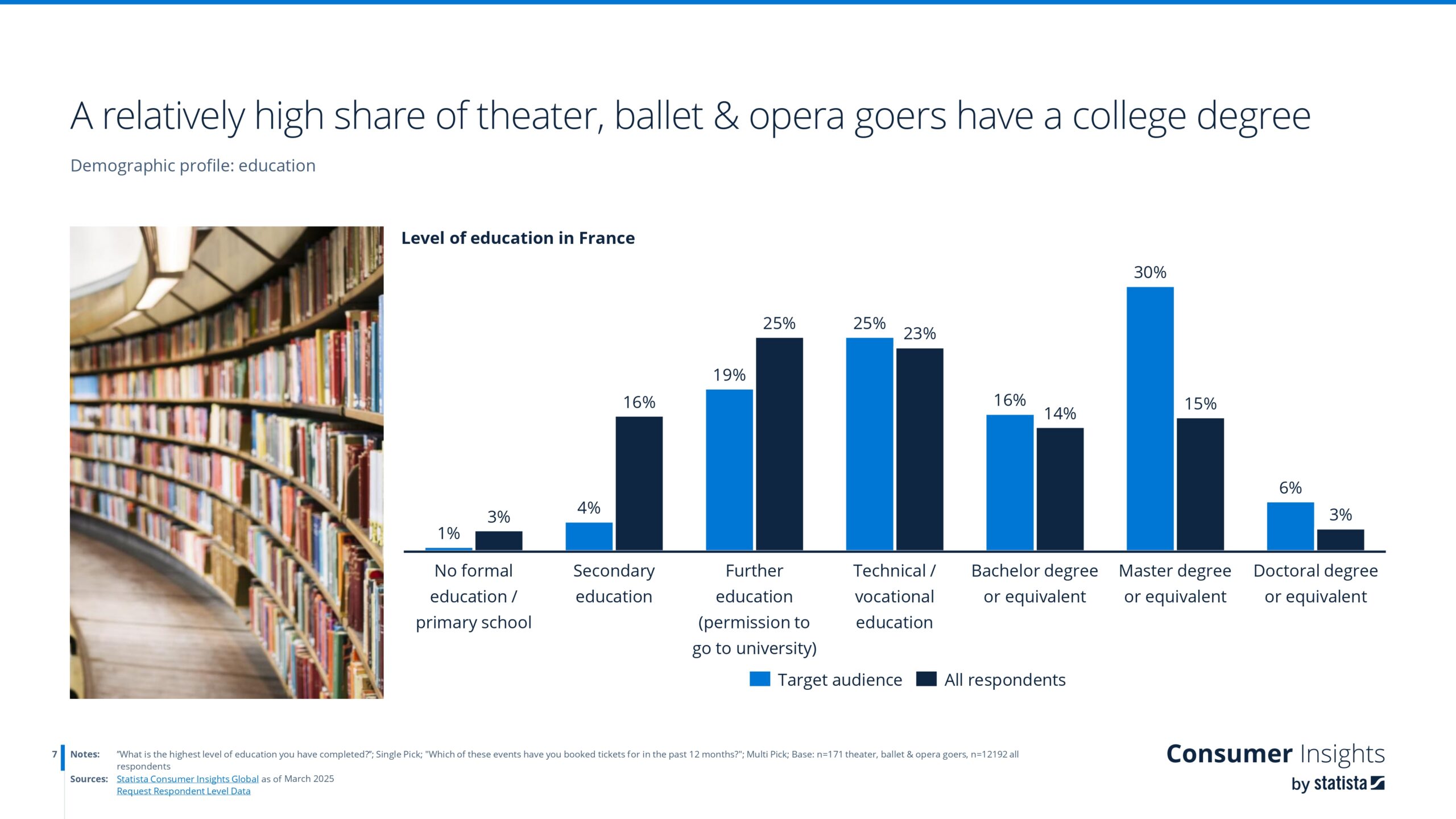
Their audiences are also generally well educated and socially privileged. Studies on theatre and dance attendance in “Investigating theater and dance audiences” have shown a recurrent overrepresentation of managers and university graduates (Fleury, 2006; Éthis, Malinas & Roth, 2015), indicating that cultural participation continues to correlate strongly with education. 52% of theatregoers have a higher education degree ranging from a bachelor’s to a doctorate, while the average percentage of French people with this level of education is 35.4%.
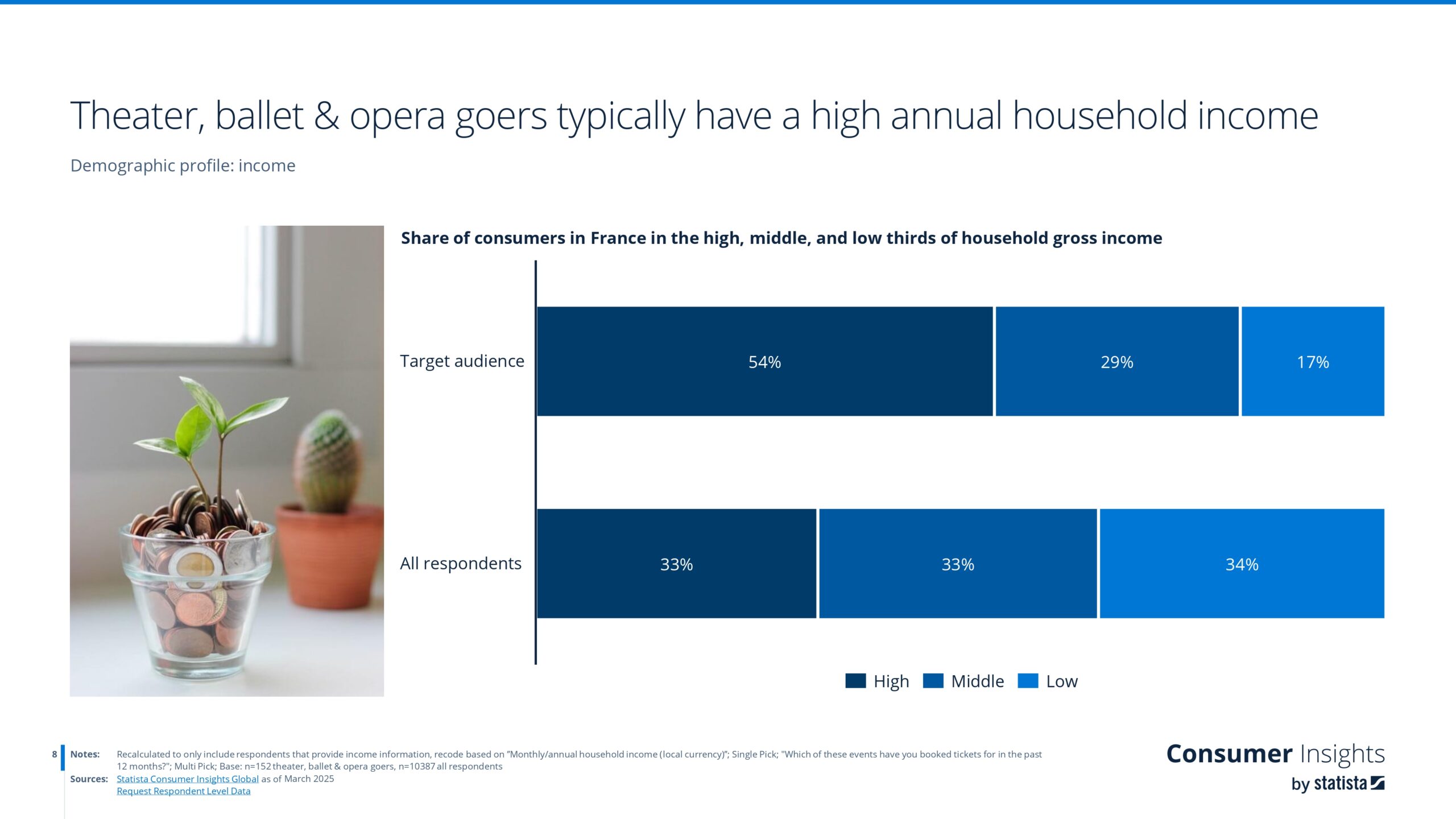
Likewise, higher-income groups are the most frequent attendees, as the cost of tickets and access to cultural venues remain barriers for less affluent populations. 54% of theatregoers report having a high annual household income, making it an 83% middle to high income audience, showing that this art form is particularly elitist.
Common Traits: A Feeling of Illegitimacy Across Socio-Cultural Backgrounds
Finally, in both sectors, this results in audiences that, while diverse in taste and motivation, largely share similar social and cultural backgrounds. This relative social homogeneity sustains the perception of theatre as a legitimate art form defined by upper-class norms, which can foster a sense of cultural illegitimacy among those whose backgrounds or tastes do not align with these standards. As Liz Tomlin points out in Why We Still Need to Talk About Class, the dominant cultural elite continues to dictate what kinds of artistic sensibilities are recognized as valuable. Consequently, those lacking the “right” kind of cultural capital may feel excluded from, or undervalued within, the theatrical sphere: a mechanism that reinforces social boundaries even within supposedly democratic cultural spaces. This sense of exclusion is particularly visible among younger audiences, who often feel alienated by the codes and communication strategies of cultural institutions. As highlighted in a recent Ministry of Culture study (Les publics in situ et en ligne), many young people report not understanding theatre brochures or websites and therefore feeling discouraged from attending, perceiving these experiences as risky or “not for them.” This difficulty in accessing and decoding cultural communication contributes to their gradual disengagement from theatre and partly explains the ageing of its audiences.
Key Differences: Age and Programming
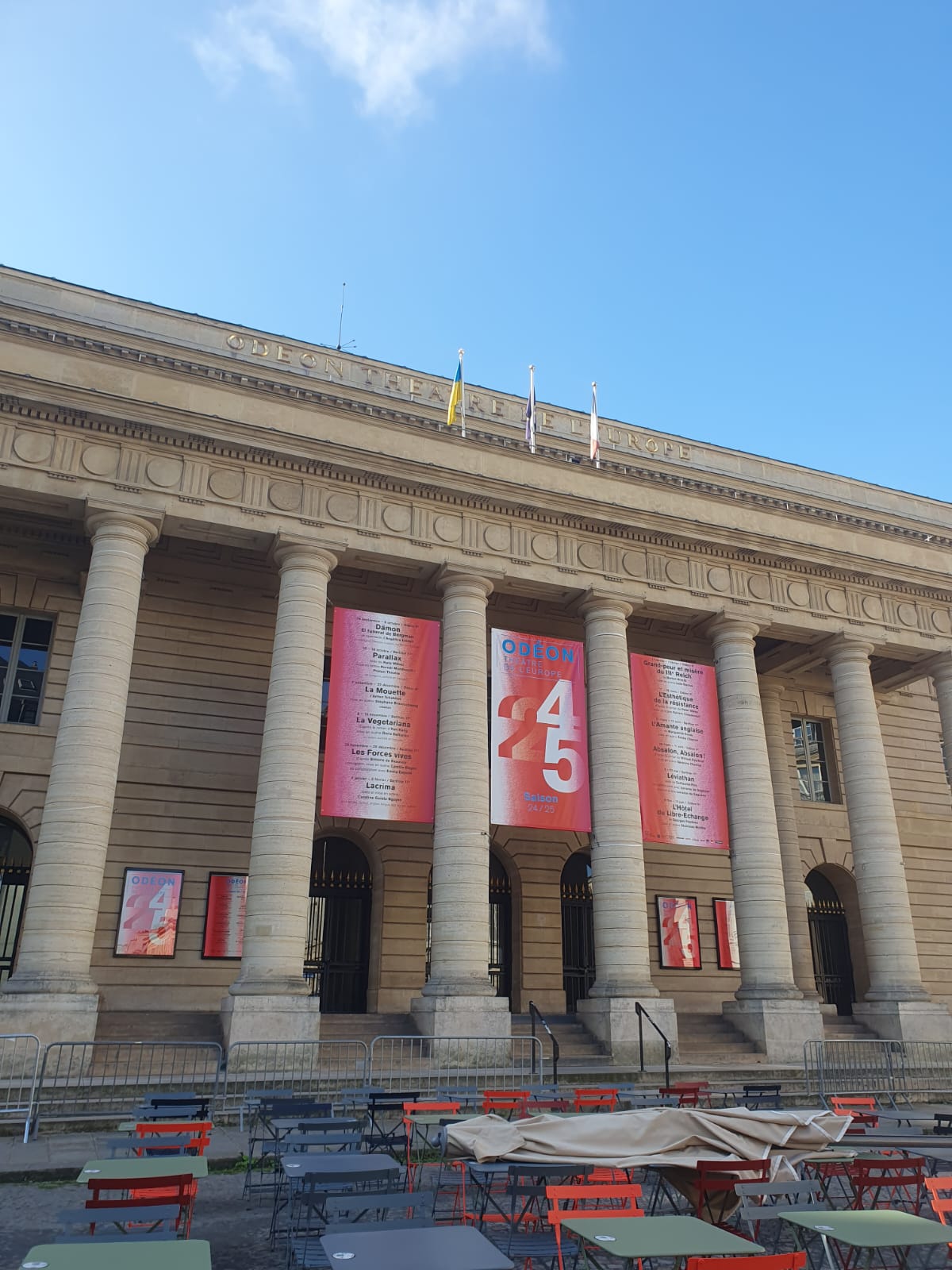
However, it should be noted that there is a difference in programming and audience age between private theatres and public theatres, whose audiences are older and whose programming is much more demanding and avant-garde. According to a study by the ASTP (Association pour le Soutien du Théâtre Privé) published in June 2025, 47% of the private theatre audience is under 35. With nearly half of the public belonging to a younger generation, private theatre differentiates itself from its public counterpart. Indeed, even though there is no study like that of the ASTP, i.e., one that includes box office results from all public theatres, the examples of the Théâtre de l’Odéon and the Festival d’Avignon, two major cultural and public theatre venues, are worth considering. In the 2024 activity report for the Odéon theatre, for example, we can see that their average young audience is 28%. As for the Avignon Festival, the 2024 audience study reveals that only 14.5% of their audience is under 35 years old. We can therefore see a clear age difference between public and private theatre audiences. The Avignon Festival also attracts a select audience of regulars and many professionals: in 2024, only 11.5% were newcomers and 16.5% were performing arts professionals. When comparing the figures, the Festival attracts more professionals than young people. Although this is a cultural event with a major impact, attended by many programmers and professionals, with only 11.5% of spectators coming for the first time, one might still wonder whether it is somewhat exclusive. Finally, the ASTP study also asked respondents (even those who had not been to the theatre in the past 12 months) what they wanted to see in terms of content. Lightheartedness is the order of the day: 51% answered “comedy” and 48% “humour” (the question was multiple choice, so they may not have chosen only those options, but these were the two most popular responses). By asking respondents about their preferences and offering programming that reflects those (for example, many private theatres in Paris: La Scene Parisienne, Le Grand Rex, Theatre du Gymnase, Theatre de la Bruyère…schedule humourists and comedies at least once per season), private theatres ensure that they remain in tune with what their audiences want to see, thereby attracting everyone to the theatre.
Focus on Public Theatre’s Challenge of Renewal
Programming VS Attracting New Audiences
Finally, it will be interesting to focus on the case of public theatre and its problems in attracting new audiences, in order to propose some possible solutions. Public theatre is fundamental to freedom of creation and expression, allowing artists to create what they want with great freedom in terms of subject matter and means. The question of its necessity is therefore not up for debate, but without betraying this avant-garde aspect, how can it still offer a programme that will attract all types of audiences and break away from its image of an exclusive, elite art form?
The main problem today lies in programming. Since the 1970s, “the management of these institutions has prioritized identifying young avant-garde talent and has gradually delegated the search for audiences to subordinate jobs.” (Glas, M.) Programming is no longer designed for audiences but for artists, as Marjorie Glas’s work shows, and this dissociation between programming and audience is specific to public theatre. The creation of specific “Public Relations” departments in theatres relegates the whole issue of democratization to a single department, often with too few employees and a low hierarchical status.
The Role of Public Relations Departments’ Work
The current solutions implemented by public theatres are interesting to study and already constitute valuable resources that are worth examining. For example, the work done by “PR” departments is really what allows new audiences, audiences who are excluded or isolated, to attend theatre for the first time. If one considers the same major public theatre structures mentioned above, the Festival d’Avignon and the Théâtre de l’Odéon both have a PR department with active members and effective actions: working with schoolchildren, students, prisoners or people in rehabilitation, people from geographically remote areas, or people who have never been to the theatre in their lives. This work of mediation and integration is the closest thing to initiatives for democratizing public theatre. Numerous public theatres also have initiatives for and preferential rates for young people and students: joint youth passes for the Paris Opera and Comédie Française offering discounted rates, or preview performances for €10 for those under 28; 6€ tickets for students at the Phénix in Valenciennes, or La Colline offering 10€ tickets for students and those under 18 and only 15€ tickets for anyone under 30.
Diversifying the Programming Offer
This financial constraint must be addressed, but the main aspect keeping people from coming to public theatres is the programming offers. These institutions could benefit from diversifying their artistic offers by incorporating simpler, shorter, and more popular forms (including comedy, young and emerging artists, and performances addressing themes relevant to younger generations). A notable example of this shift can be seen in the recent programming initiatives of the Théâtre de l’Odéon, which, alongside its regular productions, now offers a parallel programme including film screenings, DJ sets, free-entry exhibitions, and guided tours. Such initiatives transform the theatre into a genuine space for social life and exchange, attracting new audiences (particularly younger ones, through events like DJ sets) while maintaining a demanding and avant-garde artistic repertoire. These parallel events may even serve as gateways, encouraging newcomers to engage with the institution’s main programme.
The Specific Case of “Jeunes Publics”: Underestimated Value and Benefits
Another particularly undervalued form that could bring more people in is Jeune Public (youth theatre). As Le Monde pointed out in “The ageing of the cultural audience began well before the advent of digital technology” article, youth-oriented productions tend to attract younger and more diverse audiences, precisely because they are often more accessible in both form and content. Moreover, as Grisolía, Willis, Wymer, and Law argue in Social Engagement and Regional Theatre: Patterns of Theatre Attendance, “taste, expectation and entitlement is embedded early in life, suggesting that reaching out to young children will lead to a more representative audience for theatre in the future.” Investing in such programming is thus not merely a matter of inclusion, but a long-term strategy for cultivating future theatregoers. Furthermore, insights from the ASTP study, though based on the private theatre sector, provide valuable indicators of audience expectations and desires. The study highlights that what most encourages attendance is the presence of well-known actors, contemporary or relatable themes, visually engaging productions, a greater diversity of shows, and, above all, humour. Integrating such elements into public theatre programming would not mean abandoning artistic ambition, but rather rethinking accessibility as a creative and social imperative: one that bridges the gap between institutional theatres and the audiences they hope to serve.
In conclusion, the picture is more ambivalent than portrayed in the introduction: by adapting its programming and implementing inclusive PR initiatives, theatre can still make progress toward democratization. Without suggesting that all forms of demanding creativity should disappear or that public theater should conform and offer the same programming as private theater, it might be beneficial to balance its programming with less demanding works and new forms that can be used as a springboard to introduce new audiences to more demanding works.
Written by Lucie Duffournet
Bibliography:
Anon, (n.d.). 20 % de la population dispose d’un diplôme supérieur à bac + 2 – Centre d’observation de la société. [online] Available at: https://www.observationsociete.fr/education/donnees-generales/population-par-diplome/
ARTCENA. (2025). Important rajeunissement des spectateurs de théâtre | ARTCENA. [online] Available at: https://www.artcena.fr/fil-vie-pro/important-rajeunissement-des-spectateurs-de-theatre
Association pour le soutien du théâtre privé. (2025). Les Français et le Théâtre en 2024-25 – Association pour le soutien du théâtre privé. [online] Available at: https://astp.asso.fr/actualites/les-francais%c2%b7e%c2%b7s-et-le-theatre-ou-en-sommes-nous-en-2025/
Chan, T.W. and Goldthorpe, J.H. (2005). ‘The social stratification of theatre, dance and cinema attendance.’ Cultural Trends, 14(3), pp.193–212. doi: 10.1080/09548960500436774 Available at: https://doi.org/10.1080/09548960500436774
Escoffier, G. (2009). Les Theatres de société au XVIIIe siecle. [online] French Studies. Available at: https://www.academia.edu/92879218/Les_Theatres_de_societe_au_XVIIIe_siecle?auto=download
Denizot, M. (2012). Le théâtre populaire comme source du théâtre public ? Horizons/Théâtre/Horizons/Théâtre, (1), pp.12–24. doi: 10.4000/ht.1853 Available at: https://doi.org/10.4000/ht.1853
Denizot, M. (2014). Retour sur l’histoire du théâtre populaire : une ‘démocratisation culturelle’ pensée à l’aune de la nation (XIXe-XXe siècles). Politiques de la culture. [online] doi: https://doi.org/10.58079/mr9f
Denizot, M. (2024). De quelques malentendus sur la généalogie du théâtre public. Revue d’études culturelles (Dijon), 2024, 11, pp.67-78. hal-04833510. Available at: https://hal.science/hal-04833510/document
DG Communication (2015). Enquêter sur les publics du théâtre et de la danse. Publictionnaire. [online] Available at: https://publictionnaire.huma-num.fr/notice/enqueter-sur-les-publics-du-theatre-et-de-la-danse/
Festival d’Avignon. (2025). Études de public. [online] Available at: https://festival-avignon.com/index.php/fr/actions/etudes-de-public-2485
Glas, M. (2023). Quand l’art chasse le populaire. Socio-histoire du théâtre en France depuis 1945. [online] Fabula.org. Available at: https://www.fabula.org/actualites/114223/marjorie-glas-quand-l-art-chasse-le-populaire-socio-histoire-du-theatre-en-france-depuis-1945.html
Glas, M. (2024). Quand le théâtre public perd de vue le populaire. [online] Observatoire des politiques culturelles. Available at: https://www.observatoire-culture.net/theatre-public-socio-histoire/
Gouv.fr. (2025). Billetterie du spectacle vivant en 2024 [CC-2025-1] | Ministère de la Culture. [online] Available at: https://www.culture.gouv.fr/espace-documentation/statistiques-ministerielles-de-la-culture2/publications/collections-de-synthese/culture-chiffres-2007-2025/billetterie-du-spectacle-vivant-en-2024-cc-2025-1
Gouv.fr. (2023). Le Festival d’Avignon soigne l’accueil des publics nouveaux venus | Ministère de la Culture. [online] Available at: https://www.culture.gouv.fr/actualites/le-festival-d-avignon-soigne-l-accueil-des-publics-nouveaux-venus
Gouv.fr. (2017). Les publics in situ et en ligne | Ministère de la Culture. [online] Available at: https://www.culture.gouv.fr/thematiques/enseignement-superieur-et-recherche/la-revue-culture-et-recherche/Les-publics-in-situ-et-en-ligne
Grisolía, J. M., Willis, K., Wymer, C. & Law, A. (2010). Education levels determine theatre attendance. CultureCase. [online] Available at: https://culturecase.org/research/2014/03/education-levels-determine-theatre-attendance/
Guerrin, M. (2022). ‘Le vieillissement du public culturel a commencé bien avant l’arrivée du numérique’. [online] Le Monde.fr. Available at: https://www.lemonde.fr/idees/article/2022/01/28/le-vieillissement-du-public-culturel-a-commence-bien-avant-l-arrivee-du-numerique_6111309_3232.html
ODÉON – THÉÂTRE DE L’EUROPE : Rapport d’activité 2023. (n.d.). Available at: https://cdn.artishoc.coop/e54aa670-7d3a-4933-82b0-fb79918de9b8/v1/medias/eyJfcmFpbHMiOnsibWVzc2FnZSI6Ik1UazNOakE0IiwiZXhwIjpudWxsLCJwdXIiOiJtZWRpYS9tZWRpYV9pZCJ9fQ==–dabd2b32c6c480919e454ac0f6714f3a81d25204ff17f99d2098a6212ec776b1/4b56e0f00de7/rapport-d-activite-2023.pdf
ODÉON – THÉÂTRE DE L’EUROPE : Rapport d’activité 2024. (n.d.). Available at: https://cdn.artishoc.coop/e54aa670-7d3a-4933-82b0-fb79918de9b8/v1/medias/eyJfcmFpbHMiOnsibWVzc2FnZSI6Ik16STBORFl4IiwiZXhwIjpudWxsLCJwdXIiOiJtZWRpYS9tZWRpYV9pZCJ9fQ==–9aad2b787eada8ef9e61dcc4170f0d1358fbf516d90611352d08619a143e61a2/59a9ac96e040/bilan-d-activite-2024.pdf
Rau, S., Gewiese, J., Varghese J., (March 2025) Statista study – Target audience: Theater, ballet & opera goers in France, Article ID: did-123335-1
Rauch, M.-A. (2000). La déclaration de Villeurbanne. Débats Jeunesses, 6(1), pp.129–142. Accessible at : https://doi.org/10.3406/debaj.2000.1075
Tomlin, L. (2020) ‘Why we still need to talk about class’, Studies in Theatre and Performance, 40(3), pp. 251–264. doi: 10.1080/14682761.2020.1807213. Available at: https://doi.org/10.1080/14682761.2020.1807213
