Le Lieu Unique is now one of the most striking cultural venues in the city of Nantes. It is one of the faces of the capital of the Pays de la Loire region and clearly demonstrates Nantes’ ability to use its real estate heritage to develop its cultural activity. Le Lieu Unique was formerly the LU biscuit factory. It is still possible to visit the old factories today. When the factory moved, the city council decided to keep the building, located in the city center, and turn it into a cultural venue. Today, Le Lieu Unique hosts exhibitions, concerts, live shows, conferences, and has a bar and restaurant. It is one of the best-known examples of successful transitional urban planning in France.
Transitional urban planning can be defined as the use of vacant space (offices, housing, vacant lots, etc.) during an intermediate phase before a construction or an urban planning phase. These vacant spaces are now mostly occupied by cultural actors (who do not have a lot of resources), or sometimes by companies for offices. It is rare for transitional urban planning to provide housing for people, as it is often very complicated to create decent living spaces in empty buildings. Transitional urban planning is no longer so transitional, as some transitional spaces have become such important cultural venues that they are being preserved in the next development project. This is the case with Le Lieu Unique, but also with other venues such as the La Station Gare des Mines nightclub (Porte de Paris), which was due to be demolished to make way for housing but will now be preserved due to its cultural significance.
History of transitional urban planning in Nantes:
Nantes was one of the first cities to develop a genuine transitional urban planning policy in the 1990s, notably with the Allumés festival. This festival was created at a time when Nantes was undergoing deindustrialization. Factories in the city center (LU) and on the Île de Nantes were closing one after the other. The city was losing its identity and dynamism. The former Socialist Party mayor, Jean Marc Ayrault, decided to focus the city’s policy on culture. It was in this context that the Allumés festival was created. Between 1990 and 1995, the city hosted artists from six cities for six days and six nights: Barcelona (1990), Saint Petersburg (1991), Buenos Aires (1992), Naples (1993), Cairo (1994), and Havana (1995). The festival took place in all the city’s unusual venues, particularly the disused LU factories and the eastern part of the Île de Nantes. The festival was a huge success. It was followed by numerous concerts and rave parties in these same abandoned factories. This festival was a national example of the use of vacant buildings for large-scale cultural projects. Since the 1990s, numerous cases of transitional cultural urban planning have developed in Nantes and throughout France.
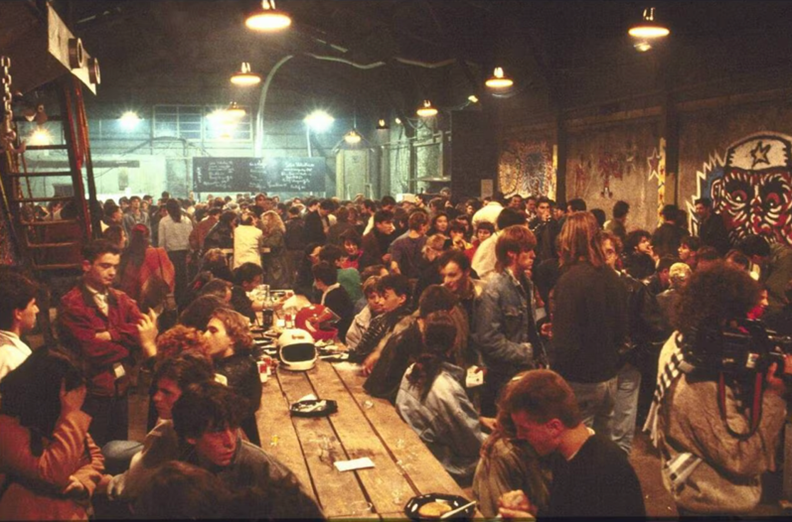
Allumés festival, Nantes 1992
Nantes has continued to be a pioneer in terms of cultural activity in transitional spaces. One example is Transfert, a huge cultural venue bringing together all kinds of artistic and cultural practices. This cultural venue was in Rezé on the wasteland that was once home to the city’s old slaughterhouses. This venue existed from 2018 to 2022 and set the pace for Nantes’ cultural and nightlife scene for five years. Transfert was created by the Pick up Production association, which organizes numerous cultural events in Nantes, such as the Hip Opsession festival, the Ateliers de Chanzy, and other events. The aim of Transfert was to create a dialogue between the city’s artists and residents in a place of urban and cultural experimentation.
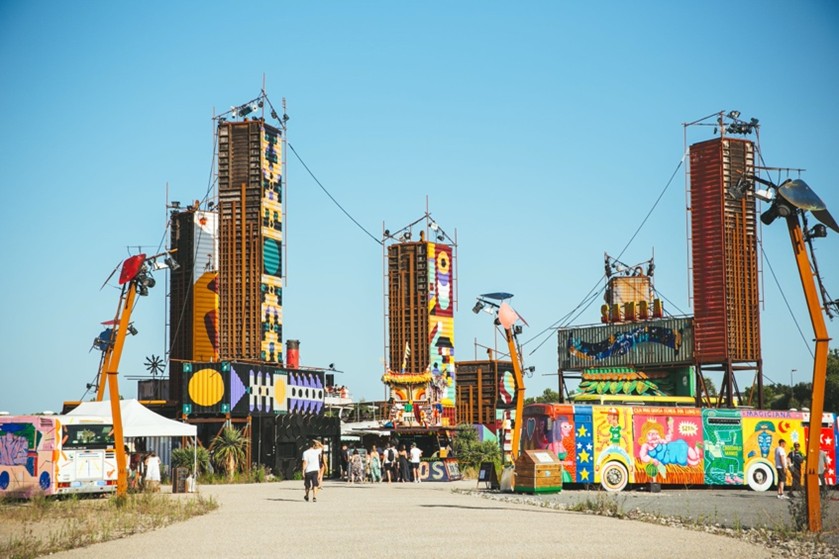
Transfert, Rezé 2022
Transitional urban planning has become increasingly important in recent years, particularly due to rising real estate prices and cuts in cultural funding. Associations and cooperatives in cities are finding it increasingly difficult to find premises and spaces to express themselves. However, these cultural practices are essential to sustaining the social and solidarity economy in Nantes, which accounts for 16% of jobs in the city. The city of Nantes therefore provides several transitional spaces prior to final development projects. These projects help to counter the financialization of real estate in urban areas, increase the intensity of use of these spaces, and create activity for residents. Transitional urban planning is integrated into the urban planning strategies of all major cities in France.
Transitional urban planning today :
Transitional urban planning projects now take many forms in Nantes. There are numerous examples in coworking, such as Solilab on the Île de Nantes, which brings together more than 140 start-ups in a former factory on the island of Nantes, the digital canteen, Open-Lande, also on the Île de Nantes in former offices, Le Grand Bain near the university hospital, which was the city’s former public baths, and Gueule de Bois, a former factory converted into a workspace for carpenters in Bouguenais.
The city also has many places dedicated to welcoming artists: Bonus (in a former school in Saint Félix and on the Île de Nantes), L’atelier de la Ville en bois (a small office converted into an artist’s residence), Pol’n (an office and apartment converted into an artist’s residence and exhibition space). Art studios have completely disappeared from the city center in traditional real estate. These art studios are therefore essential because they allow artists to work in the city center and develop their artistic network despite the continuous rise in rents.
There are also numerous multidisciplinary cultural venues that would not exist without transitional urban planning and the city council’s support for cultural creation, such as Le Trempo and Le Stéréolux, renowned music venues perfectly located in the heart of the Île de Nantes. Another example is the Blockhaus, an underground exhibition and concert venue located 50 meters from the elephant in an unusual reinforced concrete structure that look like a bunker.
New projects are developed every year, such as the former Nantes École des Beaux Arts in Bouffay, which is currently being taken over by the Yes We Camp association (well known in transitional urban planning in Paris and Marseille). This association is working with citizens to co-develop a social, cultural, and solidarity program in this former school dating from the early 20th century.
Transitional urban planning can also have a very significant political dimension, capable of changing the face of a city. The current debate surrounding Nantes University Hospital is a perfect example of this. The university hospital building is a huge concrete structure the size of an entire neighbourhood, located five minutes from the city center. However, a new hospital is being built on the Île de Nantes to replace the existing one, which is too old and too small for the number of inhabitants. The city is therefore considering what to do with the old hospital. Should the old university hospital be demolished to build new housing for the city in the heart of the center, thus creating a new neighbourhood, or should the existing building be kept and its use transformed? The city is not necessarily in Favor of demolishing the site for environmental reasons. Many architects and urban planners are therefore considering how to adapt the building. The Nantes University Hospital project therefore seems to be the ideal place to develop transitional urban planning projects that were previously unimaginable. The role of artistic and cultural associations and collectives will be essential in the reuse of this building.
Transitional urban planning nevertheless raises many ethical and political questions. Although this practice appears to be a means of combating rising real estate prices, developing the cultural, social, and solidarity economy, and providing a place for culture and art in the city center, transitional urban planning has also become a financial means for multi-property owners to increase the value of their assets. The latter seek out artistic and cultural associations to occupy their spaces in order to avoid squatters, increase the value of these vacant lots, and ultimately gentrify downtown areas. Transitional urban planning is therefore sometimes a real estate strategy that complements traditional real estate, enriching owners centers, and increasing rents.
Transitional urban planning is also highly controversial in France because it contributes to the gentrification of areas. Abandoned sites that have been repurposed for cultural use are often located on the outskirts of cities, in poor neighborhoods with aging industries. However, with the rise in real estate prices, these neighborhoods are increasingly sought after by the more affluent classes who want more space at a better price than in the city center. Transitional cultural spaces often cater to this more bourgeois population with cutting-edge cultural programming and high-quality consumption at high prices. The historic residents of these neighborhoods are therefore often left on the margins of these transitional projects, which has attracted criticism. This criticism can be seen in particular in the Parisian suburb of Pantin with “La Cité Fertile” (the largest cultural third place in Paris, located on a waste land). This venue is located in a poor, mixed-income neighbourhoods of Pantin, but prices at La Cité Fertile are very high and the clientele is mostly affluent Parisians. Long-time residents of the neighbourhood have therefore strongly criticized La Cité Fertile, accusing it of gentrifying the neighbourhood.
Transitional urban planning is also a way for cities to avoid actually addressing the structural problems of culture in France. Cities support the arts community by providing them with venues for a limited period of time while reducing their culture budgets, sometimes in their own interest as this also increases the property value of various sites belonging to the city council or the local authority.
Author and photographer: Kamil ALLET

Williemaw
25 septembre 2025 at 8 h 28 minhttps://bankrotserv.ru/