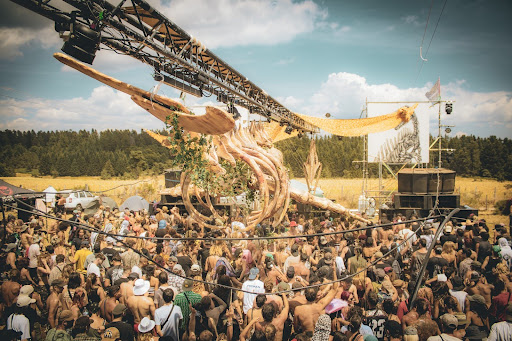
“We gather our forces. Then we surround them, and afterwards we strike.”
These words, spoken on September 2 by the resigning Interior Minister Bruno Retailleau, targeted a free party that had been taking place for two days on land devastated just weeks earlier by wildfires, near the village of Coustouge in the Aude region. A striking phrase that illustrates the severity with which the State intends to repress these parties, labeled as “sauvages”, as well as the controversies that are surrounding this underground world.
Yet it is difficult to ignore that, for tens of thousands of people in France, these parties are not mere disturbances but a genuine culture: the “free party” or “teuf”. The recent release of the film Sirat, which opens with a free party scene in the Moroccan desert, gives an opposite vision of this way of partying : a world where human connections and mutual support are strong, and where music and dance take center stage.
Caught between police repression, media stigmatization and cultural self-affirmation, the free party remains a contested phenomenon. Is it primarily a space of drug trafficking and nuisance, or is it a real alternative culture? To answer this, let’s explore the movement’s history, trace its evolution, its values and its codes, and finally examine the current issues and the repression that have accompanied it since its origins, and why it is perceived as problematic by a part of society.
The story of a culture of free and anti-system parties
First of all, to define what these “wild” parties called free parties are, we need to retrace their history and what has led to the current situation
Free parties trace their roots back to the British rave culture of the 1980s, born when house music and acid house were imported from the United States. In the UK at that time, a new way of partying emerged around these styles of music: dancing all night to hypnotic beats in alternative spaces such as warehouses and underground clubs, often facilitated by the use of drugs like ecstasy.
The British government, however, saw these gatherings as a threat. In 1994 it passed the Criminal Justice and Public Order Act, a law that explicitly targeted events built around “repetitive beats.”, strictly supervising the legal scene and criminalizing the illegal and spontaneous parties. Gradually, the scene radicalized in response to such restrictions, and the parties took on an increasingly political and illegal dimension.
Collectives like Spiral Tribe began organizing clandestine raves marked by a strong Do It Yourself and anti-system philosophy: autonomous organization, squatting venues for a single night, no ticket sales, and information spread only by word of mouth, or using private phone lines to get the location. The principles and foundations of the free party movement were born.
After the crackdown in England, Spiral Tribe and other crews left for the continent, mainly coming to France. In 1993, they organized the first teknival, a gathering of sound systems lasting several days. The movement grew enormously, with free parties multiplying and the emergence of numerous sound systems, notably Heretik, OQP, etc. But as in England, the public authorities in France sought to crack down on the movement as soon as it arrived, even though they had already been at war with “rave parties”, the legal equivalent of free parties, for several years. In the 2000s, French law (notably the Mariani Law of 2002) regulated techno gatherings: mandatory declaration for more than 250 people, seizure of equipment, police checks and even repression. However, the free party movement gradually spread throughout Europe, with teknivals still taking place in Eastern European countries such as the Czech Republic, Romania, etc.
The free party: the quintessence of counterculture?
Having traced the history of the movement, it is interesting to focus on what has grown out of it: the values that define it, and that make it not only a distinct culture but also a space of innovation and artistic freedom. To fully understand the free party, it must be approached simultaneously through its artistic, social, and political dimensions.
First and foremost, it is a musical phenomenon, since these gatherings are places of celebration and dance where “Tekno” was born. In free parties, the music is either mixed or created live: repetitive, darker, and more distorted than what plays in mainstream clubs, breaking away from more commercial forms of techno. The sound is also pushed much louder than in licensed venues, with the explicit aim of drawing dancers into a state of collective trance, sometimes facilitated by the use of drugs.
At the same time, it’s in free parties that numerous musical styles were born, and that later were taken up by the mainstream stage, such as tribe, hardtek, frenchcore, mentalcore, acidcore and more. These events have contributed to renewing the legal electronic scene, offering a first stage for many emerging artists who were able to experiment and perform at the beginning of their careers thanks to this underground setting.
For instance :
The social and political dimension has been central to free parties since their very beginning. They were born as an act of resistance against the authorities’ attempts to shut down techno music, and from the desire to create a non-commercial form of celebration: open to everyone, free of charge, and liberated from capitalist codes. The term “free” reflects both this libertarian ethos and the refusal of commercial and institutional constraints such as nightclubs, official festivals, or ticketing systems. Contrary to what we might think while hearing the name “free” party, these gatherings are not free but based on a donation system at the entrance, allowing visitors to choose the amount of money they give.
Free parties are also tied to the idea of reclaiming public or natural spaces such as warehouses, fields, industrial wastelands, abandoned quarries, and bringing them back to life, if only for a night or a few days. Within these spaces, free parties are like temporary micro-societies built on solidarity and mutual aid, where food, water, and blankets are freely shared. The film Sirat offers an interesting glimpse into these values, accompanying travelers across the deserts of Morocco, from one free party to another.
Yet, precisely because of these values of defiance and the potential disturbances they cause, free parties are deeply unpopular with part of public opinion and with authorities, for several reasons:
Firstly, one of the main issues for public opinion is noise pollution. The amplified music of the sound systems is extremely loud, not limited by any legal decibel measures, and even if organizers often try to find places far from residential areas, they can still disturb the population especially during multi-day events.
The second main point is illegal occupation. In western countries, property ownership is a very important value among people, thus illegally taking over private property is widely frowned upon.. Moreover, as repression has intensified in recent years, organizers’ options for venues have narrowed, pushing them at times to use farmland or even protected natural areas. Such choices are controversial not only outside the movement but also within it. The issue resurfaced recently when a free party was held on land ravaged by wildfires just weeks earlier, sparking heated debate even among ravers themselves, and leading the interior minister to pronounce these words we saw earlier.
Finally a big concern of public authority would be drug use: although very common in festivals and even in certain professional circles, drug consumption at free parties is frequently highlighted by authorities as the main justification for sometimes violent crackdowns. Indeed in those parties, drug trafficking is not limited in any way, sometimes leading to dangerous situations and even deaths happening at some big events.
Beyond these critiques, the persistent political and media hostility toward the movement raises broader questions. Could the anti-capitalist, anti-system spirit of these gatherings itself be a main reason behind the repression? In an increasingly authoritarian world grappling with crisis, the very act of challenging the capitalist machine through collective celebration seems to provoke growing unease for western authorities and politics.
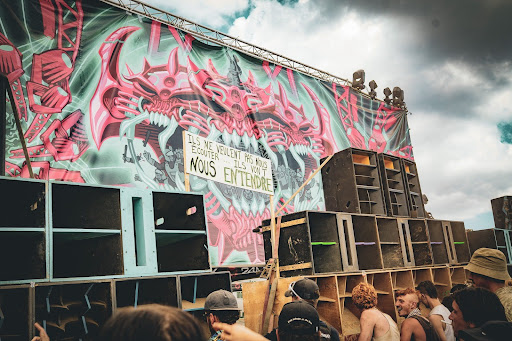
Free parties today
The free party movement is still alive today, though it faces an increasing repression. In 2019, Steve Maia Caniço drowned in the Loire River in Nantes during the Fête de la Musique, after police used batons and stun grenades to stop a sound system on the riverbank. In June 2021, a free party in Redon commemorating Steve’s death was met with a militarized police raid: explosive grenades were launched in the middle of the night into a field, a young man lost his hand, and gendarmes were filmed smashing speakers with sledgehammers and axes. Bruno Retailleau’s September 2 remarks thus fit into a broader pattern of violent repression that, in my view, is disproportionate to the potential disturbances these events may cause, and also is denying any cultural dimension.
At the same time, the media generally portray these events in a very negative light, focusing on fines issued or on neighbors annoyed by the noise. Rarely are the artistic performances, the decoration work, the self-management involved, or even the testimonies of the partygoers themselves highlighted.
Authorities are recently trying to copy the Italian model, where in recent years organizers have faced prison sentences and where police violence against ravers has been legitimized. Participants of free parties also face fines around 150 euros for only attending the gatherings. But what solutions remain possible, caught between an uncompromising government and a movement that refuses to stop dancing?
At one point, the idea of providing land for organizers (such as abandoned military zones) was put on the table. But the proposal was quickly abandoned, dismissed by successive governments as an admission of failure in their policy of repression. On the other side, many actors within the free party scene are resistant to the idea of legalization, suspicious of public authorities. At its core, the movement is also defined by its contestatory spirit, drawing meaning precisely from illegality and its anti-system stance. The culture of the free party is difficult to reconcile with legal frameworks.
Still, under mounting repression, some sound systems are experimenting with legal formats that attempt to preserve the values and codes of free parties, while making concessions to survive (examples of the Invaders festival or the Agora festival in Brittany). Every year, a demonstration occurs in the main cities of France called Manifestive, to protest against the increasing violence the movement faces.
This article, I hope, will give you a more nuanced vision of the events that led to the words pronounced by Bruno Retailleau, who summarizes these events as a gathering of punks and offenders. From the first teknivals of the 1990s to today’s sound systems, the free party has remained a symbol of freedom, solidarity, and resistance. It continues to represent a youth that rejects imposed frameworks and seeks another way to experience celebration and culture. Yet, under growing repression and media stigmatization, the future of this movement remains uncertain. But free party activities keep claiming “you can’ stop a people who are dancing”.
Written by Sebastien Bertignac
Bibliography :
Amnesty International. (2021). Redon : « freeparty » de la repression. Analyse d’Amnesty International sur l’usage de la force contre le Teknival de Redon (France) les 18 et 19 juin 2021. Repéré à https://amnestyfr.cdn.prismic.io/amnestyfr/93099a3a-e27e-41fa-afdd-e96ed9ace9d9_AI-Rapport-Redon-13092021.pdf?fbclid=PAQ0xDSwNIbQNleHRuA2FlbQIxMAABpx5bu0QWsjrqAtkmWpAcooSZQU87n_c24dJig6ZMgzqE6mJ3xTzDpQAYksdV_aem_32msGJvkSdKfBME1lgW7rg
Dofeza, W. (2025, 31 mars). Free Party : Les teufeurs se mobilisent contre la répression des fêtes libres. Mixmag France. Repéré à https://mixmag.fr/read/free-party-les-teufeurs-se-mobilisent-contre-la-repression-des-fetes-libres-news
Erauw, L. (2025, 24 juillet). Les rave parties sont illégales en Italie depuis 2022. Mixmag France. Repéré à https://mixmag.fr/read/les-rave-parties-sont-illegales-en-italie-depuis-2022-news
Queudrus, S. (2002). La free-party:Le corps sous influence, ambiance, lieux et scansions. Ethnologie française, 32(3), 521-527. https://doi.org/10.3917/ethn.023.0521
Regnault, F. (2023, 11 août). Il y a 30 ans, le premier teknival avait lieu près de Beauvais. Oise Hebdo. Repéré à https://www.oisehebdo.fr/2023/08/11/il-y-a-30-ans-le-premier-teknival-avait-lieu-pres-de-beauvais/
