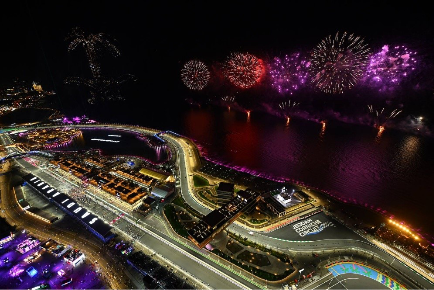
Podium ceremony with fireworks at the Saudi Arabia Grand Prix (© Getty Images/Red Bull Content Pool)
A race that begins before the start
Twenty-two cars on the starting grid, engines roaring, ready to go as soon as the lights go out. Millions of spectators, in the stands or in front of their TVs, hearts pounding.
A Formula 1 race is about to begin.
But let’s take a step back. Formula 1 is no longer just a competition among the world’s best cars and drivers. This sport has become much more: a true spectacle in which the drivers are the main actors and the track is the stage. For many spectators, the result alone isn’t enough; what really gets their hearts racing is following the glamorous life in the paddock, just as one would follow a reality TV show.
So, how does Formula 1 create such an experience? To understand how this high-level sport has evolved into a full-scale spectacle, we first need to look at what happens around the track, where the Grand Prix becomes an event designed to entertain spectators from the moment they arrive.
When sport becomes a spectacle
While Formula 1 was once a sporting competition where sheer speed and the incredible engineering of the cars mattered more than anything else, it has gradually become an entire cultural experience, a form of entertainment like any other. From the moment spectators enter the circuit, they become part of an environment where every element contributes to their overall experience.
In fact, the circuit itself becomes a stage. Giant screens all around the track, sound systems, branded spaces, huge fan zones and pre-race ceremonies all contribute to creating an atmosphere that extends beyond the actual race.
At some Grand Prix weekends, internationally renowned artists are invited to the fan zone to entertain the large crowds between sessions. At these events, the headliners of these concerts serve both to attract an even larger and more diverse audience and to capitalize on the excitement generated to further enhance the reputation of the host circuit. Indeed, circuits are tasked not only with organizing the Grand Prix from a sporting perspective but also with managing everything that happens around it – particularly the spectator experience, which is becoming increasingly demanding in terms of entertainment. It’s essential to keep fans, who sometimes travel from far away, happy and satisfied, while keeping in mind that they’ll share their feedback on social media, which can significantly influence the circuit’s renown.
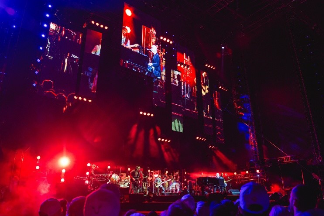
Billy Joel during the Formula 1 USGP at Circuit of The Americas on October 23, 2021 in Austin, Texas (© Getty Images/Rick Kern)
This transformation also changes the way a Grand Prix is conceived: not simply a sporting event to attend, but a weekend experience to be planned, promoted and remembered. The race is only one part of a much larger program, and the success of a Grand Prix depends on how all these different elements come together to create a coherent entertaining event.
We could take this comparison even further by looking at this sport more broadly. For example, much like a theatre troupe touring a country from one theatre to another to perform the same play each time, Formula 1 travels from one country to another across nearly every continent, and each race weekend (about twenty from March through December) always unfolds in the same way. The free practice sessions serve as rehearsals to prepare for Saturday’s qualifying and Sunday’s race. Thus, the race weekends unfold like a perfectly choreographed ritual.
From motorsport to popular culture
If the Grand Prix has become a spectacle in its own right, Formula 1’s cultural influence extends far beyond race weekends. Through streaming platforms, social media and all sorts of digital content, this sport has gradually found its way into the everyday lives of audiences who might never have considered themselves motorsport fans. Formula 1 is no longer just about watching the races at each Grand Prix, but it can also mean following a driver’s journey, watching behind-the-scenes videos, engaging with the sport’s online community, buying merchandise from the teams or drivers, etc.
In a way, this was already the case in the days of Senna or Schumacher, who were public figures closely followed by the media. But with the rise of social media, the teams have embraced this new medium and, in doing so, have added an extra layer of entertainment. Through this, they ensure that the show goes on even outside of race weekends, thereby forging a very strong connection with fans by portraying the drivers as approachable and likable people whom fans enjoy following for their personalities, beyond their racing results. Even though fans are well aware of the marketing strategy behind the many videos shared (though some may not be), they remain just as eager to follow this content, especially when it features their favorite driver(s).
The 2025 Global F1 Fan Survey, conducted by Formula 1 and Motorsport Network, gathered more than 100,000 responses from self-identified, highly engaged fans across 186 countries. Among respondents, 61% said they engaged with Formula 1 content daily, and 70% of Gen Z respondents in the United States reported doing so. And nearly one-third of respondents say the glamour, luxury, and celebrity side of F1 enhances their fandom. 43% declared being interested in knowing more about F1 drivers off the track, with 12% who are very interested. This interest is particularly strong among fans who are Gen Z and are women.
These figures should be read in light of the survey’s focus on engaged fans, but they illustrate how digital content has become an important part of contemporary Formula 1 fandom and how this sport is no longer limited to athletic competition and must meet new expectations from fans who are increasingly involved not only in the sport but also in paddock life.
Moreover, one of the most significant developments in modern Formula 1 is the growing importance of storytelling. While sporting performance remains central, audiences are increasingly and more than ever invited to discover the personalities, ambitions and relationships behind the helmets. Drivers become characters that fans can follow throughout a season.
Netflix’s “Formula 1: Drive to Survive”, first released in 2019, illustrates this shift. By offering behind-the-scenes access to drivers, team principals and the inner workings of the championship, the documentary series presents Formula 1 through a narrative lens. By focusing on the drama and rivalries in the paddock, rather than on the purely technical aspects of the sport, the series has succeeded in attracting a new audience, primarily in the US. Indeed, Formula 1, which has historically been more popular in Europe, wanted to gain visibility in the US: what better way than a Netflix series?
However, if the series offers a fresh perspective on the sport, it has also been criticized for its lack of accuracy. Intended to be a documentary taking us behind the scenes of each season, it turns out to be more of a fictional reimagining of real events. In other words, the production chooses to prioritize drama, even if it means exaggerating certain situations or completely inventing rivalries. While this certainly makes for more exciting viewing, this over-dramatization does not do justice to the sport or its participants. Here, spectacle takes precedence over sport and distorts its true nature.
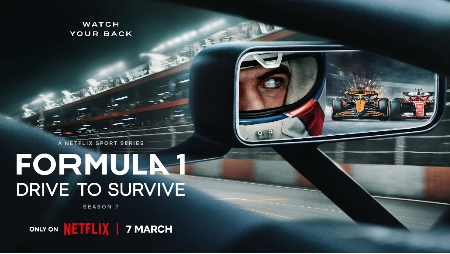
“Formula 1: Drive to survive” poster for the 7th season (released in 2025) (© Netflix)
Formula 1 as a cultural platform
As Formula 1 reaches audiences far beyond traditional motorsport fans, it has also become a meeting point for industries that might once have seemed distant from the racetrack. Fashion houses, musicians, artists and designers are increasingly drawn to the sport, which has become a platform through which they can reach audiences and increase their global visibility.
The relationship between Formula 1 and luxury is one of the clearest examples of this convergence. Since Netflix and social media, in particular, have helped bring a younger and more female audience to Formula 1, luxury brands have been able to capitalize on this new momentum. Conversely, the arrival of luxury in the sports industry is helping to attract other creative industries and make Formula 1 “the place to be”.
In 2025, LVMH began a ten-year global partnership with Formula 1, bringing together several of its brands, including Louis Vuitton, TAG Heuer and Moët Hennessy. It illustrates how Formula 1 can provide a setting in which brands express their identity through more than traditional advertising. The trophy trunk, for instance, is not merely a container for a trophy: its design, craftsmanship and visibility during a victory ceremony highlight the intertwining relationship between sports and the cultural industries.
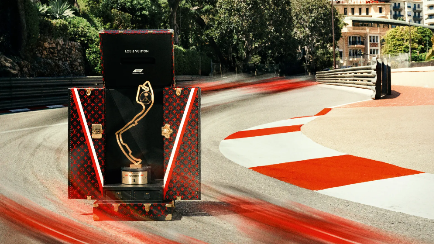
Louis Vuitton’s trophy trunk for the Monaco Grand Prix (© Louis Vuitton)
The connection also reflects a broader evolution in the image of Formula 1. The paddock has increasingly become a space where sport, celebrity and fashion intersect. Stars of all kinds parade in front of the photographers as if on a red carpet. Artists, actors, and athletes take advantage of this exposure, sometimes to promote themselves rather than their interest in the race. Pop culture is part of the landscape at a Grand Prix, and celebrities have certainly caught on to that.
The drivers themselves are the foremost ambassadors for fashion brands. Lewis Hamilton is undoubtedly in pole position at the fashion show: his consistently stylish looks are eagerly anticipated and closely scrutinized at the start of Grand Prix weekends and other important events. His passion for artistic expression through fashion has even led him to co-chair the Met Gala in 2025. The driver also played a role in establishing Formula 1 as part of today’s film culture by serving as one of the main producers of the movie “F1”, released in 2025.
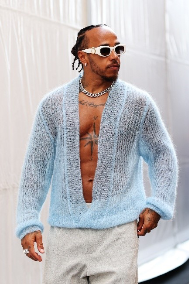
Lewis Hamilton at the Monaco Grand Prix in 2024 (© Getty Images / Ryan Pierse)
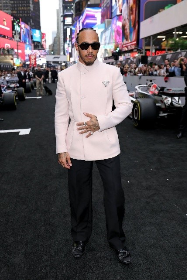
Lewis Hamilton at the “F1” movie premiere In New York in 2025 (© Mike Coppola/Getty Images for Warner Bros. Pictures)
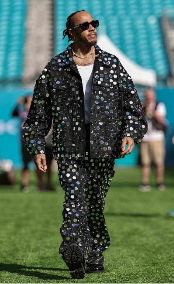
Lewis Hamilton at the Miami Grand Prix in 2024 (© Getty/Song Haiyuan/MB Media)
Visual art offers another perspective on this cultural exchange. In 2025, Racing Bulls collaborated with Nigerian artist Slawn on a special livery for the British Grand Prix. His distinctive street-art style appeared on the car, the drivers’ race suits and the team’s kit. Another example: to celebrate the opening of the new circuit in Madrid in 2026, driver Lando Norris designed a special helmet in collaboration with Madrid-based visual artist and muralist Be Fernández.
When an artist intervenes in the car or the helmet appearance, they transform into a temporary canvas, bringing contemporary art into a space usually associated with engineering and competition. Furthermore, the artwork is not displayed in a traditional gallery: it moves at high speed, appears in broadcasts and photographs, and reaches an audience through the event itself.
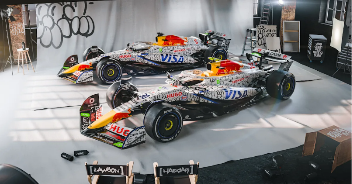
F1 VCARB cars designed by artist Slawn for British Grand Prix in 2025 (© VCARB/Red Bull Content Pool)
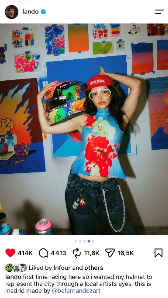
F1 driver Lando Norris’s Instragam post featuring artist Be Fernández (via Lando Norris’s Instagram)
Music has also become a more and more visible part of the Formula 1 weekend. Several Grands Prix incorporate major concerts into their programs, expanding the event beyond the race itself. The circuit organizers are reassured because, even if the race itself didn’t provide enough excitement, with overtaking, crashes, or unpredictable weather, there are always other forms of entertainment and activities to satisfy spectators looking to make the most of their experience at the circuit.
At the 2025 Miami Grand Prix, for example, the music producer Tiësto performed above the starting grid before the formation lap and returned to perform after the podium ceremony, accompanied by other big names in electronic music like Kygo. Tiësto was also one of the artists featured on the “F1” movie soundtrack, and to celebrate this announcement, the drivers’ names above their garages were replaced with those of the artists featured on the album.
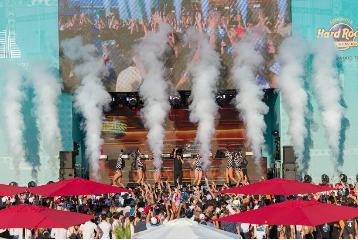
Concert at the Hard Rock Beach Club after the Miami Grand Prix in 2025 (© AJ Shorter)
This is a direct result of Formula 1’s transformation into a cultural event and platform: the more cultural it becomes, the more industries want to get involved. That is why creative industries have seized upon this new arena, perhaps even at the expense of what Formula 1 is first and foremost: a high-level sporting competition.
The fine line between sport and entertainment
So, where does sport fit into all of this?
In addition to being a sport, Formula 1 is now also a live spectacle carefully designed to entertain, a global cultural phenomenon fuelled by storytelling and social media, and a platform where artists, designers and brands can reach audiences on an unprecedented scale. Yet, as millions of dollars are invested in entertainment, celebrity appearances and commercial partnerships, one question remains: is the spectacle beginning to overshadow the sport itself?
Perhaps the two are not mutually exclusive. Behind the glamorous facade, the technical innovations, strategic decisions and high-level performances that define Formula 1 are still very much alive.
At the same time, artistic collaborations can offer genuine creative opportunities, even when artistic expression and commercial interests overlap. The real challenge is therefore not to choose between sport and spectacle, but to find a balance between them. After all, Formula 1’s appeal may lie precisely in its ability to be both: an elite sporting competition and a cultural phenomenon that extends far beyond the track.
Written by Camille Josserand
