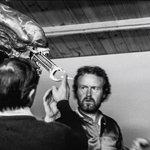
Julie Curtiss, Delivery, (2025).
PHOTO: MARIS HUTCHINSON. © JULIE CURTISS, COURTESY OF GAGOSIAN
What happens when an artwork stops being valued primarily for what it is, and starts being valued for what it might be worth tomorrow?
In her book Get the Picture, journalist Bianca Bosker, eager to understand the opaque rules of this market, makes herself an insider and starts to work for a gallerist, visiting artists’ studios and eventually spending time alongside painter Julie Curtiss. Curtiss is an especially revealing figure because her career illustrates one of the contemporary art market’s strangest paradoxes.
Bosker’s account of Curtiss comes at a moment when the artist’s work has attracted intense commercial attention. Her paintings have appeared at auction at prices vastly removed from what theyoriginally sold for. One of Curtiss painting had originally sold for $600 later reaching $106,000 at auction, while another work originally sold for $1,400 later sold for $209,000.
The figures are spectacular. But from an artist’s perspective, they can also be unsettling, « Tragicomic » as she puts it in her interview with Nate Freeman for Artnet. A market that suddenly pushes an artist’s work to extraordinary prices creates expectations that the artist may have little control over.
Curtiss is not an isolated case. The recent trajectory of British painter Flora Yukhnovich offers another striking example. Yukhnovich’s market exploded in the early 2020s. Her first oil painting to appearat auction, at Phillips New York in 2021, was estimated at $60,000–$80,000 but sold for $1.17 million. Her auction record followed in March 2022, when Warm, Wet ‘N’ Wild sold for £2.69 million at Sotheby’s London.
The acceleration was extraordinary. But so was the subsequent normalization. In March 2025, her small work Study sold at Christie’s Hong Kong for $35,600, compared with $60,400 when it hadpreviously sold at Sotheby’s in 2021, a 40% downfall.
None of this means that Yukhnovich’s career has collapsed. Quite the opposite: she is represented by Hauser & Wirth and has continued to receive major institutional attention. But the contrastillustrates an essential feature of the contemporary art market. An artist’s career and the financial performance of individual works are not the same thing.
So what happens when an artist’s market becomes a speculative market? Who benefits when a painting changes hands for ten, fifty or a hundred times its original price? And what happens when the speculation eventually turns?
The first judge is the gallerist
For most contemporary artists, the first major gateway into the market is the gallery.
This is the primary market: the moment when an artist’s work is sold for the first time, usually through a gallery representing them. The responsability of a good gallerist is to introduce an artist’s work to collectors and curators, organize exhibitions, participate in art fairs and determine, to a significant extent, who gets access to the work.
That is espacially true at the highest level of the market, this system is dominated by a relatively small number of international galleries. Gagosian, David Zwirner, Hauser & Wirth, Pace, White Cube, Perrotin, Templon…But over the last decades they have also brought a true scarcity dynamic, in order for a collector to have access to an artist work, she or he has to prove they are worthy by providing a list of other artworks they have in their collection and at which gallery or auction did they buy it. The gallery therefore becomes more than a retailer. It becomes a mechanism of selection.
An emerging artist does not simply produce a painting and wait for the market to decide what it is worth. Prices are constructed progressively through exhibitions, collector demand, institutionalvisibility, critical reception. Scarcity is part of this construction. Collectors may encounter waiting lists, limited releases and carefully controlled access to an artist’s work.
Art fairs are the epitome of this system. For several days, galleries transform exhibition stands into highly concentrated marketplaces where collectors, curators, advisers and dealers circulate in searchof the next important name.
But the primary market does not necessarily tell us whether a work will retain its value.
For that, collectors look elsewhere.
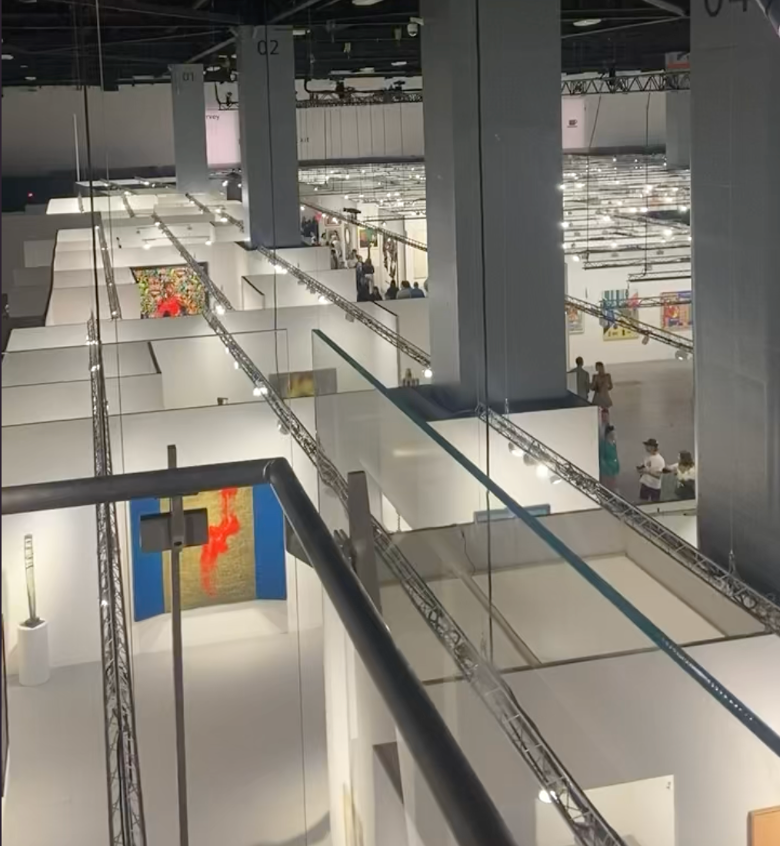
Julie Curtiss, Art Basel, Maimi (2024)
The Second Market or the soothsayer
The secondary market begins when an artwork is resold.
This is where auction houses become particularly important. Christie’s, Sotheby’s, Phillips and other auction specialists provide a public mechanism through which works can be bought and resold, often accompanied by estimates, previous-sale histories and extensive documentation.
Auction prices therefore carry a particular kind of authority. A gallery may ask a certain price for an emerging artist’s work, but a public auction establishes something different: a price that a buyer wasdemonstrably willing to pay at a particular moment.
That distinction is crucial. And that is when speculation enters the picture, quite litteraly.
One of the clearest expressions of this speculation is flipping. A collector acquires an artwork, sometimes directly from a gallery, and resells it relatively quickly after the artist’s market has risen. The collector’s objective is not necessarily to live with the work, support the artist’s practice or build a meaningful collection. The artwork becomes an asset whose value can potentially appreciate.
The recent auction history of Rashid Johnson provides a particularly revealing example. In 2022, a collector acquired one of his paintings for $816,500 including fees. In spring 2025, the same work soldfor $292,100, representing a 72% loss for the consignor. Artnet News documented the sale as part of a broader correction in the contemporary art market.
The fall in price does not mean that Johnson suddenly became a less important artist. At almost exactly the same moment, another Johnson work, Two Standing Broken Men, sold at Sotheby’s for $1.76 million, well above its estimate. The two results demonstrate something that is easy to forget when looking at auction records: there is no single, permanent “value” attached to an artist.
There are prices, moments, buyers, sellers and expectations.
And when those expectations become disconnected from the underlying career of an artist, the correction can be brutal.
The wider market itself has recently demonstrated this volatility. According to the Art Basel & UBS Global Art Market Report 2026, global art sales recovered by 4% in 2025 to an estimated $59.6 billion, following two consecutive years of decline. Public auction sales increased by 9%, reaching $20.7 billion.
In other words, the contemporary art market is not simply a cultural ecosystem in which prices happen to exist. It is increasingly a financial environment in which expectations, liquidity and future resale value can shape the way art is bought, more tragic than comic..
The Museum as the Market’s Seal of Approval
If auction prices can accelerate an artist’s market, institutional recognition can stabilize it.
For many artists, one of the most important milestones in a career is not a record-breaking auction but the acquisition of a work by a museum. Once a work enters a recognized institution’s permanent collection, it acquires a different kind of status. It is preserved, catalogued, researched and potentially exhibited. It becomes part of an institutional narrative of art history.
Museum acquisition can therefore function almost like a seal of permanence.
But museums are not neutral spaces. They do not simply reflect history either. They participate in constructing it. Their collections are shaped by curatorial choices, institutional priorities, donors, cultural politics and the availability of works on the market.
This creates a circular system.
The market gives visibility to certain artists. Galleries promote them. Collectors acquire them. Museums begin to exhibit and collect them. Institutional recognition then reinforces their legitimacy, which can strengthen their market position further.
The artists who receive institutional recognition are therefore not necessarily those who were simply “discovered” by museums. Many have already passed through several layers of selection beforeentering a permanent collection.
The museum may appear to stand outside the market. In reality, it can become one of the forces that ultimately sustains it.
When Paintings Become Financial Products
The transformation of art into an investment asset becomes even more explicit when financial institutions and specialized companies enter the picture.
The contemporary art market has developed an ecosystem of investment funds, financial advisers and platforms that treat artworks not only as cultural objects but also as alternative assets.
The Fine Art Group, founded by Philip Hoffman in 2001, is one example of a company built around art investment and art finance.
Other models have gone further. Masterworks, for example, has developed a platform through which investors can acquire fractional interests in artworks rather than purchasing an entire workthemselves.
The financialization of art is also visible in wealth management. Deloitte’s Art & Finance Report found that approximately 63% of surveyed wealth managers already incorporated art and collectiblesinto their services.
This does not necessarily mean that every collector treats art as a financial product. People buy art for many reasons: pleasure, identity, cultural belonging, philanthropy, status or a genuineattachment to an artist.
But the existence of a sophisticated financial infrastructure around art changes the environment in which those purchases take place.
The global art market reached an estimated $59.6 billion in 2025, according to the latest Art Basel & UBS report. The figure is enormous, but the market remains remarkably difficult to read from the outside. Unlike public financial markets, there is no single transparent exchange listing every transaction and every price. Private sales are common, dealer prices are often confidential and ownershipstructures can be difficult to trace.
This opacity is not an accident. It is one of the defining characteristics of the market.
The Room of Requirement: Evanesco Artworks
A freeport is a special customs zone in which goods can be stored under advantageous customs and tax conditions. In the art world, these facilities have become sophisticated storage environmentscapable of housing extremely valuable collections.
The Geneva Freeport is the most famous example.
Among the companies operating there is Le Riche or Natural Le Coultre, a Swiss specialist in the transport, storage and management of fine art. The company states that it operates more than 35,000 square metres of secure warehouse space for artworks and valuables, including more than 25,000 square metres at the Geneva Freeport itself.
Natural Le Coultre describes facilities equipped with constant temperature and humidity control, security systems, private storage areas, showrooms and collection-management services. The company also works with museums, galleries and collectors for transportation, installation, conservation and storage.
The infrastructure reveals how far the art market has evolved. An artwork can be transported, insured, inventoried, photographed, stored and exchanged without necessarily being displayed publicly.
The freeport therefore introduces an uncomfortable question : What happens when an object whose purpose is traditionally associated with visibility, contemplation and cultural transmission spendsyears hidden from view?
The contradiction is particularly striking because artworks are simultaneously treated as objects of public cultural importance and private financial value.
The history of Geneva’s freeport is also closely connected with the controversial figure of Yves Bouvier, the Swiss businessman and art dealer who was closely associated with Natural Le Coultre and the development of the freeport model. The dispute between Bouvier and Russian collector Dmitry Rybolovlev became one of the most notorious legal battles in the international art market, and is the subject of a mini-documentary series on Arte.
The controversy surrounding Bouvier should not, however, be confused with the legitimate use of freeports for professional art storage. Museums, galleries and collectors have practical reasons to use such facilities. The issue is not simply that art is stored there, but that the same infrastructure can facilitate a market in which ownership can change without the work ever entering public view.
The artwork becomes, in effect, an asset that does not need to be seen in order to have value.
Woman Artist
The financialization of art becomes even more revealing when gender is taken into account.
Women have made up a substantial proportion of the population entering fine-art education, yet their representation in the highest levels of the auction market remains dramatically lower.
A major international study published in the Journal of Cultural Economics, based on auction data covering almost the entire global population of transactions for Western artists between 2000 and 2017 and more than 1,800 auction houses, found that works by women represented less than 4% of total auction sales. The study also found that only men occupied the top 40 positions by total sales value during the period examined.
The finding becomes more complex when prices are examined.
After controlling for characteristics such as the size and type of artwork, the auction house and the period in which the work was sold, the researchers found that works by women were actually 4.4% more expensive on average than works by men. At the very top of the market, however, works by male artists sold for 18.4% more than those by female artists for sales above $1 million.
The problem, therefore, is not simply that collectors pay less for individual works by women.
It is that women artists are far less likely to reach the parts of the market where enormous prices are generated in the first place.
The latest Art Basel & UBS report also suggests that the situation is changing, although slowly. In 2025, Frida Kahlo’s El Sueño (La Cama) sold for $54.7 million at Sotheby’s New York, setting a new auction record for a female artist.
But even a record-breaking sale cannot erase the structural imbalance.
The question is not simply who sells for the highest price.
It is who gets the opportunity to enter the system that produces those prices. What appears to be a neutral measurement of demand is built on decades of decisions about who is exhibited, collected, represented and remembered.
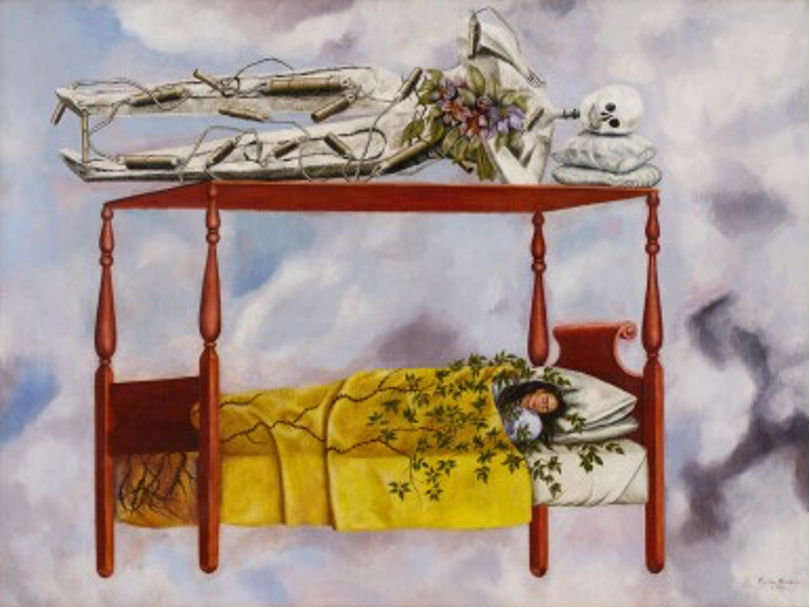
Frida Khalo, El sueño (La cama) Julie Curtiss, Delivery, (2025).
© FRIDA KHALO, COURTESY OF SOTHEBY’S
The Artist’s Last Share: Can the Droit de Suite Change the Equation?
At the end of this chain, one question becomes unavoidable: how much of the financial value generated by an artwork actually returns to the person who created it?
In France and throughout the European Union, one mechanism attempts to answer that question: the droit de suite, or resale right.
The principle is simple. When an original work of art is professionally resold, the artist can receive a percentage of the resale price. In France, the rate is 4% on the first €50,000, then progressivelydecreases across higher price brackets, reaching 0.25% on the portion above €500,000. The total payment is capped at €12,500 per sale.
The system is important because it recognizes something that the conventional structure of the art market tends to obscure: an artwork can generate enormous economic value long after it has left the artist’s studio.
This immediately raises questions about transactions that take place privately, or within the increasingly sophisticated infrastructures surrounding art storage and wealth management.
The limitation becomes particularly significant in the United States, one of the world’s largest art markets. Unlike France and the European Union, does not have a nationwide resale royalty system comparable to the European droit de suite.
The question, then, is whether the existing mechanism goes far enough.
If an artwork originally sold for a few thousand dollars later changes hands for hundreds of thousands, should the artist receive only a limited resale royalty? Should private transactions be covered? Should the system operate in the United States? And, perhaps more importantly, would expanding the royalty solve the real problem?
When the Market Is as Opaque as the Artworks Are Invisible
The contemporary art market is often presented as a place where taste, talent and demand naturally meet.
But the reality is considerably more complicated.
An artist’s career can be shaped by galleries, collectors, fairs, auction houses, museums, financial advisers and increasingly sophisticated storage and investment infrastructures. Each institution has&its own logic. Together, they form a system capable of transforming an object created in a studio into a financial asset worth millions.
The latest Art Basel & UBS figures show a market that remains enormous despite its volatility: $59.6 billion in global sales in 2025, with public auction sales alone reaching $20.7 billions.
But the most important question may not be how large the market is.
It may be what happens to art when its price becomes easier to track than its meaning.
Julie Curtiss’s experience, Flora Yukhnovich’s spectacular rise and correction, Rashid Johnson’s contradictory auction results and the existence of freeports all reveal different aspects of the sametension. Art can be a cultural object, a personal possession, a symbol of status, an investment and a financial instrument at the same time.
None of these functions necessarily cancels out the others.
But when financial value becomes dominant, something changes.
The painting may still hang on a wall. It may still provoke emotion, tell a story or challenge the viewer. Yet behind it exists another story: who bought it, who sold it, what they paid, what they expect it to be worth tomorrow and whether it will ever be seen again.
Perhaps this is the contemporary art market’s greatest paradox.
The more valuable a work becomes, the more carefully the market may protect it. And the more carefully it is protected, the further it can sometimes move from the public for whom art was originallymade.
Written by Émilie