Try to picture a sculpture. You are probably imagining bronze, marble or steel — something solid, permanent, made to outlast the hand that shaped it. Now imagine a sculpture that dissolves while you are still looking at it. That is the paradox at the heart of the work of Fujiko Nakaya, the Japanese artist who has been sculpting fog since 1970. Her fog sculptures have no fixed shape, no stable outline and no permanent place in the catalogue of art history. Nobody has ever seen the same Nakaya work twice, because wind, humidity and temperature rewrite it in real time. She is, in other words, the perfect counter-example to everything we think a sculpture should be.
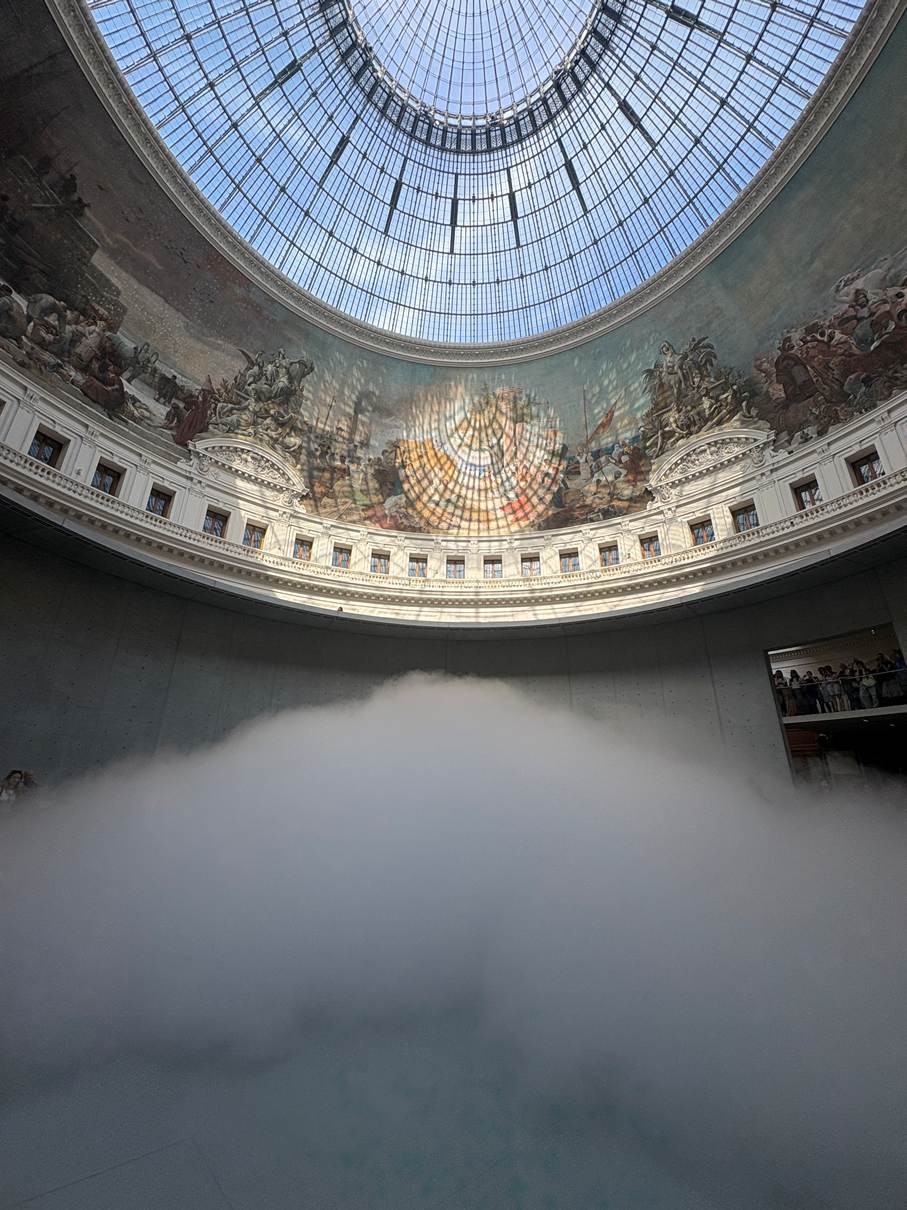
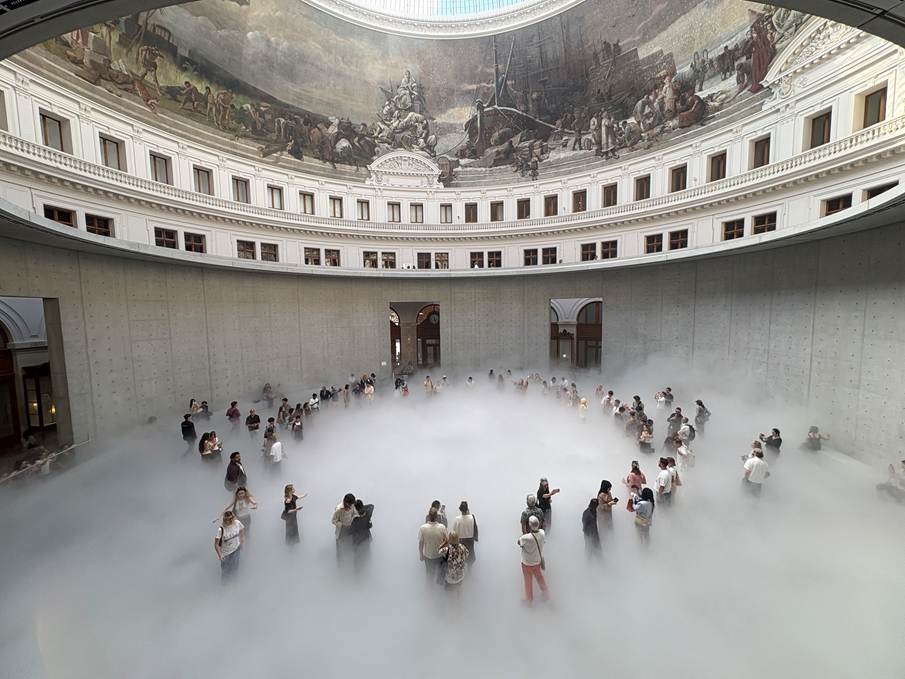
Fujiko Nakaya’s fog sculpture Cloud #07156 filling the Rotunda of the Bourse de Commerce – Pinault Collection, Paris.
A Father Who Studied Snow, a Daughter Who Sculpts Fog
Fujiko Nakaya was born in Sapporo, Hokkaido, in 1933. Her father, Ukichiro Nakaya, was a physicist who became the first person in the world to create artificial snow crystals — a scientist of snow who raised an artist of fog. After studying in the United States, she joined Experiments in Art and Technology (E.A.T.), the collective that brought artists and engineers together. In 1970, at the Osaka World Expo, she designed a fog installation for the Pepsi Pavilion, and a new sculptural medium was born.
Over the past five decades, more than eighty fog installations have been realised across dozens of countries, from Showa Kinen Park in Tachikawa, Tokyo to the Guggenheim Museum in Bilbao.In 2023 she received the Wolf Prize in Arts, one of the most prestigious international awards in contemporary art — a late but well-deserved coronation for an artist in her nineties who is still creating.
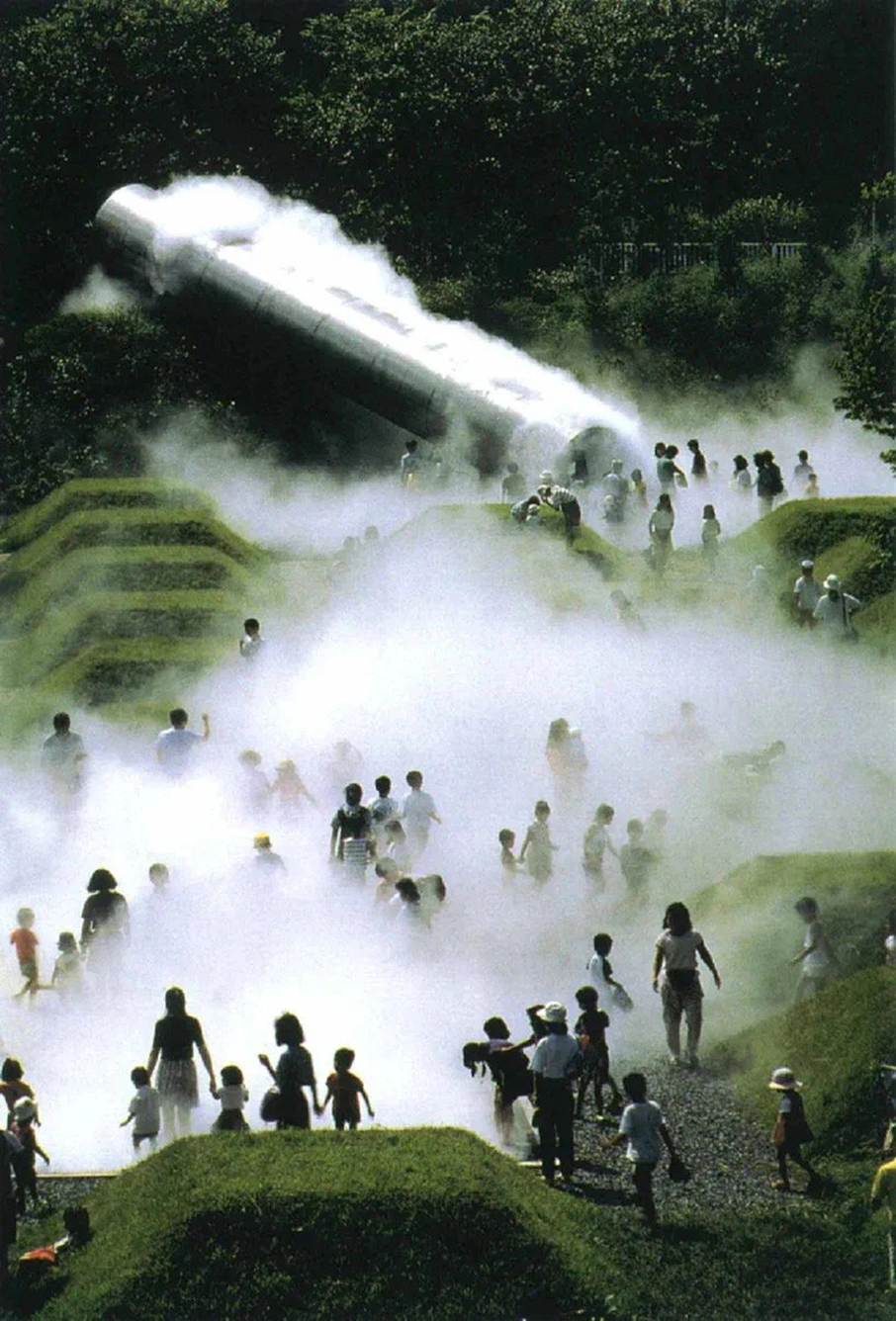
Foggy Forest, 1992, at Showa Kinen Park, Tachikawa, Tokyo. (Courtesy of Fujiko Nakaya, photo: Shigeo Ogawa)
She Does Not Design Fog. She Designs the Conditions of Fog
The real question is not how she makes fog, but what she is actually making. Traditional sculpture tames a material into a fixed form, and the work exists because it has been fixed. Nakaya reverses this logic: she never designs the shape of the fog. She designs the conditions under which fog can happen — the position of the nozzles, the pressure of the water, the way the vapour enters a space. Once the work is switched on, wind, humidity, temperature and the movement of visitors all continue to rewrite it. She sets a rule, not a result; she designs a behaviour, not an object.
This is the meaning of “negative sculpture”. Rather than shaping a form, she shapes a relationship — between material and environment, between the work and its audience, between order and impermanence. The fog is not a controlled material but a participant in the completion of the work. What she truly challenges is not the material itself, but our definition of what a work of art is. Why should a sculpture be fixed? Must the artist be the only person who decides what a work finally looks like? A great work often begins with a question worth redefining, not with a new technology — and Nakaya has spent a lifetime proving it.
A Date with a Cloud: Cloud #07156 at the Bourse de Commerce
On 20 August 2026, I walked into the Bourse de Commerce – Pinault Collection in Paris, the former stock exchange transformed into a museum, to meet the fog in person. Cloud #07156, a new work created for the exhibition Clair-obscur, was occupying the heart of the building: the central Rotunda.
The moment I entered the Rotunda, dense white fog rushed towards me. One second I could still read the lines of Tadao Ando’s fair-faced concrete; the next, the world had been wiped to a blank white. Light falling from the dome was cut into countless shards by the vapour, floating and bending in the air. Your eyes lose focus: silhouettes three steps away dissolve, and all you can hear is the sound of footsteps and the soft hiss of rising mist. An orderly museum becomes a space in which to get lost — and, strangely, a space in which to take risks. When the fog finally lifts, everyone returns from their loss of focus, and strangers exchange glances as if they had just shared a small adventure.
From the second-floor walkway, however, the experience inverts. Visitors watch the whole scene from above, like gods contemplating a landscape that never stops shifting. On the ground floor you are immersed; on the upper level you observe. The same work is experienced as two entirely different times.
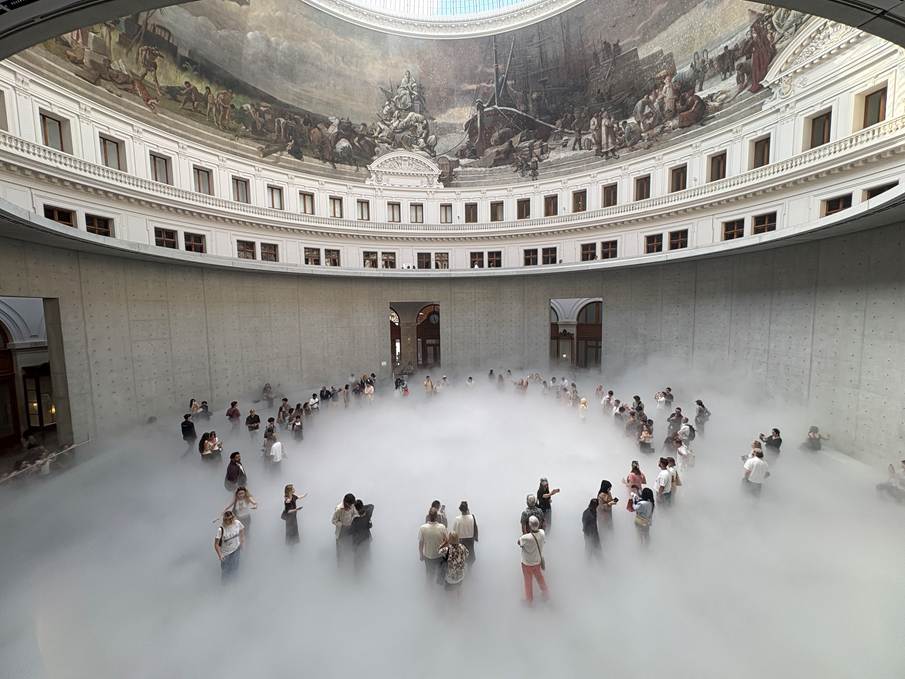
From the second-floor walkway: Cloud #07156 seen from above, where visitors on the ground floor are swallowed by the fog — the same work, experienced as two entirely different times.
Three Hundred Years of Architecture in One Rotunda
That tension is rooted in the building itself. The foundations of the Rotunda go back to the 16th century, when the palace of Catherine de Medici stood on this site; a single surviving column still rises inside the building. Between 1763 and 1767, the architect Nicolas Le Camus de Mézières built a circular grain exchange, the Halle aux blés, to store wheat for the city of Paris. In the early 19th century, after a series of fires, the architect François-Joseph Bélanger rebuilt the dome in 1813 with a ground-breaking cast-iron structure — the first long-span cast-iron frame ever erected. Then, between 1885 and 1889, the architect Henri Blondel transformed the building into the Bourse de Commerce, glazing the dome and painting a circular frieze around the hall celebrating global trade. In 1889, the year of the Universal Exhibition, it opened as the Paris stock exchange.
In 2021, Tadao Ando inserted a fair-faced concrete cylinder, about thirty metres in diameter and nine metres high, into the old circular hall — a perfect geometric plug that divides the building in two: the ceremonial Rotunda inside the cylinder, and a continuous ring corridor between the cylinder and the historic walls. Straight lines, right angles, exact geometry: Ando’s concrete is a pure confession of certainty.
A Conversation Between Certainty and Impermanence
And so the exhibition becomes a carefully staged dialogue. On the ground floor, Nakaya dissolves Ando’s certainty with ultimate impermanence: the concrete edges are softened into contours that drift and breathe. On the upper level, Ando’s corridor becomes a rational grandstand that frames Nakaya’s impermanence into a flowing picture. Hard and soft, permanence and change, construction and evaporation — the two artists complete each other.
Looking back over her career, from Fog Sculpture #08025 (F.O.G.) outside the Guggenheim Museum Bilbao in 1998 to Cloud #07156 in Paris, Nakaya has always used the lightest, most perishable medium to ask questions about nature and humanity, the ephemeral and the eternal. Her works cannot be stored in a warehouse; they cannot be preserved. And yet they are remembered far more vividly than many fixed sculptures, because every visitor becomes part of a work that is never finished. She reminds us that sculpture does not have to be permanent, just as beauty does not have to be solid. Some things stay with us precisely because they cannot be grasped.
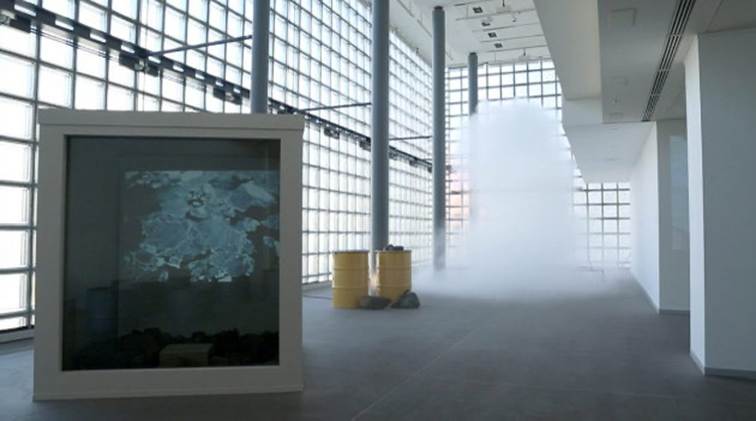
Glacier Falls – Greenland, 2017–18, at the Forum of Maison Hermès, Ginza, Tokyo. (Courtesy of Fujiko Nakaya, video still: Noriko Koshida)
Article written by Yunan Jiang
