A year after Fayard was acquired by Vivendi and Lise Boëll, former publisher of Éric Zemmour, was appointed as its director, the house is now releasing Ce que je cherche, the first book by Jordan Bardella, president of the Rassemblement National (far-right french political party). Vincent Bolloré, the French billionaire, already controls a vast media empire (Canal+, CNews, C8, Europe 1, Le Journal du Dimanche, Prisma Media, etc.), whose ideological influence is hard to deny. His growing grip on the French publishing sector now raises serious concerns about the erosion of editorial independence and the ideological shift that such concentration of power may bring.

“Le liseur aux canaris”, creation of the artist-designer Stéphane Phélippot, rue de la Fosse, Nantes
The History of publishing concentration
The French book trade took shape in the 19th century, driven by reforms aimed at expanding public education. In the 1930s, Louis Hachette made a name for himself thanks to orders from the Ministry of Public Education for Emille Littré’s Dictionnaire de la langue Française (Dictionary of the French Language) and children’s book collections. At the same time, Pierre Larousse and other houses such as Hatier and Nathan were gaining ground in the book market. In the 20th century, mass culture expanded with increasing print runs and sales. This period also saw the creation of the first major literary prizes, including the Prix Goncourt (1903) and the Prix Femina (1904). At that time, a handful of major historical publishing houses took the helm, including Hachette, Calmann-Lévy, Plon, Hetzzel, Garnier, Flammarion and Fayard, joined by Albin Michel and Grasset at the dawn of the 20th century.
During the Second World War, publishing became deeply political : collaboration with German authorities led to the dismissal of Jewish staff, the promotion of German-language authors, and even the plundering of Calmann-Lévy, a Jewish-owned publishing house. Despite the presence of publishing houses involved in the resistance, such as Les Editions de Minuit, historian Jean-Yves Mollier explains this subservience to the occupation by ‘their boundless admiration for Marshal Pétain, or the long submission of this profession to the imperatives of censorship for several centuries’. After the occupation, the provisional government entrusted Hachette to a cooperative organisation to break its monopoly. However, the company fought back and regained control of the structure in 1947.
This political dimension of publishing has never disappeared, partly because the sector has long been dominated by a small economic elite. Indeed, the sector’s growth has been accompanied by increasing concentration, particularly during the 1990s, when the largest groups dominated the market, while the majority of publishers shared the rest. The arrival on the market of Jean-Luc Lagardère, who became the main shareholder of Hachette and bought Hatier, its subsidiaries and then Vivendi Universal Publishing, reinforced this concentration. IInstitutions became involved, and the European Commission intervened to ensure that Hachette, already the market leader, retained only 40% of Vivendi. Yet it quickly became clear that public authorities had limited influence over this growing phenomenon of concentration.
Today, five groups account for 75% of the publishing sector’s turnover : Hachette (Fayard, Stock, Grasset, Larousse), Editis (La Découverte, Delcourt, etc.), Media Participation (Seuil, Fleurus, Dargaud), Madrigall (Gallimard, Flammarion, etc.) and Albin Michel. As Olivier Legrain reminds us in his book Sauver l’Information de l’Emprise des milliardaires, “publishing is a medium.” Books are a powerful vehicle for ideology and influence. Like the media, they attract billionaires in search of power and gradually shape public opinion. It is therefore understandable that buying up publishing companies is a low-cost way for billionaires to exercise control over what is said: with the exception of Hachette and Editis, the major groups are each worth between €200 million and €500 million, which is nothing compared to investments in the media, which require colossal investments accompanied by social plans.
An overpowering minority confronting a majority that struggles to make its voice heard
But what is the concrete impact of this handful of billionaires controlling publishing ? First, independent publishers are being crushed by strategies of invisibility and massive advertising. Maud Leroy, who founded Editions des Lisières in 2016, testifies : ‘I set up my publishing house to give a voice to women, colonised peoples and rural communities. I’ve only been able to make a living from my work for the past year ; before that, it was voluntary work so that I could pay the authors.’ Jean-Yves Mollier, a historian specialising in publishing, explains this concentration partly by France’s strong centralisation. Why, he asks, is Paris the only major literary hub when other dynamic cities could also host publishing activity ? Large publishing groups such as Hachette are not only publishers but also distributors. They promote their own books and therefore wield more influence over bookshops than independent publishers, who cannot, for instance, offer discounts in exchange for visibility.
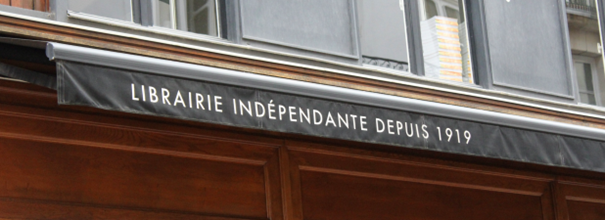
Bookshop frontage, Coiffard, rue de la Fosse, Nantes
Another, and perhaps the most dangerous, consequence is the power of influence publishing carries. For example, it is very easy to subtly devote laudatory biographies to political figures, or to give more visibility to a particular author (often on the right or far right of the political spectrum). This summer, Sonia Mabrouk, a prominent figure in the media controlled by Bolloré (journalist, radio and television presenter, notably at Europe 1), was appointed director of a collection published by Fayard entitled ‘Pensée Libre’ (Free Thought). This invocation of ‘freedom of expression’ gives free rein to far-right figures such as Robert Sarah (a fierce critic of homosexuality and abortion rights), Éric Ciotti, Jordan Bardella, and Philippe de Villiers. This was facilitated by the appointment of Lise Boëll, Zemmour’s publisher, as head of Fayard Publishing a few months after its acquisition by Bolloré. As with Europe 1 and the entire Bolloré media sphere, the voice of the far right is becoming increasingly vocal and spreading at breakneck speed, with books serving as a medium for this. It is also important to remember that Fayard has historically been left-leaning. The house notably published Barack and Michelle Obama’s French edition of Mein Kampf: Historiciser le mal (Historicising Evil), a critical work that analyses the origins of Nazism and the dangers of its ideology. The political shift made by the publishing house is therefore surprising in its speed and the ease with which ideological discourses are put in place.

Photograph of Sonia Mabrouk
The need to take action
One solution proposed by Thierry Discepelo, author of La Trahison des Editeurs would be to grant independent publishers special status and offer them tax breaks and preferential postal rates to counter the publishing magnates. The ‘Déborder Bolloré’ project is an initiative that originated within the independent media : how to deal with Bolloré’s monopoly on the media and now publishing ? This collective work brings together around a hundred independent publishing houses. It questions the growing concentration of publishing, and more broadly, of the media, in the hands of a far-right billionaire. On the one hand, it aims to highlight the dangerous ideological shift that this implies, and on the other, to encourage mobilisation and collaboration between committed publishers. This project gives independent publishers autonomy and supports the call for a boycott launched by independent bookshops of books published by Bolloré’s groups. In fact, following Bolloré’s takeover of Hachette, 80 independent bookshops have announced that books owned by the billionaire will not be given any visibility and will even be removed from the shelves. With this gesture, booksellers affirm their refusal to become a ‘propaganda tool for reactionary forces’. They explain that it is not all authors published by Hachette who are targeted, but rather the financing behind a monopoly that ‘aims to destroy (them).’

Literature section shelf, FNAC, Place du Commerce, Nantes
These movements are in line with the ‘Désarmer Bolloré’ (Disarm Bolloré) collective, which defines its appeal in these terms: « While we can temporarily rejoice that the Rassemblement National did not ultimately succeed in winning these elections, it intends to continue its conquest of territories and imaginations. We must, without waiting for the next elections, join forces against the forces of fascism in society. / We therefore call for a battle against Bolloré everywhere : because he is responsible for ecological devastation and neo-colonial exploitation, but also because in just a few years he has become a major lever in the far right’s conquest of power. For this collective, the battle we must fight is not merely about books but about ideology itself. They denounce the monopolisation of public discourse by far-right figures such as Pascal Praud, Eric Zemmour, and Cyril Hanouna, who promote a “civilisational project” and manipulate public opinion through toxic rhetoric. Fundamental issues such as feminism, LGBTQI+ rights, the climate crisis, and immigration are being hijacked by the Bolloré empire to spread far-right rhetoric, gradually normalising hate-filled ideas that should never be accepted in a democratic society.
The collective reminds us how this empire was built : first and foremost, through the media, with the takeover of Vivendi, Universal, Canal+, Europe 1 and Cnews. Then, thanks to its industrial weight with the Bolloré Energy company, which owns several oil depots, sells domestic fuel and Blue, and is also investing in a very worrying way in companies specialising in the automation of surveillance methods. He is also the second largest shareholder in the Luxembourg holding company Sofcin, which is shamelessly involved in deforestation, land grabbing and inhumane working conditions in Africa and Asia in order to make a fortune from the cultivation and sale of tobacco. It is clear that Bolloré is not only a threat to publishers, he threatens us all, and it is of paramount importance to stand up to his empire.

Logo of Bolloré
Culture under the strain of capitalism
This dangerous turning point affects not only publishing but all forms of media. The capitalist system allows the richest 10% to hold 55% of total wealth, giving them disproportionate control over the circulation of ideas, art, and culture. What is really being called into question is cultural democracy : if the plurality of voices is threatened, it is democracy as a whole that suffers. To combat this phenomenon, institutions must intervene through more effective regulatory tools (anti-concentration laws) but also through concrete civil action. Furthermore, readers who choose independent authors or buy from small bookshops instead of FNAC or Amazon are already contributing to this form of resistance. And as we have seen previously, what sets these billionaires apart is that they dominate all spheres of discourse and information : the media, polling institutes, social networks, and many sectors of industry. This is where we must remain vigilant and be careful about what we consume : which media do we choose to read, watch, and listen to ? What figures do we use ? (Pierre-Edouard Sternin, the founder of Smart Box, knows exactly how to instil his ideology, particularly through his Pericles project and the founding of his polling institute). What books do we read ? Vigilance and commitment will be our means of resisting the far right and fighting for democracy.
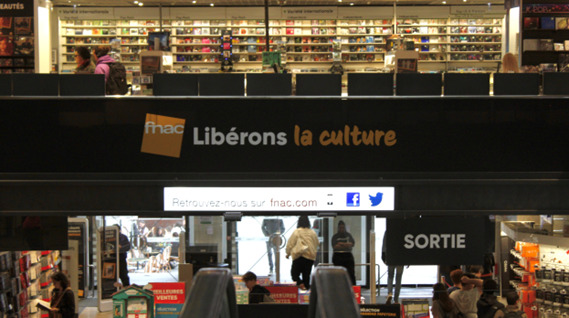
Central aisle of the store, FNAC, rue du commerce, Nantes
Author : Justine Calmels
Photographer : Chloé Descamps
Sources
- Bolloré/Hachette-: Ça suffit et c’est bientôt fini. (n.d.). Retrieved 28 September 2025, from https://desarmerbollore.net/news/bollore-hachette-ca-suffit-et-c-est-bientot-fini
- Déborder Bolloré: Une stratégie collective pour l’édition indépendante. (n.d.). Retrieved 28 September 2025, from https://www.medianes.org/deborder-bollore-une-strategie-collective-pour-ledition-independante/
- Édition: Un an après, le massacre de Hachette par Bolloré. (2025, January 2). https://www.blast-info.fr/articles/2024/edition-un-an-apres-le-massacre-de-hachette-par-bollore-DUaCFDbrS2W-IdDraSv50g
- Face au groupe Bolloré, des librairies refusent « d’être l’outil de propagande des forces réactionnaires ». (2024, November 26). Basta! https://basta.media/Face-groupe-Bollore-des-librairies-refusent-etre-outil-propagande-forces-reactionnaires
- Fayard, Hachette, Relay: Bolloré champion de l’édition politique? | France Culture. (n.d.). Retrieved 28 September 2025, from https://www.radiofrance.fr/franceculture/podcasts/la-question-du-jour/fayard-hachette-relay-bollore-champion-de-l-edition-politique-4362339
- Fayard ménage une place pour Sonia Mabrouk, star de la bollosphère. (n.d.). ActuaLitté.com. Retrieved 28 September 2025, from https://actualitte.com/article/124352/edition/fayard-menage-une-place-pour-sonia-mabrouk-star-de-la-bollosphere
- Le rachat d’Hachette par Vivendi suscite toute une gamme d’inquiétudes chez les auteurs. (n.d.). Retrieved 28 September 2025, from https://www.lemonde.fr/economie/article/2023/11/15/le-rachat-d-hachette-par-vivendi-suscite-toute-une-gamme-d-inquietudes-chez-les-auteurs_6200323_3234.html
- L’histoire mouvementée de l’édition française. (n.d.). La Revue des Médias. Retrieved 28 September 2025, from https://larevuedesmedias.ina.fr/lhistoire-mouvementee-de-ledition-francaise
- Pour les auteurs publiés par Hachette, faut-il “déserter Bolloré” ? (n.d.). Retrieved 28 September 2025, from https://actualitte.com/article/126310/auteurs/pour-les-auteurs-publies-par-hachette-faut-il-deserter-bollore
