Introduction: the most irreverent of witches
When discussing the icons of modern video games, one name almost invariably sparks heated debate: Bayonetta. Born in 2009 from the boundless imagination of Japanese studio PlatinumGames, this witch of the Umbra with her endless legs and gun-heels is not merely the heroine of a fast-paced, flamboyant beat them all (a genre of video game involving defeating hordes of enemies in successive waves). Over the course of three opus, she has become a veritable case study in sociology and marketing.
The embodiment of “deadly chic”, Bayonetta moves through a baroque universe where she battles angelic and demonic forces with rare audacity. But beyond her devastating combos and her hair-based magic, it is her portrayal that raises questions. Is she a relic of outdated sexism or the figurehead of a new wave of gaming feminism? This character, who seems to have been designed for visual appeal, nevertheless constantly overturns the balance of power, leaving no one indifferent.It is precisely this paradox that I intend to analyse in the first part. Beyond my personal affinity for this franchise, which has shaped my journey as a gamer, the aim is to examine how Bayonetta emerges as a groundbreaking figure. This case study will serve as a foundation for us to put things into perspective, in the second part, by comparing it with two other iconic franchises. This comparison will help us understand how the industry juggles, depending on the era and the audience, between different models of female empowerment.
Part 1: The Bayonetta Paradox: “Male Gaze” or “Female Agency”?
The “Male Gaze” theory: An initial perspective that is (too) narrow?
To fully understand why Bayonetta pushes the boundaries so much, we must first face the obvious: at first glance, she appears to be the ultimate fantasy of a video game industry still deeply steeped in heteronormative codes. To analyze this, one cannot overlook the concept of the “Male Gaze”, theorized by film critic Laura Mulvey in her seminal essay Visual Pleasure and Narrative Cinema (1975). In it, Mulvey explains that, in visual culture, women are often relegated to the status of passive objects, whose primary function is to satisfy the male viewer’s scopic/visual pleasure (the pleasure of looking).
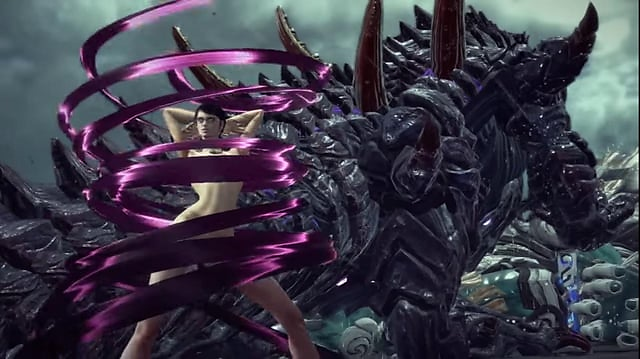
In the case of our Witch of Umbra, there is no shortage of grounds for such criticism. The game, directed by Hideki Kamiya, pulls out all the stops: persistent camera angles focusing on the heroine’s anatomy, pin-up poses in the midst of combat and, above all, that iconic yet controversial gameplay mechanic where her clothes (made from her own hair) vanish to summon demons: to make full use of her powers, she needs to be naked. One might think we are witnessing the height of fetishization here, where the heroine is nothing more than a pixelated doll designed by and for a male gaze in search of excitement. This is, in fact, the main line of attack taken by critics such as Anita Sarkeesian in her Feminist Frequency project, who sees Bayonetta as a typical example of gratuitous “sexification” that undermines the legitimacy of female characters.However, to stop at this superficial interpretation would be a mistake, as Bayonetta is far from being a lifeless wax doll. Whilst the male gaze is certainly present in technical terms (the camera is a tool), the heroine seems to find it amusing, or even to subvert it. She regularly breaks the fourth wall, engaging the player/spectator with winks or sharp remarks, transforming what should be a moment of vulnerability (nudity) into a display of absolute power. She does not submit to the gaze: she captures it, dominates it and turns it into a mockery. As a player, you soon realize that you don’t own Bayonetta ; it is she who grants us, with regal condescension, permission to witness her spectacle. This is where the paradox arises: can we still speak of an object when the subject is so outrageously in control?
“Female Agency”: Empowerment through performance
If we are willing to look beyond the lens of the Male Gaze, we discover that Bayonetta is not the product of passivity, but rather the embodiment of “Female Agency” (the capacity to act). Agency refers to an individual’s ability to make autonomous choices and to exert power over their environment. For our witch, this involves a radical reappropriation of the codes of femininity: she does not dress or move to please, but to perform her own power. She fits perfectly into what third-wave feminist theorists call empowerment through self-reclamation.
This power manifests itself first and foremost through absolute mastery of the body. Her movements, inspired by voguing and cabaret dance, are not mere aesthetic displays ; they are the language of a character who occupies the space with imperial authority. In every battle, Bayonetta transforms violence into an elegant choreography, reminding us that femininity, even when pushed to its artificial extreme, can be a vehicle for raw power. This is what is known as gender performance: she uses “clichés” (high heels, lace, lipstick, lascivious poses) to subvert them. By turning her heels into guns and her lipstick into bullets, she literally transforms a symbol of sartorial constraint into an instrument of death.But Bayonetta’s agency is also evident in her relationships with others, particularly in her deconstruction of the maternal role through the child character of Cereza in the first game. Far from the image of the “sacrificial mother” or damsel in distress all too often found in video games, she protects the child with a detached, ironic air, without ever sacrificing her own identity or her own pleasure. She proves that a woman can be protective without being defined solely by her maternal instinct. She remains the protagonist of her own story, a woman who chooses her battles, her alliances and her behaviors. Also, almost all men characters of the franchise are categorized either as antagonist (Balder), or caricature (Luka), or even dumb and clumsy (Enzo). In the opposite, women are the true powerful and main characters of the games (Bayonetta, Jeanne, Viola). For us, players, empowerment does not come from the fact that she is “properly dressed” or “respectable”, but from the fact that she is invincible and free. She embodies the figure of the “Femme Fatale” who, instead of leading men to their doom in a dark tale, leads the forces of hell and heaven to their own destruction, all with a smirk.
Mari Shimazaki: The role of the designer and the management of artistic intent
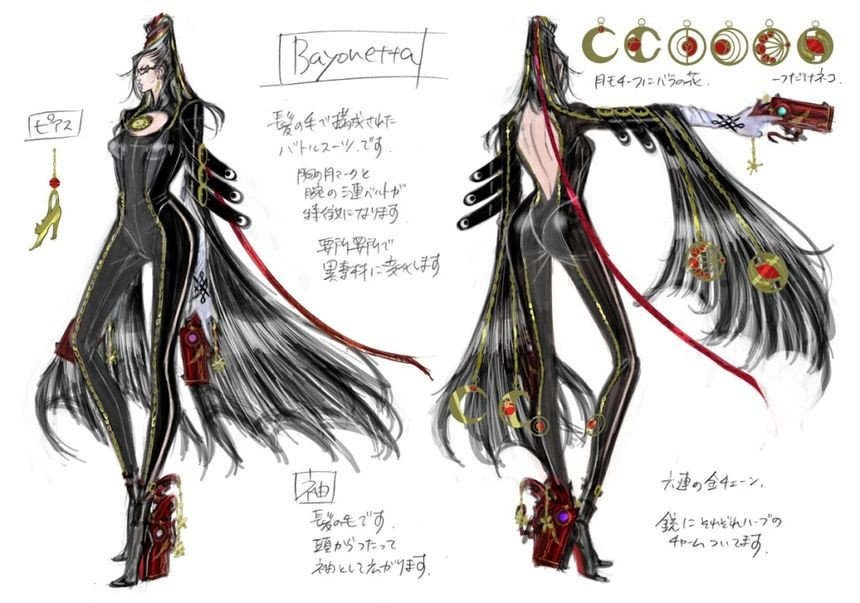
In analyses of the cultural industries, it is often overlooked that the “product” is the result of a human vision. In the case of Bayonetta, the key argument against accusations of sexism lies in its creative origins: whilst the game is directed by Hideki Kamiya, the heroine was designed by a woman, Mari Shimazaki. This detail radically changes the game in cultural management, as it shifts the focus from an object of fantasy to a form of idealized female independence.
Mari Shimazaki has often explained in interviews (notably in the Eyes of Bayonetta artbook) that she was not seeking to fulfil a “sexy character” brief designed to please men. Her intention was to create a woman “whom other women would want to emulate”. This known as mastering brand identity through aesthetics. She imbued the character with a haute couture wardrobe and accessories (such as her famous glasses) that lend her an air of intellectual authority and self-control. By insisting on these glasses against the advice of some team members, Shimazaki created an anchor point: Bayonetta is not just a body; she is a mind, a style, an attitude. Need I even mention that she is a witch, a figure who has been so terribly persecuted throughout centuries of patriarchy, yet who symbolizes the woman who possesses knowledge, power and freedom: Bayonetta embodies all of this, the embodiment of a woman liberated from all gender-based constraints, revolutionary, beautiful and a warrior.From a production perspective, this decision is a stroke of strategic genius. By entrusting the design to a woman, PlatinumGames has created a character that resonates with the aesthetics of fashion and luxury, capturing an audience that extends far beyond the typical “beat them all” gamer, reaching women and queers audiences. It is this artistic direction that allows the character to become a virtual fashion icon, capable of being adapted for other media. The empowerment here stems not only from the scriptwriting, but from the thoughtful visual design: every detail, from the 1960s beehive-inspired hairstyle to the catwalk stride, screams confidence and a refusal to compromise. The Shimazaki case proves that diversity in creative teams does not merely serve a social cause ; it enriches the artistic vision and transforms a simple “action game” into a cult classic with an unshakeable visual identity.
Part 2: Further examples of strategic shifts: Lara Croft and Aloy – moving away from the fetish towards a new cultural standard
The Lara Croft case: Rebranding
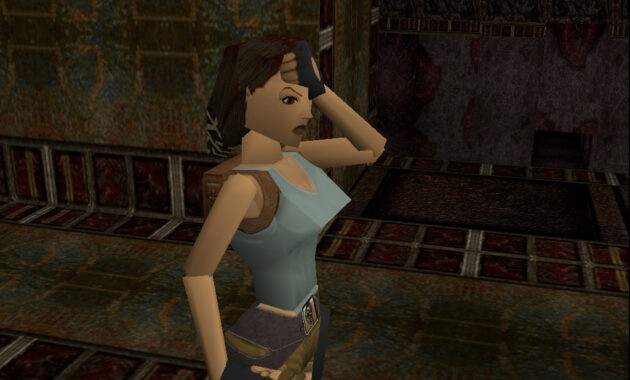
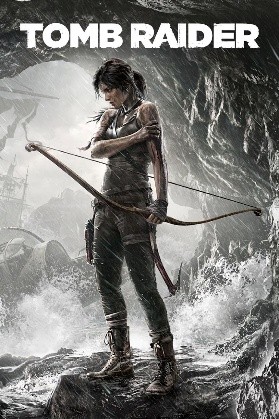
If there is one figure who single-handedly embodies the industry’s transformations and the dilemmas of cultural management, it is Lara Croft. To understand the contrast with Bayonetta, you must analyze Tomb Raider not merely as a series of games, but as a brand lifecycle management strategy. In 1996, Lara was born into a unique context, caught between a technological revolution and aggressive, exaggerated marketing aimed at capturing the attention of a teenage male audience.
Indeed, the PlayStation 1 was a technical revolution, and to sell this console, Sony and the publisher Eidos needed a living “technical demo”. Lara Croft was conceived as an assembly of polygons designed to showcase the power of 3D. Her measurements (the famous exaggerated conical bust, which was initially a developer’s cursor error but retained for marketing purposes) were used as a technological selling point. She was a demonstration “object”, a glossy icon whose empowerment is paradoxical: she is certainly a solitary, fabulously wealthy adventurer, but she remains a prisoner of a pin-up image over which she does not seem to have full control. The marketing wasn’t selling Tomb Raider (the exploration game); it was selling Lara (the sexy icon).
However, by the early 2010s, this strategy had run its course. The image of “Lara the bimbo” had become a hindrance to the franchise’s growth, as the player base diversified and narrative expectations evolved. This is where one of the most famous rebranding campaigns in the history of video games came into play, with the 2013 reboot orchestrated by Crystal Dynamics. To save the intellectual property, a strategic shift was needed: the heroine had to be “de-fetishized” in order to humanize her.The design of the new Lara Croft marks a radical break with the past: realistic body measurements, functional survival gear and, above all, an emphasis on her psychological vulnerability. We are no longer being sold a fantasy of power, but a story of resilience. This choice is not merely moral or political; it is eminently economic. By transforming Lara into a survivor with whom players can finally identify emotionally, the studio has opened the brand up to a much wider audience. This rebranding has enabled a shift from a model based on visual appeal (the pure Male Gaze) to one based on narrative engagement. Unlike Bayonetta, who embraces her hyper-femininity to turn it into a subversive performance, the new Lara Croft chooses to distance herself from it in order to gain legitimacy as a “serious” character within the contemporary cultural landscape.
Aloy and the “Neutral” heroine: Efficiency as the new standard
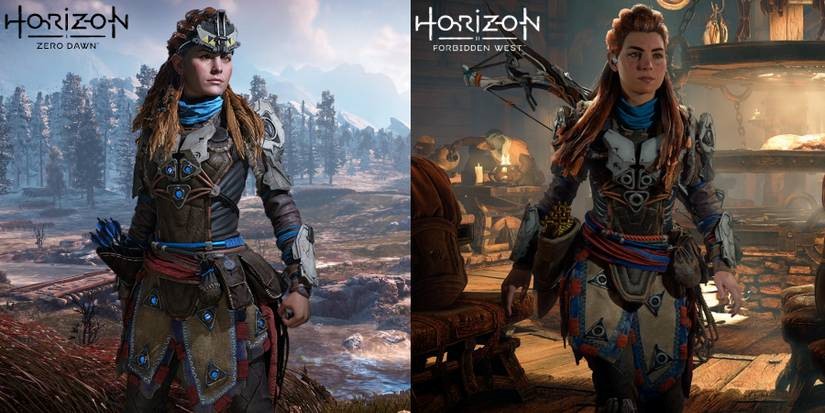
Whilst Bayonetta embodies hyper-femininity and Lara Croft represents a transition, Aloy (from the Horizon series) epitomizes the culmination of a new paradigm: the functional heroine. Aloy is a fascinating case study because she embodies the neutralization of gender in favor of competence. Here, empowerment no longer comes through seduction or the reappropriation of sexual codes, but through raw efficiency that renders the character’s gender almost secondary to the narrative.
Aloy’s design, created by Guerrilla Games, is a marketing statement in itself. Her appearance is dictated by her environment and her function: her clothing is a patchwork of hides and mechanical parts, her hair is practical, and her round face (deliberately less “glamorous” than usual standards) has even sparked absurd debates on social media. These reactions precisely highlight the project’s success: Aloy is not there to please the viewer ; she is there to survive and solve an age-old mystery. She embodies what might be called technocratic empowerment: her power stems from her ability to understand and manipulate technologies that no one else has mastered.From a strategic perspective, Sony’s choice of Aloy reflects a commitment to inclusive universality. By creating a character whose femininity is “neutral” (neither denied nor emphasized), the studio breaks down gender barriers for the audience. This is an extremely effective brand management strategy for a big-budget franchise: Aloy becomes a universally accepted icon, capable of representing the PlayStation brand without bearing the burden of controversies linked to sexualization. Aloy proves that video games have reached a level of maturity where a woman can finally be defined by her actions and technical intelligence, establishing efficiency as the new standard of female strength.
Conclusion
On reflection, it becomes clear that the evolution of female characters in video games is not simply a reflection of our societal progress, but also the result of increasingly sophisticated strategic management within the creative industries. Whether we look at Bayonetta’s subversive performance or Lara Croft’s humanistic rebranding, the conclusion is the same: the heroine is no longer a mere avatar ; she is a cultural asset whose identity must be managed with the precision of a master craftsman.
The Bayonetta case study teaches us that a strong, divisive brand identity can be a powerful driver of loyalty, provided that it is underpinned by a clear artistic vision, such as that of Mari Shimazaki, capable of transforming the “gaze” into “power”. Conversely, the emergence of characters such as Aloy demonstrates the industry’s desire to standardize inclusivity, transforming effectiveness into a new form of liberating neutrality.The future of video games probably does not lie in the choice of a single model, but in this cohabitation of diversity. By mastering these new codes of empowerment, studios are not just selling games, they participate in the construction of a collective imagination where genre becomes a storytelling tool rather than a marketing constraint. As future cultural professionals, our role will be to continue to navigate this paradox: that of reconciling the imperatives of the market with the need to offer ever more complex, autonomous and, ultimately, human representations.
Written by Enzo
Sources
Part 1
With a Terrible Fate – Bayonetta: Female Sexuality and Agency
ResearchGate – Gender, Power, and the Gamic Gaze
PlatinumGames Official Blog – Designing Bayonetta : original article in which Mari Shimazaki explained her wills and constraints about Bayonetta’s design
PlatinumGames Official Blog – Umbran Studies (Character Design)
Thèse Erasmus University – Male gaze, empowerment and the female gamers: The case of “Bayonetta”
In Media Res – Bayonetta, Femme Disturbance, and AAA Queer Desires
Part 2
- Lara Croft
The Guardian – Lara Croft: the reboot of a video game icon
Journal of Gaming & Virtual Worlds – The evolution of Lara Croft
Polygon – How Crystal Dynamics reinvented Tomb Raider
- Aloy
Kotaku – The Real Human Face Behind Horizon Zero Dawn’s Aloy
The Mary Sue – Why Aloy Is a Great Example of a « Neutral » Heroine
GamesIndustry.biz – How Horizon Zero Dawn moved beyond the « female protagonist » debate
To go deeper and further