
In the media landscape and its financing, the CNC (Centre National du Cinéma et de l’image animée) is unique. While Hollywood relies heavily on private equity and the box office, the French system is built on a philosophy of « cultural exception. » This institutional tool of financing movies is what gives independence and diversity to the entire French audiovisual sector. To some extent, it plays a heavy part in France’s still existing notable influence on cinema worldwide.
I. After the war, 1946 and the Blum-Byrnes « Shock »
To understand the CNC, you have to understand the fear that birthed it. In 1946, France was a nation in ruins. It owed the United States billions in war debt. During the negotiations for the Blum-Byrnes agreements and the Marshall Plan, US Secretary of State James F. Byrnes saw an opportunity to export not just capital, but ideology. He demanded that France scrap its pre-war cinema quotas.
The result was a disaster for French studios. In 1947, 340 American films were released in France, compared to only 65 French ones. The French film industry (the same industry that had invented the medium with the Lumière brothers) was on the verge of becoming a mere distribution hub for Hollywood.
The Law of October 25, 1946
The CNC was created by law on October 25, 1946, as a defensive maneuver. It was a regulatory shield. Its mission was to organize the profession, ensure transparency in ticket sales (the billetterie), and, most importantly, create a « Mutualized Fund. »
The genius of this early legislation was that it recognized cinema as a strategic industry. If the French people were going to watch American movies, those American movies would have to pay for the reconstruction of French studios. This led to the creation of the TSA (Taxe Supplémentaire Additionnelle).
II. The « Virtuous Circle »
The core of the CNC’s power lies in its budgetary autonomy. Unlike most cultural ministries worldwide, the CNC does not wait for a check from the government’s general budget. If the French Prime Minister decides to cut public spending on hospitals or roads, the CNC’s budget remains untouched.
1. The TSA (Taxe sur le prix des entrées de cinéma)
Every time a spectator buys a cinema ticket in France, roughly 10.72\% of the price goes directly to the CNC.
This means that when Avatar or Avengers breaks box office records in Paris, they are involuntarily funding the next small-budget French drama. It is a form of cultural redistribution: the « strong » (blockbusters) support the « weak » (arthouse films).
2. The TST (Taxe sur les Services de Télévision)
In the 1980s, as television began to eclipse cinema, the CNC evolved. The TST was introduced, requiring broadcasters (TF1, France Télévisions, Canal+) to pay a percentage of their advertising revenue and subscriptions into the pot. In exchange, these channels gained the right to broadcast the films the CNC helped produce.
3. Automatic vs. Selective Aid
The CNC operates on a dual-track system that balances populism and elitism:
Automatic Aid: If a producer makes a movie that sells millions of tickets, the CNC « earmarks » a portion of the tax generated by that movie for the producer’s next project. This encourages commercial success and keeps successful producers in the game.
Selective Aid (The « Avance sur Recettes »): Created in 1959 by André Malraux, this is the « soul » of the CNC. A committee of experts reads scripts and grants interest-free loans to films based on artistic merit alone, often to first-time directors. If the film fails commercially, the loan is never repaid. This is how directors like Jean-Luc Godard, François Truffaut, and more recently, Julia Ducournau (Titane), were able to exist.
III. The 1980s: Jack Lang (oops) and « Media Chronology »
The 1980s were a turning point. Under President François Mitterrand and his Culture Minister Jack Lang, the « Cultural Exception » was codified into a global crusade. Lang declared at a UNESCO conference in Mexico that « cultural imperialism » was a form of financial occupation.
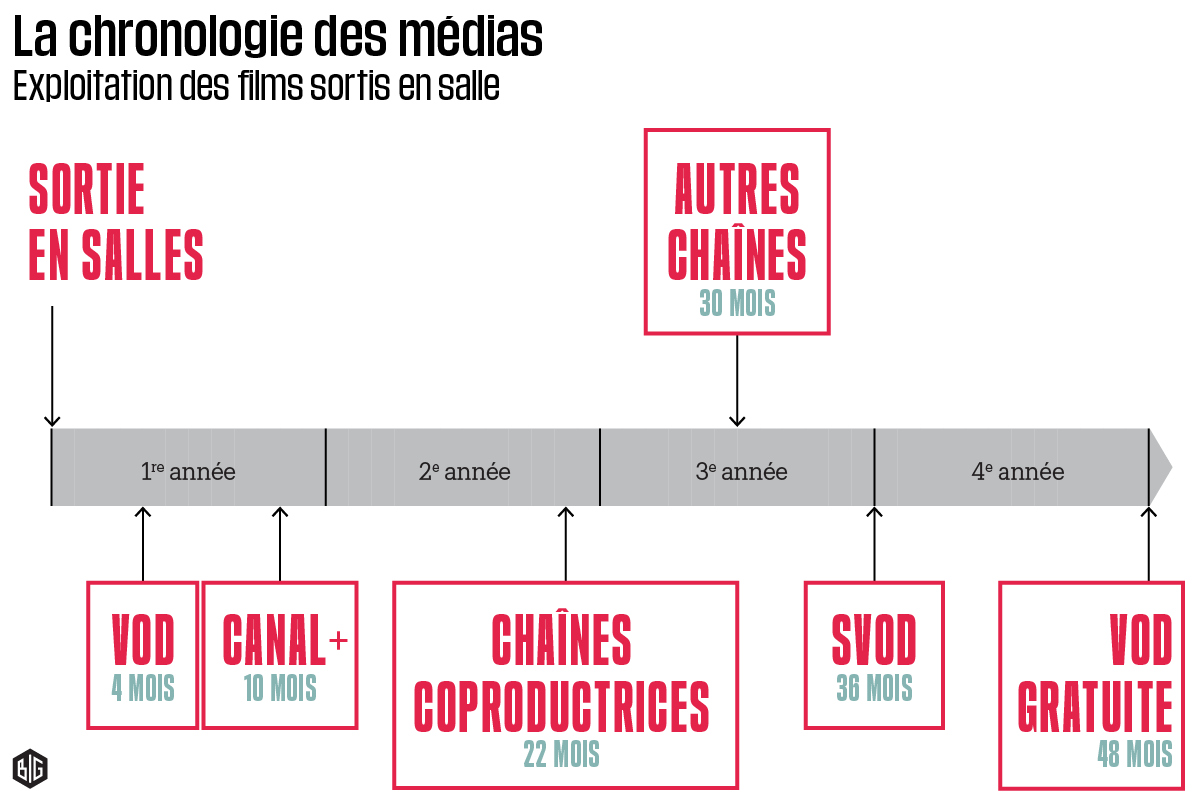
To protect the CNC’s ecosystem, France established the « Chronologie des Médias » (Media Chronology). This is a strict legislative calendar that dictates when a film can move from theaters to DVD, then to Pay-TV (Canal+), and finally to free-to-air TV and streaming.
The Goal is to ensure that movie theaters remain the primary source of revenue.
It is a legally binding framework. By forcing a delay between the theater and Netflix, the law ensures that theaters stay profitable, which in turn ensures the TSA tax keeps flowing into the CNC.
IV. Soft Power: The « Aide aux Cinémas du Monde »
The CNC is about France’s position as the « Patron Saint » of global cinema. Through the ACM (Aide aux Cinémas du Monde), the CNC co-funds films from Africa, Asia, and Latin America.
Because if a director from Thailand or Senegal wants to make a film, they often can’t find funding at home. If the CNC provides 20% of the budget, that film becomes a « Franco-Thai » or « Franco-Senegalese » co-production. This ensures that:
– The film is finished using French post-production studios (supporting French jobs).
– The film likely premieres at the Cannes Film Festival.
– France maintains its reputation as the global capital of « Cinéma d’Auteur. »
This is soft power in its purest form. It’s the reason why, in any given year, nearly half the films in the official selection at Cannes have received some form of CNC support.ù
V. The Digital War (2010–2026)
The greatest threat to the CNC came not from Hollywood studios, but from Silicon Valley. When Netflix, Amazon Prime, and Disney+ arrived in France, they initially operated outside the French system. They paid their taxes in the Netherlands or Luxembourg and didn’t contribute to the « virtuous circle. »
For a decade, critics predicted the death of the CNC. « How can a 1946 system survive in the age of the algorithm? » they asked.
The SMAD Decree (2021)
France responded with the SMAD Decree (Services de Médias Audiovisuels à la Demande). This was a landmark piece of legislation that essentially told the streaming giants: « If you want to operate in the French market, you must play by French rules. »
Under this decree, platforms are now required to invest 20% to 25% of their French revenue back into local French and European productions. To respect a (slightly shortened) version of the Media Chronology. To contribute to the CNC fund via a specific tax on video-on-demand.
Instead of fighting the platforms to the death, the CNC essentially « taxed them into the family. » Today, Netflix is one of the largest contributors to French cinema, a move that would have been unthinkable twenty years ago.
VI. Today, the « Waste » Myth
As you might have seen, social media often explodes when a commercial comedy like Ducobu or Marsupilami receives CNC support. The argument is: « Why are we giving ‘public money’ to a movie that is already making millions? »
However, it’s actually not « Public Money »: As established, it’s money generated by the industry itself. If you didn’t go to the movies this year, you didn’t pay a cent to the CNC.
On top of that, paradoxically, these commercial hits are the CNC’s best friends. Because they sell millions of tickets, they generate a massive amount of TSA tax. That tax is then used to fund the experimental, non-commercial films that actually win the awards. Without the « low-brow » comedies, the « high-brow » art films would have no funding.
Finally, even if a comedy is « silly, » it employs French technicians, actors, and catering companies. The CNC views cinema as an industry (the « I » in CNC used to stand for Industrie). Keeping cameras rolling on any project keeps the technical infrastructure of the country alive for when the next masterpiece arrives.
VII. The Future: Video Games and AI
The CNC is currently undergoing its most significant transformation since the 80s. It has recognized that the « moving image » is no longer just film.
The most visible shift is the full integration of video games into the cultural fold. France has pioneered the Crédit d’Impôt Jeu Vidéo (CIJV), a dedicated tax credit managed by the CNC that treats game developers with the same artistic respect as film directors. This isn’t just about corporate retention; while it certainly helps keep giants like Ubisoft anchored in Montpellier and Paris, it also provides a vital lifeline for independent « auteur » studios. Without this framework, global sensations like Stray—the « cat game » that captured the world’s imagination—might never have found the funding to match their artistic ambition. The CNC now views a high-quality game script with the same intellectual weight as a screenplay, bridging the gap between traditional narrative and interactive media.
Also, when it comes to AI, recognizing that it could either be a powerful tool or a replacement for human creativity, the CNC has begun integrating « AI Transparency Clauses » into its funding agreements. To qualify for subsidies, productions must now provide a detailed « algorithmic audit, » disclosing where and how AI was used in the creative process.This is an intent to provide legal defense of the Droit d’Auteur (Author’s Rights). As seen in class, in French law, an « author » must be a human being whose unique personality is reflected in the work. By mandating transparency, the CNC ensures that public funds continue to support human labor and original thought, preventing a future where « cultural exception » is automated by a server in Silicon Valley. This move has sparked a global conversation, with France once again acting as the laboratory for how a nation can embrace technology without sacrificing its soul.

VIII. Conclusion: The CNC as a « Institution Tool of Sovereignty »
The CNC is a statement of intent. It posits that a nation is only as strong as the stories it tells itself. By decoupling the creation of art from the immediate necessity of profit, the French system has created a diverse audiovisual landscape that serves as a global alternative to the « monoculture » of global streaming.
While critics may call it protectionist, the results speak for themselves. France remains the leading film market in Europe, the top European exporter of films, and a consistent heavyweight at every major film festival on earth. In an era of globalized digital content, the CNC’s « closed-circuit » model isn’t an outdated relic as some might think.
Sources :
CNC’s About Page – https://www.cnc.fr/web/en/about
It’s Wikipedia – https://fr.wikipedia.org/wiki/Centre_national_du_cin%C3%A9ma_et_de_l%27image_anim%C3%A9e
Anatomy of a Fall article on the CNC – https://www.cnc.fr/cinema/actualites/oscars-2024-anatomie-dune-chute-sacre-meilleur-scenario-original_2147433
CNC funding – https://www.lesechos.fr/tech-medias/medias/video-qui-finance-vraiment-le-cinema-francais-2196554
AI and video games – https://www.gamekult.com/actualite/cnc-le-plan-vertueux-pro-ia-pour-le-jeu-video-qui-fait-grincer-les-dents-des-createurs-3050868382.html