“The image allows a conflict to exist in the present time and to leave a trace in history”
These are the words of Emeric Lhuisset, photograph and professor at Sciences Po. Whether one is talking about representations (caricatures, press illustrations, photography, videography) or symbols (placards, flags), images have become a tool in popular resistance movements. They’re used to denounce, to illustrate unfairness and general living conditions, to rally people around a cause, by sharing revendications and encouraging involvement, and to build a collective memory, by creating a representation of these protests and their actors.
These images have been used over varied protests, from social movements to worker’s rights protests, including student mobilisation. And on top of evolving with the protests, the use of images has been influenced by three significative advances: the development of the press in the 19th century, the rise of photography and television in the 20th century, and the wake of social media nowadays.
From illustrated press to political protest: the power of printed images
Before the rise of the illustrated press, images were already used to support and represent popular struggles, but were not as widespread. Most examples that come to mind are in the form of paintings: The Death of Marat, Liberty Leading the People…
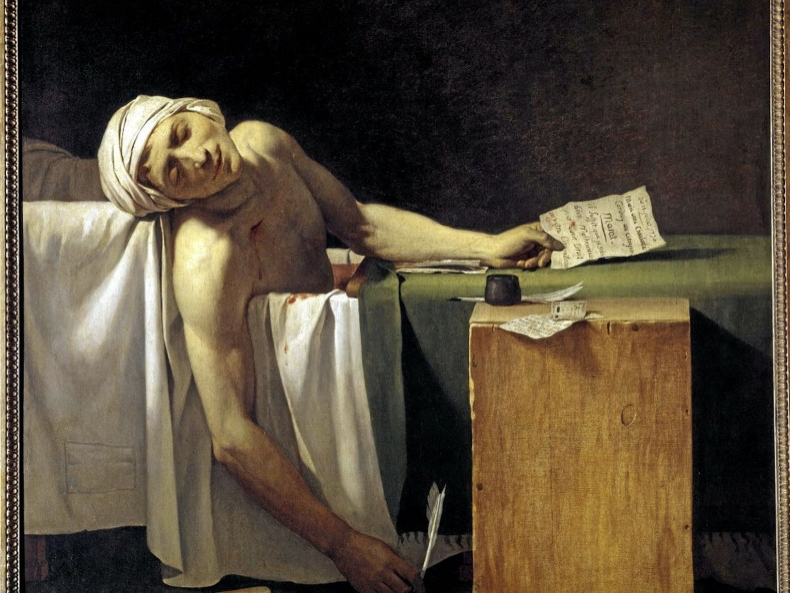
Painting of French revolutionary Marat, dead in his bathtub, David, Louvre museum
For The Death of Marat, by representing the violence of his assassination, Jacques-Louis David depicts Marat as a true martyr of freedom, a vulnerable yet heroic figure. The painting is undeniably impactful. However, it could only be seen by those who visited exhibition rooms. On top of that, the painting was hidden for years during David’s exile, further lessening its impact.
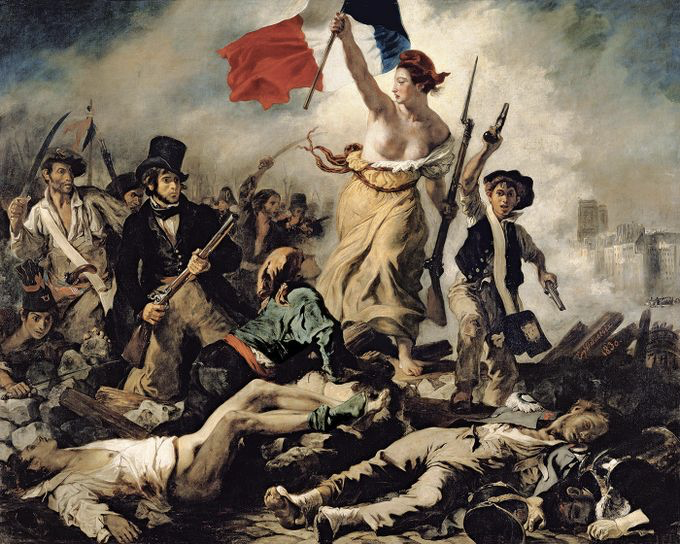
Painting of the allegory of Liberty leading the French people, Delacroix, Louvre museum
The historical context of Liberty Leading the People makes its political significance particularly striking: it represents the events following the July Revolution of 1830, which erupted after Charles X issued ordinances restricting press freedom and dissolving the Chamber of Deputies.
The painting is important both through the subject it represents, but also the way it represents it. The allegory of freedom is inspired by the Greek ideal (through its profile, the draping…) but is irrevocably contemporary, through its representation as a popular woman. Her dirty clothes, muscular body and visible body hair challenged conventional representations of beauty and made her appear closer to the ordinary people she led: what shocked the critics as too vulgar is what makes the message of the painting so universal. Liberty looks like the people she is leading, the people in their diversity: the youth, workers, craftsmen, gentlemen, farmers, students… all represented in the painting.
But here again, as striking as it might be, only one single original painting existed, not visible to all, only to those who visited the Musée du Luxembourg.
Although these paintings conveyed powerful political messages, their impact was partly limited by the conditions under which they could be seen. The development of the illustrated press progressively transformed these conditions, allowing images to be reproduced, and to circulate on a much larger scale.
As a result, images could reach wider audiences, and truly became a tool in the transmission of political ideas. At the beginning of the reign of Charles X, the number of Parisian newspaper readers was estimated at around 50 000. Less than a hundred years later, just before WW1, the number had multiplied by 10. Advances in printing technology made it possible to produce newspapers on a much larger scale, and therefore to sell them for as little as 5 cents. These innovations, coupled with the progressive end of censorship allowed for images to have an even stronger impact.
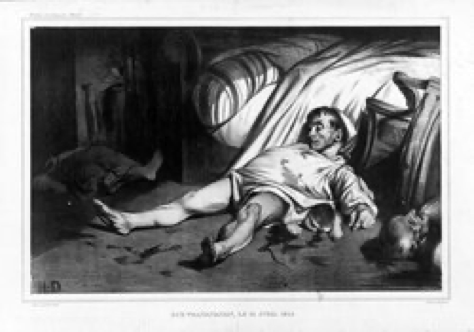
Lithography of a dead man lying on a bedroom floor
This is perfectly illustrated by Honoré Daumier’s lithograph Rue Transnonain, le 15 avril 1834, which depicts the aftermath of the massacre of civilians by the French army following a worker’s uprising. Published by the satirical newspaper l’Association mensuelle, the lithograph exposes the brutality of repression, by presenting the violence from the perspective of its victims, therefore transforming the image into a powerful denunciation of injustice. The technique of the lithograph and the development of the press allowed it to be printed massively, showing how newspapers could use images to inform the public, challenge political power, and give visibility to popular struggles. The lithograph ended up being seized by the authorities, proving the perceived political threat that such images can cause.
Witnessing the Revolution: photography and television during May 1968
With the development of photography and television in the 20th century, images could capture events right as they unfolded, bringing the reality of popular struggles ever closer. This transformation was particularly illustrated during May 1968, when photographs, television broadcasts and militant posters played a central role in documenting and shaping the movement.
The wider circulation of images allowed for the emergence of a true iconography of the movement, with logos, banners, placards, pins, stickers… Philippe Artières, in his book Banderole, Histoire d’un objet politique, describes the banner as something that “structures the protest, as it forms the skeleton around which participants will gather”. He explains how its graphic power is put at the service of the protesters.
In the second half of the 20th century, protesters, trade unions, and political organisations, develop a distinct visual identity for their social movement. This is partly due to the development of photography and television. Activist objects are now designed with cameras in mind: they are no longer just objects, but a part of a carefully constructed staging, a theatricalization. If the images are spectacular enough, the movement will get more attention, more recognition.
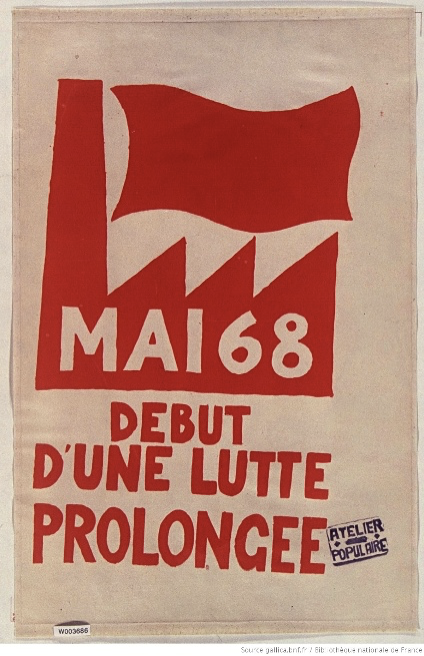
Screen print of a May 1968 slogan
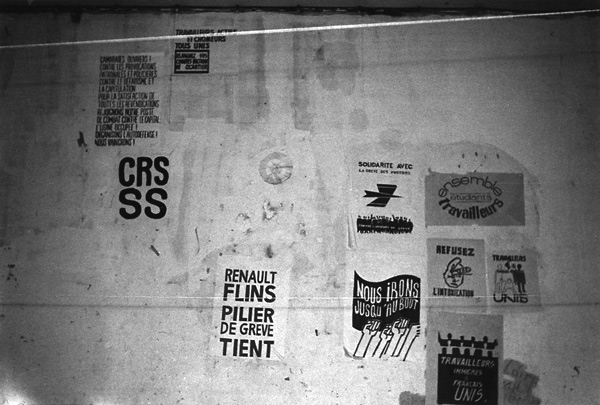
Picture of the wall collage of several may 1968 posters
sérigraphie, Atelier de l’École des beaux-arts – 1968 – BnF, Estampes et photographie École des beaux-arts : « CRS SS » Photographie, 13 x 9 cmBnF, département Philosophie, histoire, sciences de l’homme, Lb61-600 (Tracts mai 1968)
Protesters reused the same motifs on their placards, reproduced using processes such as silkscreen printing, contributing to their growing recognition. Simple, striking designs, similar colour palettes… these images were in the newspapers, on television, on people’s minds, and have even been reused in contemporary protests.
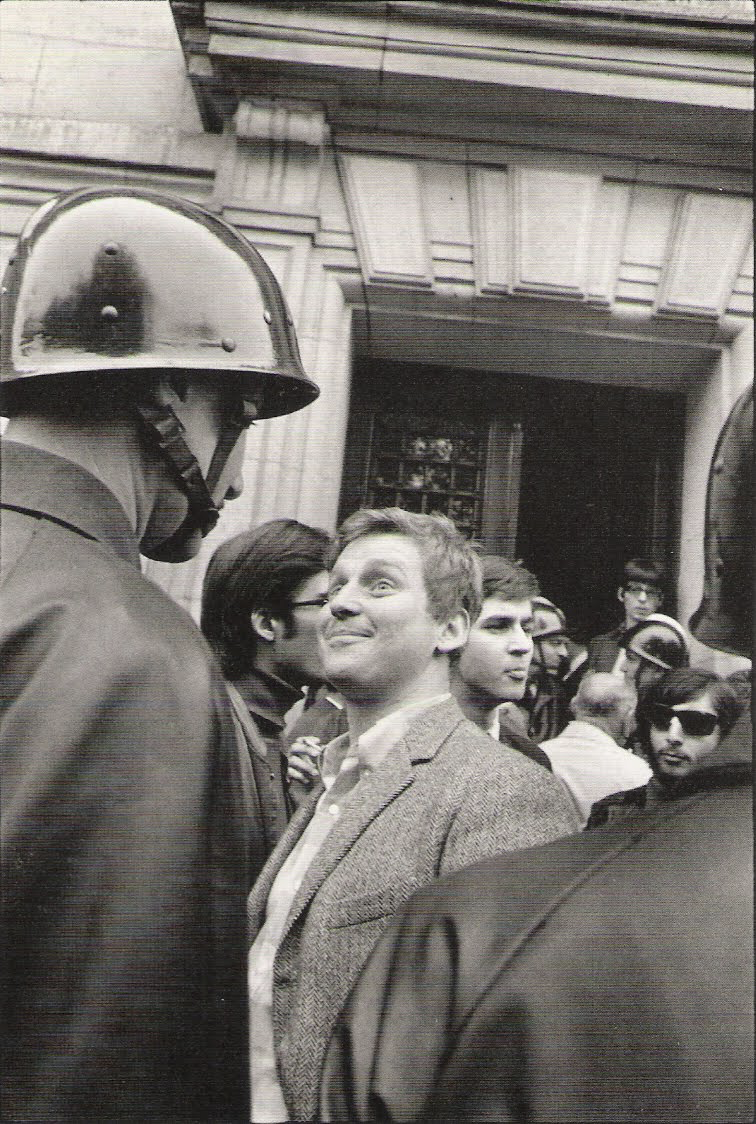
©Gilles Caron, Black and white picture of a smiling man facing a police officer
But the use of images during the May 1968 protests is also linked to photojournalism. Photographers such as Gilles Caron documented the demonstrations and confrontations, creating images that would become emblematic of the movement. His photograph of Daniel Cohn-Bendit facing a CRS officer in front of the Sorbonne is perhaps one of the most recognizable. The contrast between Cohn-Bendit’s relaxed, almost provocative smile and the imposing figure of the police officer creates a powerful visual representation of the confrontation between youth and authority, freedom and repression.
Although the image was not published in the mainstream press at the time, it gradually became one of the most iconic images of the protests through its successive republications and use in later commemorations.
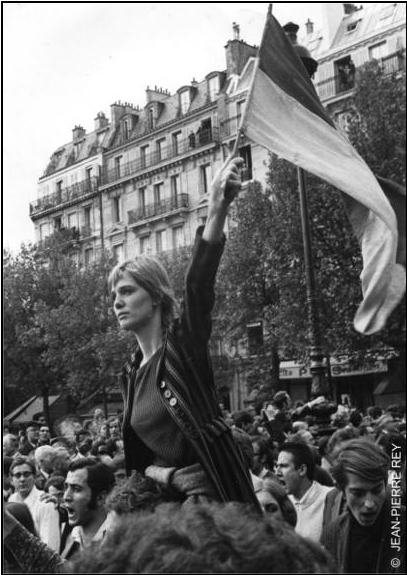
Jean Pierre Rey, Black and white picture of a young woman waving a flag
Other photographs offer different perspectives. Jean-Pierre Rey’s photograph known as La Marianne de Mai 68 depicts a young woman, standing on the shoulders of another protester, carrying a flag. Her posture, the flag and her position above the crowd remind the viewer of the allegorical figure of Marianne, also recalling Liberty Leading the People: in both cases, a woman holding a flag, leading a crowd, becomes a symbolic incarnation of a resistance movement.
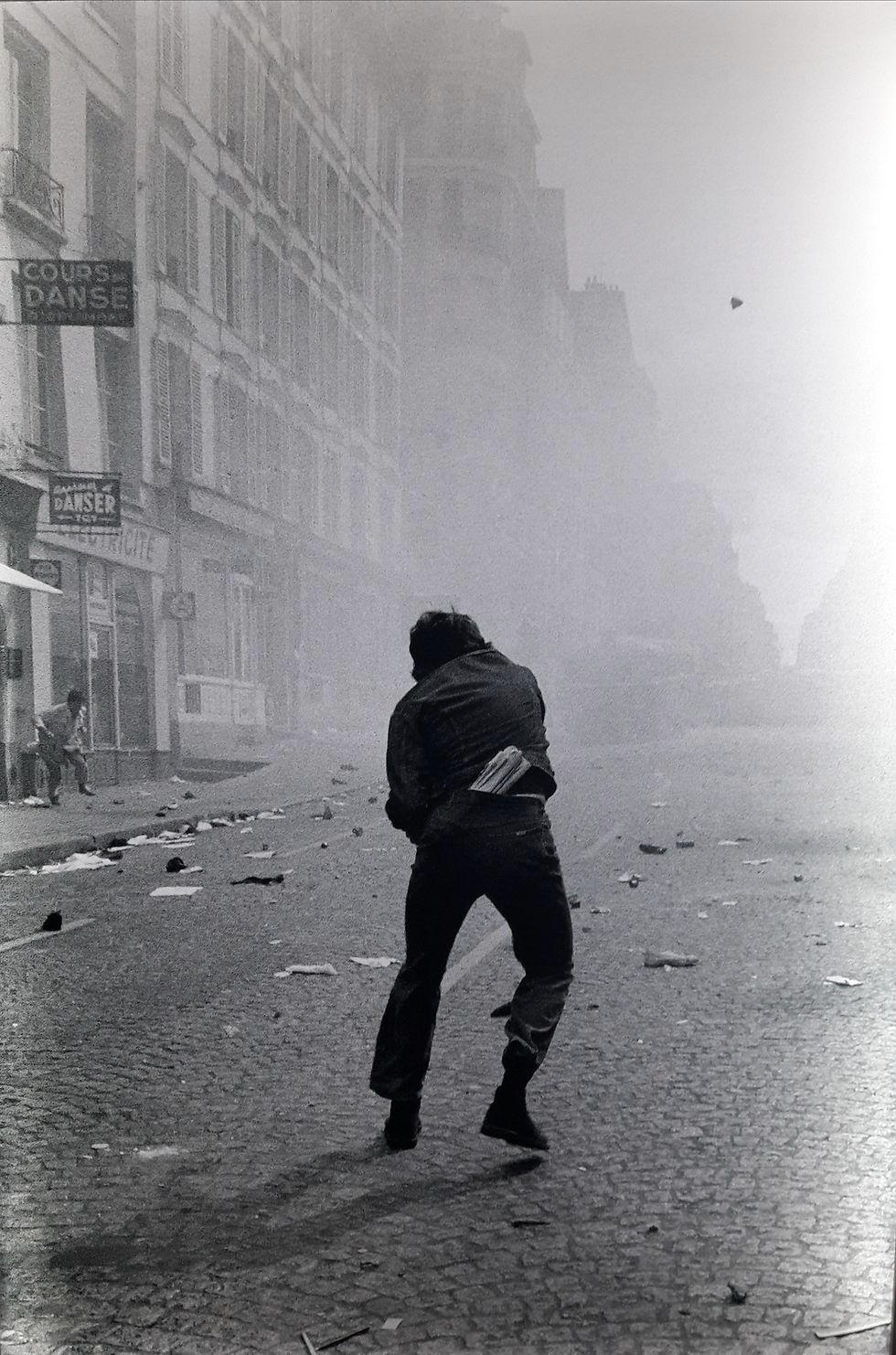
Gilles Caron, Black and white picture of a man running away
Meanwhile, Gilles Caron’s Student chased by a CRS offers a much more dramatic representation of the protests. Through the movement and composition of the photograph, Caron captures the vulnerability of protesters facing police violence. Unlike previous photographs, this image places the viewer in the middle of the confrontation.
Together, these photographs demonstrate how photojournalism contributed not only to documenting the protests, but also to constructing their visual identity, and shaping how the movement is remembered today. On top of that, the fact that pictures were taken in the middle of the protests helped make it more concrete in people’s minds, representing protesters as real human beings, and not just faceless, theoretical individuals.
Photography also helped document the everyday life of the movement, beyond the confrontations. Images of students preparing placards, participating in assemblies or creating posters in the popular workshops reveal the collective and organisational dimension of the protests. They show that popular struggles are not only defined by moments of confrontation, but also by the everyday efforts involved in building a movement.
However, the power of images is not only reflected in what they show, but also in what they leave out. During May 1968, the circulation of images was subject to different forms of censorship and editorial control. The French public television broadcaster, ORTF (Office de radiodiffusion-télévision française), was particularly criticised for its close ties to the government and its biased coverage of the events. A striking example was the television programme Panorama, which had prepared a report on the student movement but was prevented from broadcasting it on May 10, 1968, by government representatives.
Other images, although filmed by journalists, were excluded from news reports and remained largely unknown to the public. The French public didn’t see the images of the brutal police repression of May the 6th, nor the march of far-right party Front National Anticommuniste. Journalists captured all these events, knowing they wouldn’t be used as news, but that they would be a part of history.
The importance of images as historical records was recognised during the events themselves. As early as May 1968, curators of the Bibliothèque nationale de France (BnF) began collecting posters, placards, drawings and leaflets from demonstrations, universities and occupied factories. This initiative resulted in the preservation of nearly 400 posters and 15,000 leaflets. By collecting these ephemeral materials, the institution acknowledged their historical significance and ensured that the visual identity of the movement would not disappear with the end of the protests.
This demonstrates that images are not only tools of mobilisation in the present, but also essential documents for understanding and remembering popular struggles.
Ultimately, May 1968 demonstrates how the development of photography and television transformed the role of images in popular struggles, turning them into more immediate and widely circulated tools for documenting events, constructing a collective identity, challenging dominant narratives and shaping collective memory.
From protests to social media: images in contemporary student movements
In contemporary student movements, the development of social media has transformed both the production and circulation of protest images. Unlike during Mai 1968, protesters are no longer solely represented by journalists or traditional media. They can document and publish their own images in real time, gaining greater control over the representation of the protests. At the same time, the influence of Internet culture has given rise to new forms of visual expression through memes, placards, costumes…
Social media allows for the immediate and widespread circulation of images, without waiting for the work of accredited journalists, or the diffusion of a TV programme. On top of that, the number of people producing and sharing images has increased dramatically. In France, the 2026 high-schooler movement has been widely documented on social media, with students capturing the blocking of schools as well as the numerous protests that have taken over the country. This multiplication of images had resulted in a plurality of perspectives.
Protesters get to show the events from their own perspective, especially when they deem traditional media’s coverage doesn’t accurately reflect the events. A number of student representatives criticized the media coverage of the events, focusing solely on the violence, committed by outsiders. A video used by right-wing channel CNews to highlight the violence sparked outrage when it was revealed that it did not represent the French protests, but was filmed in Albany.
Protesters are feeling increasingly frustrated by the media representation, and political exploitation of these images, and are therefore taking matters into their own hands by showing the reality of the protests on social media. Images, videos, hashtags, stories… all allow the movement a visibility outside of the physical space of the demonstration.
These protests are also unique in the way they are influenced by the internet culture, which has become a true political language. Students demonstrate with colourful placards, referencing viral “memes”, repurposed to convey political messages. Many protesters also use humour as a communication strategy, thus making political demands more accessible, even though some raise the risk of simplification. Humour also helps to gain attention and virality.
The visual aspect of this movement echoes May 1968: screen printed placards were based on the repetition of simple and recognizable motifs. Nowadays, memes have a similar function, only with more contemporary references and a faster circulation.
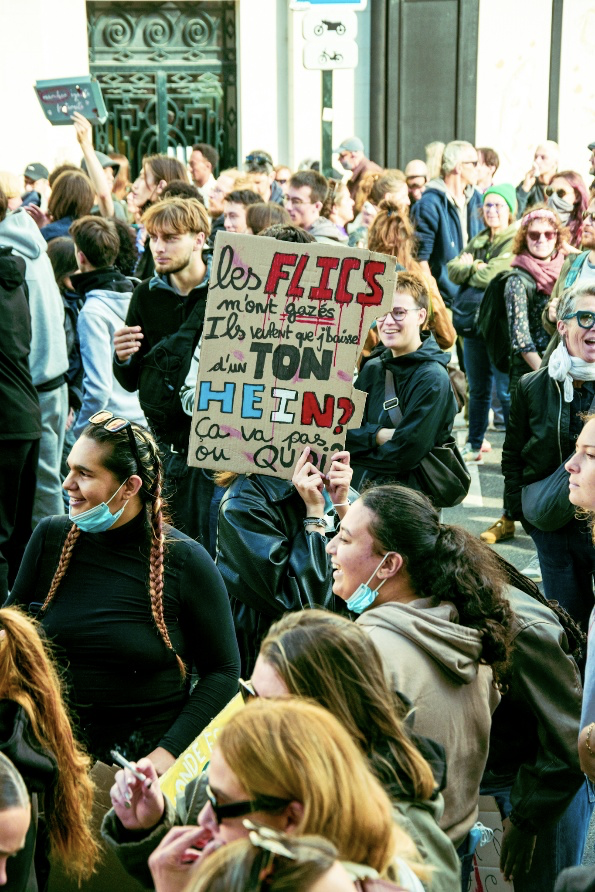
Dylan Arcila-Duque, Picture of a protest, showing a placard with writing
However, the accessibility of social-media-led communication also raises the question of control. Protesters get to share their own images, but not their diffusion or interpretation. The overwhelming volume of images circulating on social media also makes it more difficult to distinguish genuine images. Several images were later found to be AI generated, such as a picture of an elderly couple forced to strip by looters. When official TV channels share such images, the protesters’ distrust in the media can only be understood.
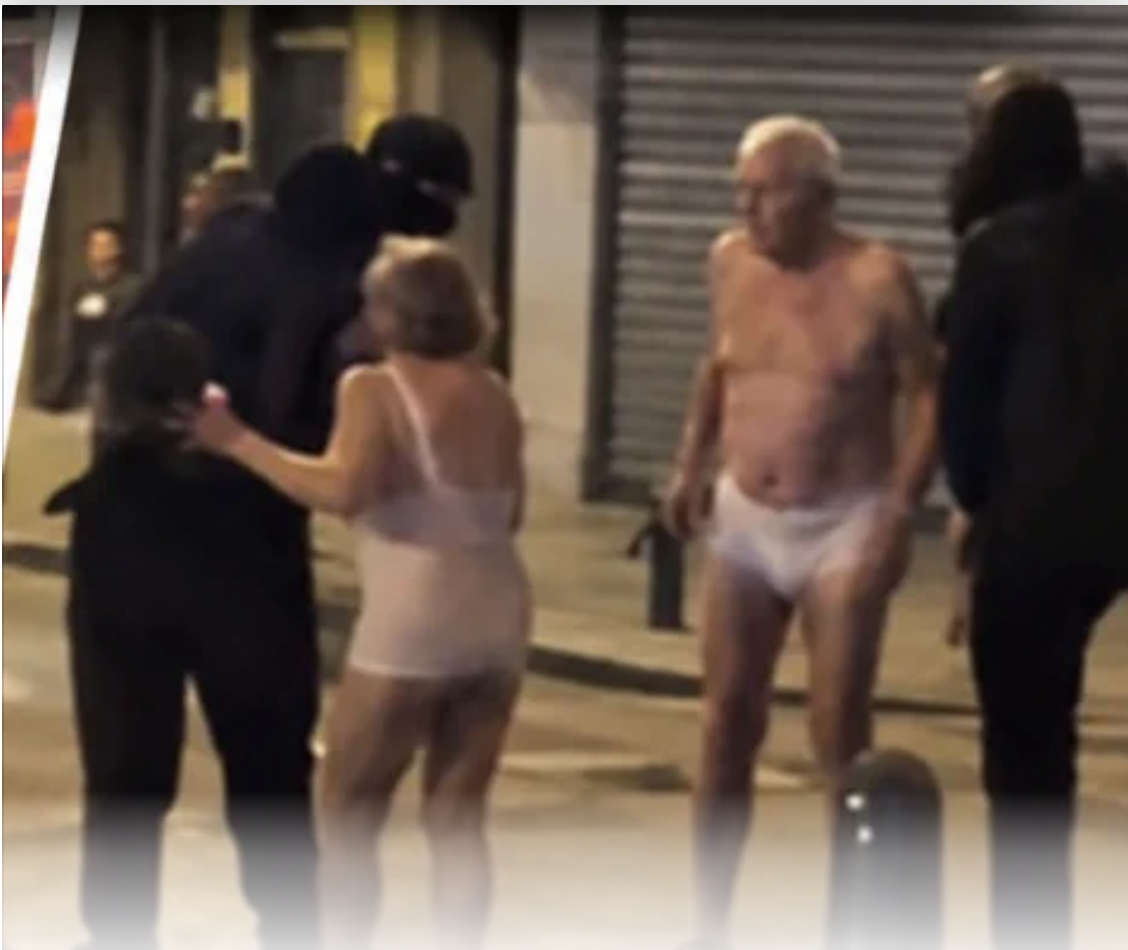
CAPTURE D’ECRAN / FRANCEINFO, AI generated image of an elderly couple being robbed
When looking at pictures of the protests, one can wonder which images are going to be this generation’s Liberty Leading the People, or Marianne de Mai 1968. Is it going to be the picture of the statue, Place de la République, wearing a yellow vest? Is it going to be students climbing over the Colonne de la Bastille? Is it going to be the orchestra playing in a cloud of tear gas in front of the Paris city hall, a Trojan horse built by art students, or a mayor putting himself between the students and the police? Some images may become symbols of a movement, while others may gradually disappear from collective memory. Ultimately, only time will tell which images will remain and come to embody these struggles for future generations.
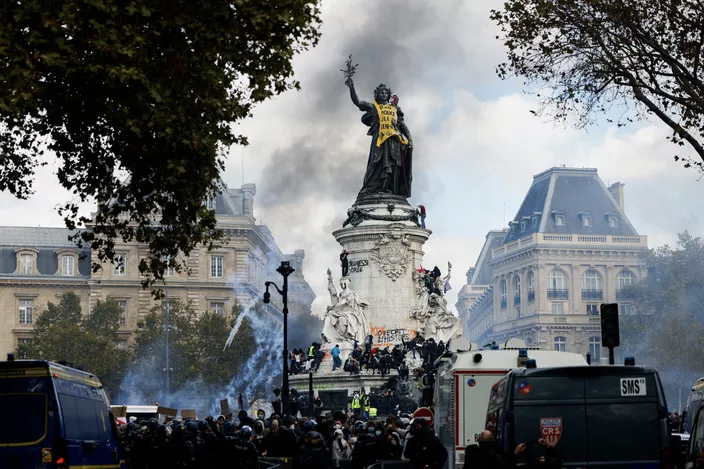
GEOFFROY VAN DER HASSELT / AFP, Picture of a statue wearing a yellow vest with writing
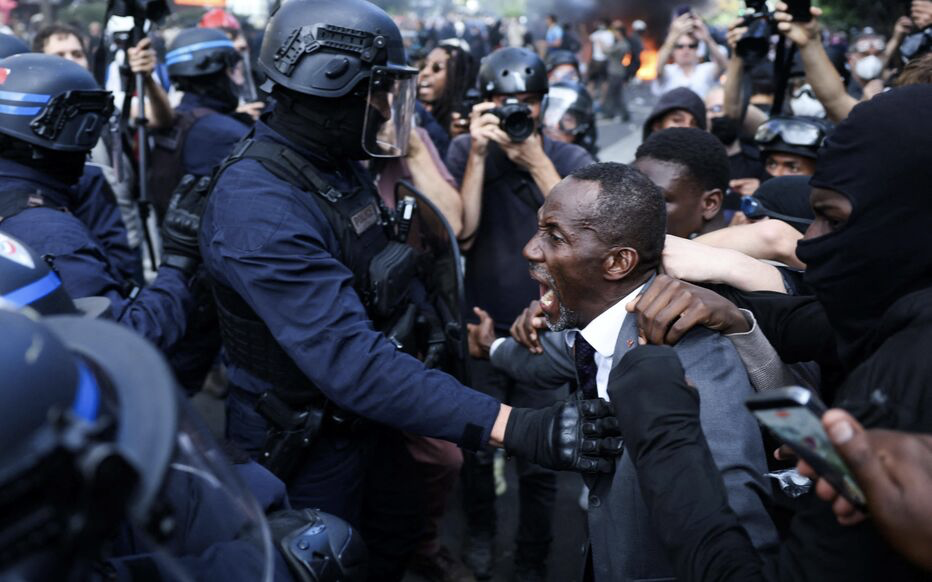
AFP/KENZO TRIBOUILLARD, Picture of a man putting himself between students and the police
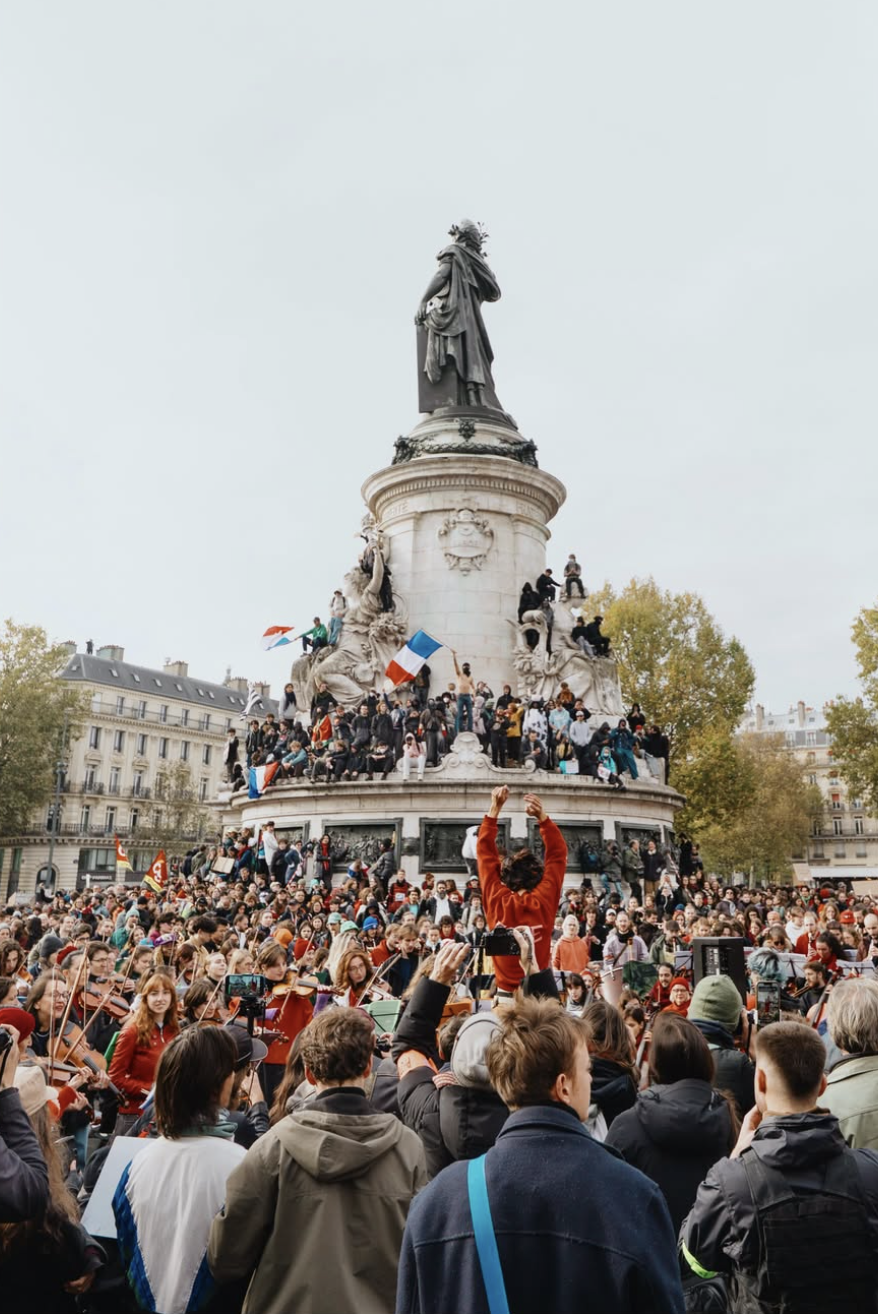
Remy El Sibaïe/@orchestre_du_nouveau_monde, Picture of an orchestra playing in the middle of a protest
written by Sarah
Webography:
Guerre des mots et des images : Lutte et représentations populaires (1831-1968) – Studocu
Faire l’histoire des objets militants sans les objets : les images de manifestation comme sources
Histoire visuelle de Mai 68: une construction médiatique et culturelle
dp_icones_mai_68.pdf
Les images censurées de Mai 68 | Lumni Enseignement
