I’ve always loved movies, but something that struck me is how little we actually talk about their posters. They’re everywhere, in cinemas, on walls, now mostly online, but we don’t really pay attention to them. And yet, those posters say a lot. They don’t just sell a film, they show how Hollywood plays with our desires, how culture changes with technology, and sometimes how fans are even more creative than studios themselves. Honestly, I feel like the real story of cinema might be hiding in plain sight, right there on the poster.
The Golden Age of Movie Posters
People call the 1910s to 1930s the golden age of movie posters. Not because Hollywood suddenly cared about art, but because they had no choice. Printing was expensive, colors were limited, and the poster had to catch someone’s attention from far away in the street. Designers had to do a lot with very little.
One of my favorites is Metropolis (1927). The artist Heinz Schulz-Neudamm didn’t just draw a robot with skyscrapers. He basically turned a whole idea of the future into a single image. Even if you had no clue about the plot, just walking past it, you knew this was about technology, myth, and pure awe.
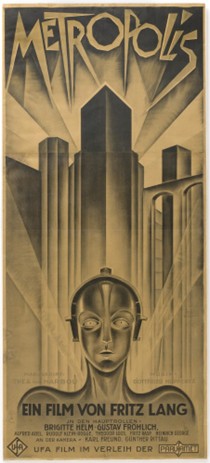
The original German three-sheet poster for Fritz Lang’s Metropolis (1927), designed by Heinz Schulz-Neudamm.
What I find funny is the paradox. These posters feel artistic not because the artists had unlimited freedom, but because they had less. No giant actors’ faces to put in, no lawyers telling them which star had to be bigger. They just had one mission: turn a film into a single powerful image. And because of that, I think that the posters were clearer, stronger.
I also realized this “one powerful image” thing didn’t look the same everywhere. Different countries solved the same problem with totally different tools: printing tech, censorship rules, even paper sizes.
German posters were about expressionism and geometry because theaters were competing in crowded city centers and posters had to shout from a distance, like the Metropolis one.
On the opposite, French affiches were painterly and theatrical. The market there liked romance, elegance, and poetic montage. Their posters came out of the “affiche” tradition (Mucha, Toulouse-Lautrec). Even for big films like Abel Gance’s Napoléon (1927), the posters had brushstrokes, romantic silhouettes and elegant typography. It is less about shock, more about style. Even when selling American films, French posters often reframed them with a lyrical vibe.
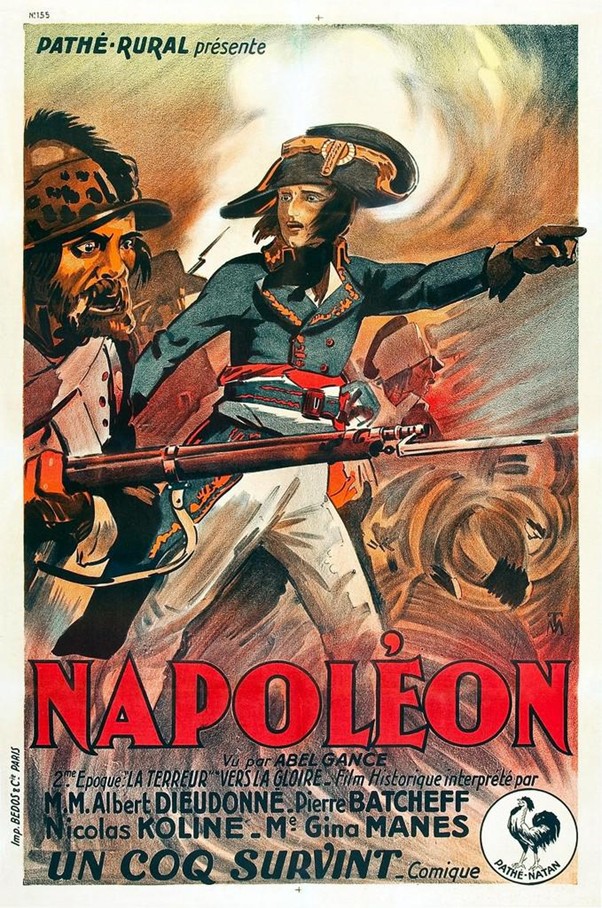
French movie poster for Abel Gance’s (1927).
And that’s maybe the real magic of this so-called golden age: each country translated cinema into its own language, but all of them were chasing the same goal : condensing an entire film into one single image. And I feel like, without knowing it, they were already doing marketing the way we think of it today. They created symbols. One poster, one picture, that represented a whole movie.
Saul Bass and the Psychology of Posters
If the golden age showed people what to desire, Saul Bass showed them how to feel. In the 1950s and 60s, his posters were super minimal, almost abstract. I think that’s what makes them so powerful. He wasn’t trying to explain the story, he just wanted you to feel something before even watching the film.
That’s what fascinates me about him. Instead of selling you the plot, Bass sold you an emotion. His posters were basically asking: what should you feel when you walk into the theater? Should you be anxious, paranoid, obsessed? He designed the psychology of cinema.
My favorite example is Vertigo (1958) : the spiral swallowing two tiny figures (no actors). Just this one image that already makes you feel dizzy and uneasy, just like Hitchcock’s film. I think that’s genius. People often call it one of the best posters ever made, and I agree. It doesn’t give you information, it sets the mood in your head.
He could take a whole film and reduce it to one unforgettable sign. The torn body in Anatomy of a Murder (1959), the little running man in North by Northwest (1959)… They’re like logos. And it makes sense, because Bass also designed real logos for companies. He knew exactly how to make shapes stick in your memory. He proved a poster could be both art and advertising.
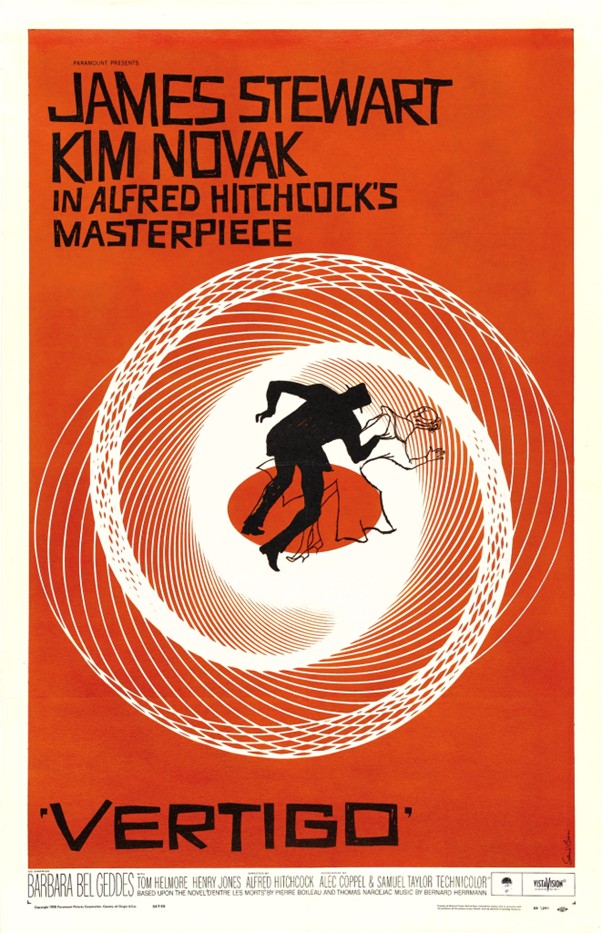
The 1958 movie poster for Alfred Hitchcock’s Vertigo, designed by Saul Bass
And what’s interesting is that he wasn’t alone. In the same period and until the 80’s in Poland, designers were reinventing posters too, but for totally different reasons. Poland often didn’t license US studio art, so designers had to reinvent imported films from scratch, it created interpretation.
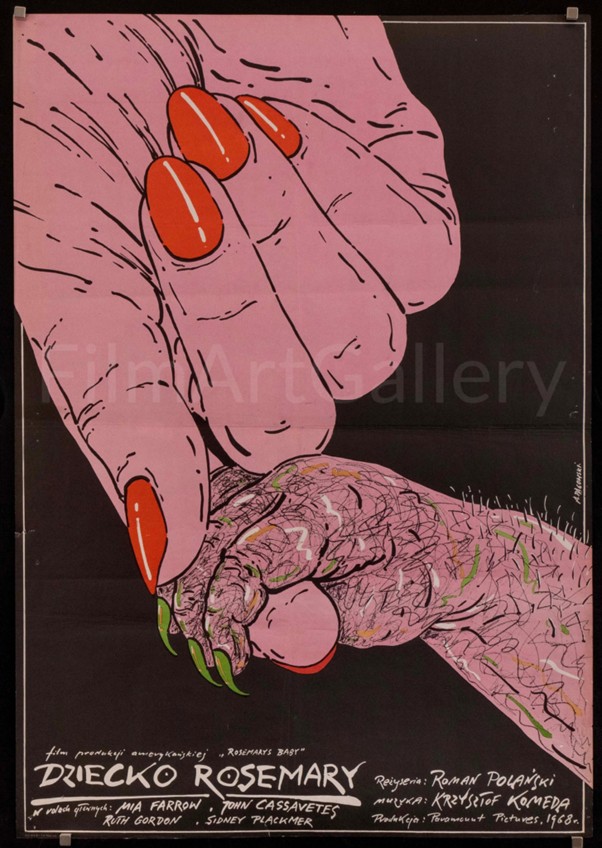
The 1968 Polish poster for Roman Polanski’s Rosemary’s Baby, designed by Andrzej Klimowski
But if the 50s and 60s proved a poster could still be art, the decades that followed went in the other direction. By the 1990s, the artist had lost control, and the stars’ faces had taken over.
The Rise of the “Floating Heads”
By the 1990s, posters had a new boss: not the illustrator, not even the designer, but the stars themselves. The studio played it safe by focusing on what sold best: famous faces. That’s how we got the formula we all know today : big heads lined up, glowing against an orange-and-blue background, sometimes with sparks or explosions just to fill the space.
Critics call this the Photoshop era. Not really because of the software, but because of the laziness it made possible. I feel like a poster could be built like a PowerPoint slide: drag, drop, align. It started to look like a template.
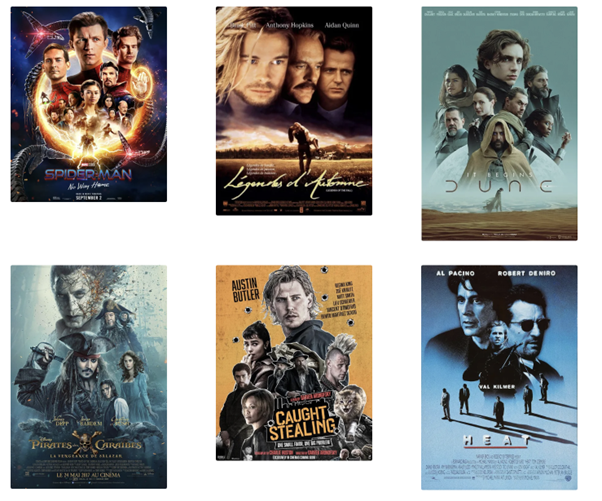
A set of six promotional posters, illustrating the “floating heads”poster design style.
So, these clichés were tested to work all over the world. Fireballs, blue glows, serious expressions means action everywhere, no matter the culture. So subtlety disappeared. What mattered is that anyone could “read” the poster instantly, even at thumbnail size.
Sadly, it worked, because a face is the easiest thing to recognize. There’s this idea from the sociologist Richard Dyer : stars are like “texts”, people already project meanings onto them. So, smartly, the floating heads formula took that literally. The poster didn’t interpret the film anymore, it just showed a catalogue of actors with ready-made meanings attached to them.
And it was efficient. If you only swap faces, you can keep the same layout : Harry Potter, Spider-Man, Pirates of the Caribbean, Dune…
But I truly feel like something got lost. That’s why I imagined (thanks to AI) Saul Bass’s Vertigo. Instead of the hypnotic spiral, you’d get James Stewart and Kim Novak staring seriously over San Francisco Bay, in teal and orange. It tells you who is in the movie, but not what the movie feels like.
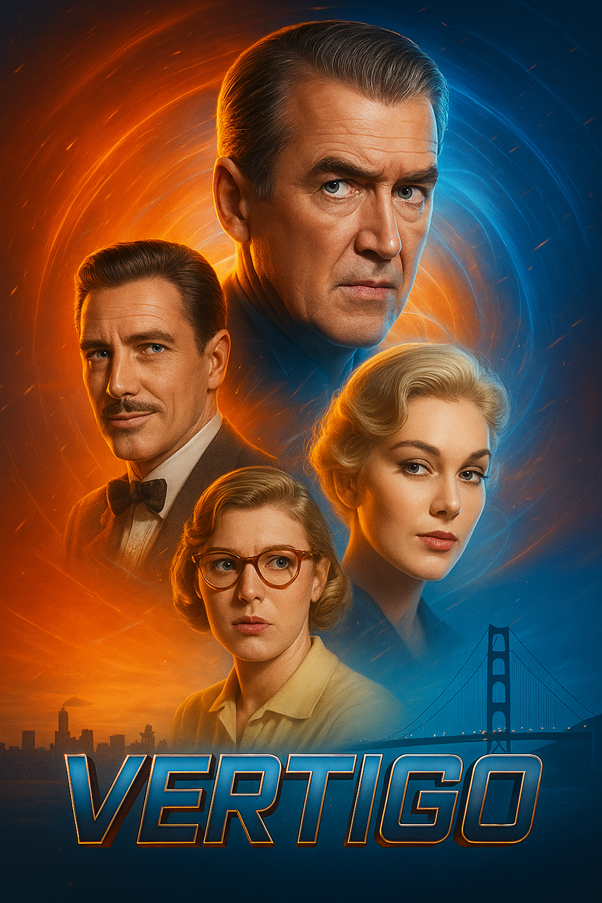
AI-generated reinterpretation of Alfred Hitchcock’s Vertigo (1958), redesigned in the modern “floating heads” formula.
That’s the tragedy, I think. Posters stopped being interpretations. They didn’t make you wonder or dream anymore. They just reassured you : “Don’t worry, you know exactly what you’re getting.” Desire was replaced by recognition.
For me, the floating heads formula marks a big shift. Posters went from being a creative lens on the story to being proof of who got paid to be in it.
Movie Posters in the Age of Algorithms
Since 2020, posters have a new boss: the algorithm. On Netflix, Disney+, or Amazon Prime, a poster isn’t really a poster anymore : it’s a tiny thumbnail, fighting for attention on a crowded screen. So what works are giant faces, bold colors, and titles you can read instantly on a phone screen.
But I think that the craziest part is that studios don’t even guess what works anymore, they test it. Streaming platforms run A/B experiments all the time : does a red background get more clicks than a blue one? Does showing the star’s face work better than showing the group? The real designer of posters today isn’t the artist : it’s the algorithm. Every choice, from color to composition, is data-driven, and is constantly shaping what we end up clickin on.
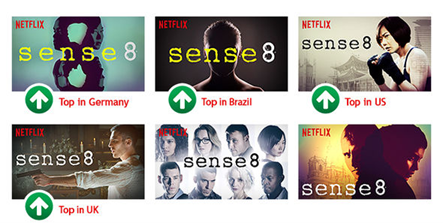
The 2015 Netflix thumbnails for Sense8, highlighting regional variations in viewer engagement.
But what really blows my mind is that two people might not even see the same poster for the same film : one person might get the romance version, another gets the action version, all based on what the platform thinks will make them press play. The poster doesn’t just advertise the movie anymore, it advertises a version of the movie that’s tailored to you.
That’s why so many posters today feel interchangeable. They’re not designed to surprise, but to conform, and it’s all about playing it safe. In marketing theory that’s called risk minimization. Because when failure is expensive, studios prefer sameness over difference. So where the poster used to be a space of invention, it is now like a standardized product.
But I’m a hopeful person, and I feel like if we look well we can find some films that prove that a bold poster can work. For exemple, Parasite (2019) used those eerie black censor bars across the characters’ eyes. Everything Everywhere All At Once (2022) went completely over the top, with a chaotic collage that felt like the movie itself. And The Lobster (2015) had Colin Farrell hugging empty air which captured the film’s absurd mood in one shot. None of these relied on floating heads or explosions, it was about curiosity, mystery, discomfort. And they worked.
There’s this idea that I like a lot, from scholar Jonathan Gray : posters and trailers shape our expectations as much as the films themselves. I think that’s so true, for example, before you even saw Parasite, those censor bars had already framed it as a story about class, and censorship. The poster became part of the cultural meaning of the film.
And outside Hollywood, posters are still alive in other ways. On Letterboxd, for example, film fans can choose alternative designs for their profiles (festival versions, vintage ones…). But there is also fan-arts, and some of those fan-made posters even spread further than the official ones, and collectors buy limited runs from studios like Mondo that sell out instantly, treated like art prints instead of ads (As I feel it should be, art).
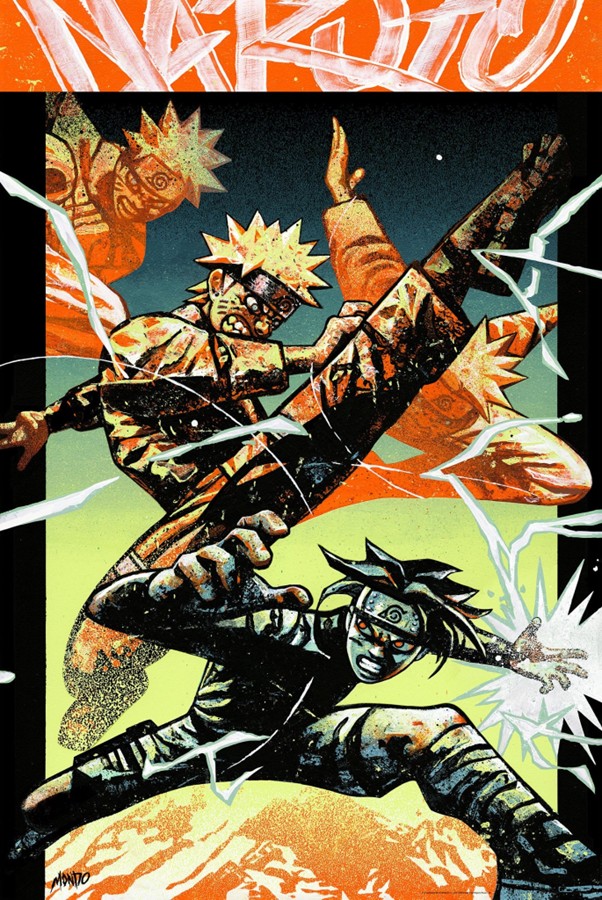
A 2023 Mondo poster for Masashi Kishimoto’s Naruto, illustrated by Gian Galang
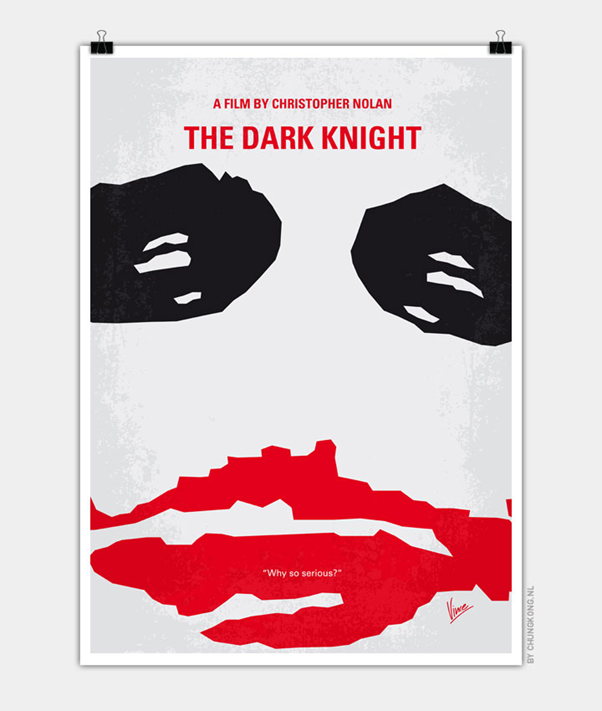
The 2008 minimal poster for Christopher Nolan’s The Dark Knight, designed by Chungkong
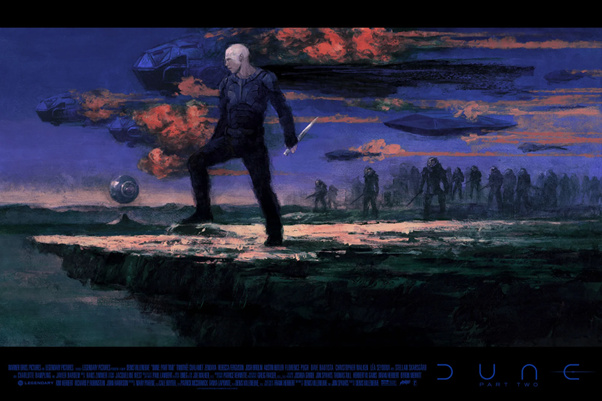
The 2024 Mondo poster for Denis Villeneuve’s Dune: Part Two, illustrated by Hans Woody.
So yes, the algorithm has made most official posters feel the same. But in the margins, in fan culture and alternative art, the poster is still experimenting, still surprising. To me, that’s a good reminder : a poster doesn’t have to be just marketing. It can still be something we desire for itself…
A poster is not just an ad, it’s the very first image of a movie that you’ll carry in your head before the lights go down. It can shape the way you watch the story, sometimes even more than the trailer or the reviews.
And maybe that’s why I care so much about them. I never watch trailers, I never read reviews before going to the cinema, so the poster is the only thing I allow myself. It’s the very single image that, for me, sets the mood and the expectation.
For me, the movie always begins long before the opening scene : it begins with its poster.
Author: Camille Caye
