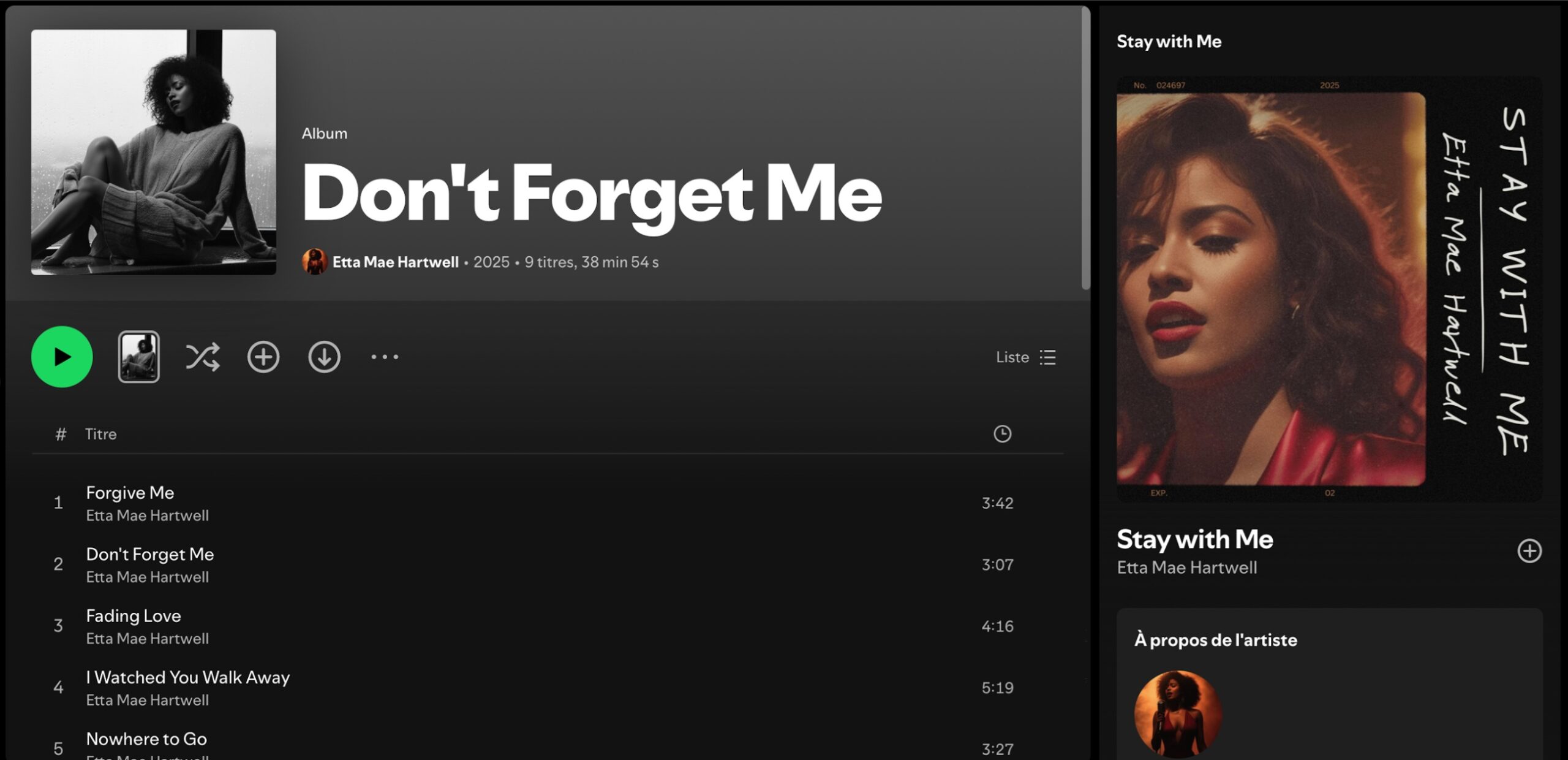
If you arrive on Etta Mae Hartwell’s page on Spotify and listen to a few songs, you have every reason to believe she is a talented living young artist. In her description, it says she sings her own stories with emotion and resilience. Some songs even have the label « (Live Session) ». But when you dig just a little deeper, you notice that the names of her songs are very cheesy and basic and all her works — 5 albums and a single — are from 2025. Impossible you will tell me? Indeed… for a human being.
In fact, Etta Mae Hartwell is an AI generated artist, like there are thousands on Spotify. If you use the platform, you probably listen to AI generated artists every day without even knowing it. And that is problematic.
Generative AI is impacting artists and the music industry harder than we might think, and it is urgent to act to keep pace with innovation in terms of information, protection and regulation.
An incredible revolution, making the music listening experience simpler
Artificial intelligence offers music platforms users unprecedented personalization possibilities. Algorithms analyze every song users listen to — the tempo, the mood, the genre, the frequency it is listened to, etc. — to suggest songs they might like or offer them personalized playlists, such as « Discover Weekly » or « Release Radar » on Spotify. They are like Virtual DJs that adapt the selection to the listener’s tastes, making the experience effortless, smoother and allowing them to easily discover artists that match their tastes. Although this seems great at first, these algorithms enclose people in their existing tastes and habits and do not encourage broader discovery and exploration, creating a « musical bubble » from which it is hard to escape.
The emergence of these algorithms is explained by music platforms’ business model and the fact that they seek profit through streams and duration of listening with advertisement and paid subscriptions.
Important impacts on music-related professions
Algorithms have allowed smaller artists to reach a new audience, but this comes with a great risk of dependence on the algorithm: artists must please it to be visible and thus find new listeners or keep theirs. They often have to make sacrifices to survive and feel limited, since it leaves them less room for creativity and experimentation. We are therefore witnessing a standardization of the format of tracks posted on streaming platforms, with notably shorter songs and intros. Moreover, as mentioned earlier, artists outside the sphere of a listener’s « tastes » have fewer chances of being recommended to them, making it harder to reach a not-yet-convinced audience and thus to grow.
AI tools have allowed artists to create more easily and thus faster. They can now create with fewer resources, making music making even more accessible than it has been since the revolution brought by DAWs (Digital Audio Workstations, softwares like FL Studio or Ableton). With the simplification of some processes, AI has enabled newcomers to start creating music faster and even create whole tracks through prompts with generative AIs.
There are indeed two types of use of AI in music creation: Assistance in the creative process vs. fully automated prompt-to-output applications. The first option is when a producer uses AI tools to help them create a track they are working on, but they still follow the process of creating it themselves (with control over the arrangement and the position of each element, the effects, etc.). With the latter, people don’t even need to be artists or know anything about music production to fully generate a song with AI. These models, such as Suno or Udio, are impressive: They can generate any genre of music from a textual description and can even recreate specific lyrics and moods. Music producers must now compete with these AI generated songs and find ways to stay creative but relevant. In the 2025 study on AI generated music conducted by Deezer and Ipsos on 9000 adults, they have found that 97% of people cannot tell apart an AI generated track and one created by a human, which is fascinating but also terrifying. In the end, I think these challenges make artists’ life more difficult than it simplifies it. It puts a toll on all artists and threatens their subsistence in the long run. According to the PMP Strategy/CISAC study published in November 2024 on the economic impact of AI in music and audiovisual industries, under current conditions, this market penetration by generative AI outputs could put 24% of music creators’ revenues at risk by 2028 (10 billion €).
Other professions are also affected by these changes: more traditional jobs risk being replaced, like music curators and radio programmers. The independent radio NTS was precisely created to counter this trend. Their selling point? The music played is carefully chosen by humans, not algorithms, creating an authentic and thoughtful journey.
Data analysts, AI specialists and sound engineers, on the other hand, are of growing importance. So, AI rearranges the existing narrative and order while creating new opportunities for people outside the creative industries. But what about those people whose job disappeared?
Can we still talk about « artistic creation »?
Sure, AI tools have opened creativity to people without any musical or technical training and have facilitated experimentation. Artists can explore new sounds and new styles easily and even produce other types of content, such as adaptive or interactive music. For artists from other fields like the audiovisual sector, generative AI is finally a budget-friendly option to experiment with sounds that match the mood of their visuals before committing to hiring a composer (if they do).
Artistic possibilities and freedom are quickly limited because of how algorithms work, dictating the survival of the artists. There is less room for originality, slow development, or complex structures. All tracks merge into a uniform ensemble.
The market is furthermore flooded with cheap AI-generated tracks. Cheap because they cost almost nothing to produce or acquire and because they are empty of emotions, intention, meaning — of humanity overall. They are omnipresent in B2B situations and in advertising. They are also saturating streaming platforms with enormous amounts of content daily, and it is growing at a fast pace. According to the Deezer and Ipsos study mentioned earlier, 18% of all tracks on Deezer were AI-generated in June 2025 for a total of 20,000 new tracks every day, already rising to 34% in November 2025 with 40,000 new songs per day. It is insane.
This has a crucial impact on the quality of what is listened to on streaming platforms and the overall experience of music listening. It leaves almost no room for originality, since AI creates from what already exists. Even though they combine multiple sources to create something new (not always), no original creations can come from generative AIs. It is already a shared feeling: According to the same Deezer study, people generally agree with the fact that AI will only generate more generic songs and of weaker quality (51%) and think that AI could lead to a loss of creativity in music production (64%).
AI can indeed generate a song with a nice arrangement, but also a lack of coherence throughout the whole track. Without meaning, intention or emotions, there is no real artistic creation per se. Yet, an artist’s objective is to translate their emotions through their work, make people feel a certain way, share and connect with the audience this way. This is one purpose of art. So, for me, we cannot refer to AI generated musicians as « artists ».
But if in reality most do not make the difference between an AI generated track and one created by a human, why bother taking the time to learn music production and produce songs if you can be successful and earn money thanks to AI generated ones? We can take the example of the fictional rock band The Velvet Sundown, which has accumulated more than one million streams on Spotify in just a few weeks and released three albums in less than a year. This is beyond competition for human producers and without any warning stating that they are AI generated, it should be considered as unfair competition. It thus raises the following question: Do we still decide what we listen to today? Spotify was recently accused of filling its playlists with « ghost artists » by buying sounds from a sound bank and attribute them to non-existing artists, all because it is cheaper than paying royalties to existing artists. They denied the allegation, but we can still observe the phenomenon on the platform, without any mention of AI whatsoever.
Take a listen to The Velvet Sundown – Rivers Run Free:
There is a clear lack of regulation concerning AI
A clear labelling of AI generated content is needed on music streaming platforms, like it is the case on other platforms such as Instagram. According to the same Deezer study, most people are asking for it (80%). They indeed want to know whether they are listening to a real artist or a ghost one. Deezer has been a pioneer in this field: It is the first streaming platform to have developed a system to detect AI generated songs and label them as such. Alexis Lanternier, CEO of Deezer, said: « Deezer has been avant-garde regarding the implementation of solutions that guarantee transparency and limit the negative impact of the influx of fully AI generated content in music streaming. »
One major challenge with AI is the respect of copyrights in the way they are trained. As we discussed, AI models do not invent anything new, they find inspiration from existing works. The regulatory framework around AI is vastly still in progress if not non-existent and heterogeneous across regions. Although innovation moves fast and AI models have evolved very quickly, regulations always take more time to be implemented. But there is a real need for it. Right now, AI models are trained from copyrighted works without the consent of the artists or third parties involved (labels, etc.). It is highly unethical to do so and companies should not be able to, as 65% of the respondents of the Deezer study agree. Artists should clearly be better protected.
Regarding the defense of artists and creators, Deezer is leading the way. It is currently the only platform to have signed the international Statement on AI training, which states that “The unlicensed use of creative works for training generative AI is a major, unjust threat to the livelihoods of the people behind those works, and must not be permitted.” Some labels are also speaking out, like the independent label IDOL, which refuses the use of the works possessed or controlled by them for AI training purposes without their explicit consent.
A landmark copyright ruling against OpenAI was delivered in Germany in November by the Regional Court of Munich concerning lyrics from well-known German songs that could be generated through ChatGPT. The court stated that the use of copyrighted song lyrics for training generative AI models without a licence violates German copyright law. For the first time in Europe, these questions are being addressed directly, showing the way forward for implementing regulations concerning AIs’ use and training and holding the companies releasing these models accountable for any law infringement.
AI is weakening culture altogether
A few major streaming platforms — Spotify, Deezer, Apple Music — control the whole market and influence what society listens to. These private companies have a central role in the music industry and create an oligopoly, but their capitalistic approach is often not in favor of the artists. This is especially true for Spotify.
With the algorithmization of streaming platforms and the development of playlists classified by genre or mood, we lost the experience of the album as a coherent artistic work, a journey to follow in the right order. Songs are taken individually, losing part of the intention the artist has put inside it.
In a way, streaming platforms and their algorithms, by enabling instant access to songs from all over the world, encourage diversity in the listening experience (up to a certain point as we saw with algorithms). Music is now tailored to every moment of someone’s life, classified by mood. But music then becomes a background noise, something we listen to all the time without paying attention to it. It is not listened to anymore; it is heard at best. Spotify’s founder Daniel Ek has stated that their biggest competitor was silence, and that says a lot. We can thus wonder: Has music become too accessible? With new releases every Friday and new songs being published constantly, Terrence Nguea, music producer, feels like there is « too much music and we always have to quickly move on to something else ».
For me, this is representative of our current society: users’ passive listening reflects people’s passivity in everyday life due to smartphones, social media and algorithms. Attention span is significantly dropping, with a constant need of new stimulation. People are always looking for the next thing to do, watch or listen to, and are always multitasking, never fully focusing on one thing such as listening to a song. I hope this article aroused your curiosity concerning AI generated music and called into question your music listening habits, so you will try to pay more attention to what you listen to and give back meaning to songs.
Written by Laura Vurpillot
Sources:
Faut-il réapprendre à écouter de la musique ? | Tracks | ARTE (October 6th 2025)
Deezer (November 12th 2025). Étude Deezer/Ipsos : 97 % des personnes sont incapables de faire la différence entre une musique entièrement générée par l’IA et une musique créée par des humains. Deezer Newsroom.
Deezer (June 20th 2025). Deezer déploie le premier système d’étiquetage IA au monde pour le streaming musical. Deezer Newsroom.
AI-Generated Band With 1M Spotify Fans Reveals Its Origin (July 9th 2025). Romania Journal.
https://www.romaniajournal.ro/spare-time/ai-generated-band-with-1m-spotify-fans-reveals-its-origin
PMP Strategy/CISAC study on the economic impact of AI in music and audiovisual industries (November 2024)
https://www.cisac.org/services/reports-and-research/cisacpmp-strategy-ai-study
International statement on AI training
https://www.aitrainingstatement.org
Florian Reynaud (August 3rd 2025). Comment les faux groupes générés par IA déferlent sur la musique, de YouTube à Spotify. Le Monde.
Ronak Kalhor-Witzel (November 17 2025). Germany delivers landmark copyright ruling against OpenAI: What it means for AI and IP. Inside Tech Law.