Reserved for Buddhist seals and images for centuries, ukiyo-e is a genre of Japanese art that emerged and flourished from the 17th through 19th centuries. The term ukiyo-e translates as “picture of the floating world”. Produced on woodblock prints, its artists represented subjects as female beauties; kabuki actors and sumo wrestlers; scenes from history and folk tales; travel scenes and landscapes; flora and fauna; and erotica.
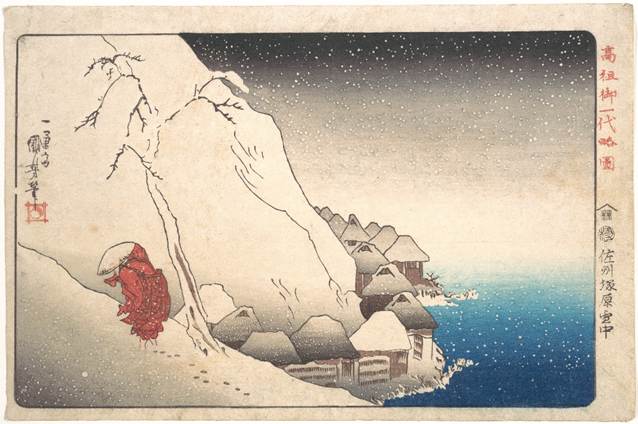
Utagawa Kuniyoshi, Monk Nichiren in Exile on Sado Island, Art Institute of Chicago
Short history of ukiyo-e
In the 17th century, Japanese woodblock print grew more popular in the chōnin class (merchants, craftsmen and workers) who had become wealthy enough to afford to decorate their home. The earliest ukiyo-e artists started in the world of Japanese painting, inspired from yamato-e style to outline forms which allowed inks to be dripped on a wet surface and spread out towards the outlines.
In response to the increasing demand for ukiyo-e works, the first ukiyo-e woodblock prints were produced by Hishikawa Moronobu (1618-1694). The success led the artist to begin signing his work. He produced illustrations, not just for books, but as single-sheet images, which could stand alone or be used as part of a series.
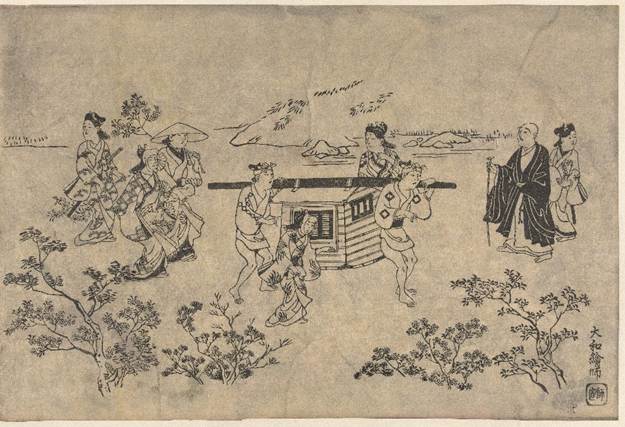
Hishikawa Moronobu, Traveling party, Rijskmuseum
At first, the prints were monochromatic and colours were gradually introduced but used only for special commissions in the beginning. Using colours became standard with the success of Suzuki Harunobu’s (1724-1770) brocade prints in the 1760s. Adding colours to prints means carving a different shape on wood for each colour and then various version of the same print can exist with variation of colour. Usually, woodblocks for printing were not carved by artists, the production was divided between four actors:
- the artist, who designed the prints;
- the carver, who cut the woodblocks;
- the printer, who inked and pressed the woodblocks onto handmade paper;
- the publisher, who financed, promoted, and distributed the works.
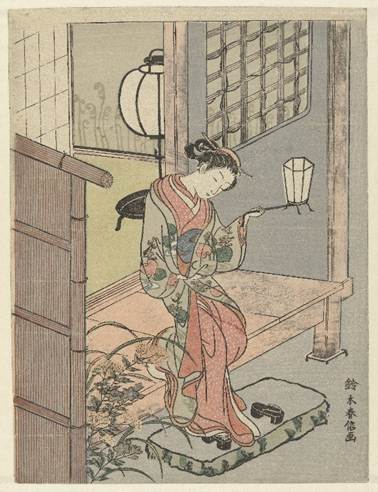
Suzuki Harunobu, Young Lady with lantern, Rijskmuseum
Between the 18th century and the 19th century, numerous masters of ukiyo-e created portraits, landscapes. For example, some of the most well-known works of this Japanese art are the series of woodblock prints The Great Wave off Kanagawa by Katsushika Hokusai (1760-1849) and The Fifty-three Stations of the Tōkaidō by Utagawa Hiroshige (1797-1858). These two masters are central in the perception of Japanese art by the West and the trend of Japonisme became prominent and had an influence on early French Impressionists such as Edgar Degas, Édouard Manet and Claude Monet, as well as influencing Post-Impressionists such as Vincent van Gogh and Henri de Toulouse-Lautrec.
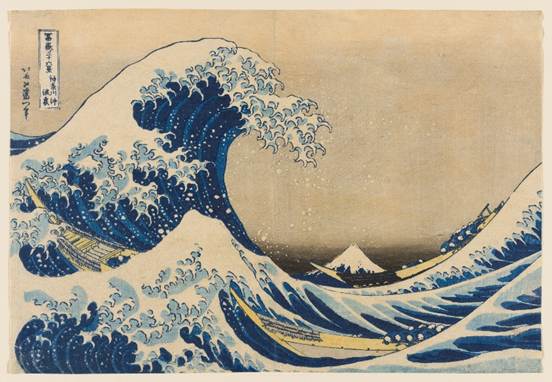
Katsushika Hokusai, The Great Wave off Kanagawa, Rijskmuseum
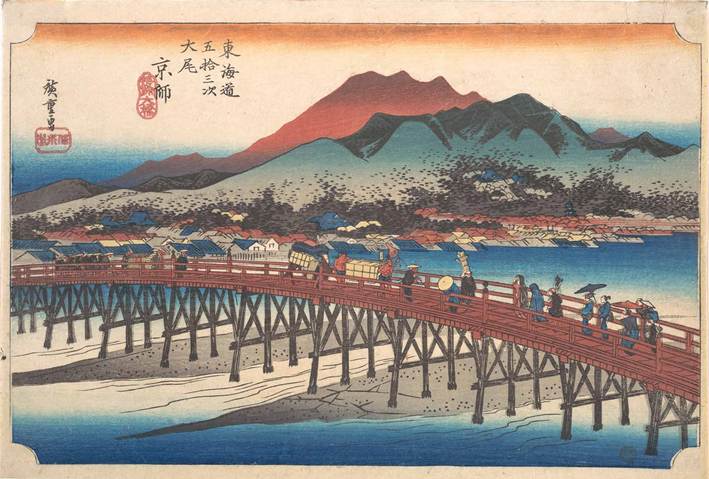
Utagawa Hiroshige, The Great Bridge at Sanjō, from the series Fifty-Three Stations of the Tōkaidō, The Metropolitan Museum of Art
After the deaths of these two masters and due to the technological and social modernization that followed the Meiji Restoration of 1868, this art declined. But, in the 20th century, the shin-hanga (“new prints”) and sōsaku-hanga (“creative prints”) revived Japanese printmaking. One of the most famous artist of this time is Kawase Hasui (1883-1957).
Sometimes the same name comes back between two Japanese artists. This is often a master and its apprentice that reused the name with “II” after. This is the case for Utagawa Hiroshige (1797-1858) and Utagawa Hiroshige II (1826-1869).
Specific terms of this art
Ukiyo-e is the generic name of woodblock prints but there are other Japanese terms to describe in a more specific ways artworks according to the subject, the orientation and the size of the work. These three categories can be attributed to ukiyo-e. When ukiyo-e prints are assembled in a book of illustrations, such as the volume Thirty-Six Views of Mount Fuji, by Hokusai, the book is called e-hon.
Firstly, there is a non-exhaustive list of name according to the subject represented on the print:
- Bijin-ga, represents attractive female characters;
- Yakusha-e, translates in “actor prints”, it is about kabuki actors;
- Kachō-e, translates in “flower and bird pictures”, it represents nature prints and landscapes, Ohara Koson, also written Shoson or Hoson, is the master of kachō-e woodblock print with a large number of prints on birds, nature and other animals;
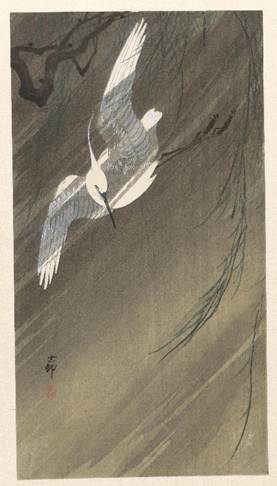
Ohara Koson, Great Egret in a storm, kachō-e, Rijksmuseum
- Fūkei-ga, represents landscape paintings where nature is as a state of mind;
- Yokohama-e, foreign characters and scenes in the port of Yokahama, the name comes from the name of the city that was the primary foreign settlement after 1859;
- Surimono, prints that include a five-line kyōka poem in the design;
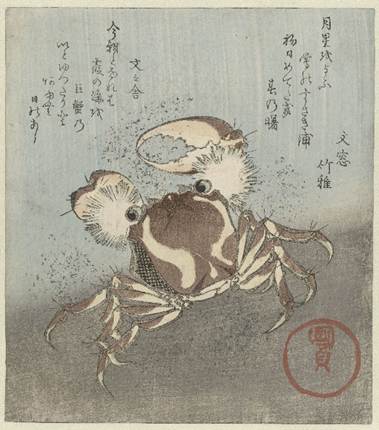
Utagawa Kunisada, Crab walks along the water, surimono, Rijksmuseum
- Uchiwa-e, printed hand fans.
In terms of orientation, there are only two possibilities: tate-e (“portrait” orientation) and yoko-e (“landscape” orientation). The more frequent one is tate-e except in the specific format of ōban fūkei-ga by Hokusai and by Hiroshige which used most of the time yoko-e orientation.
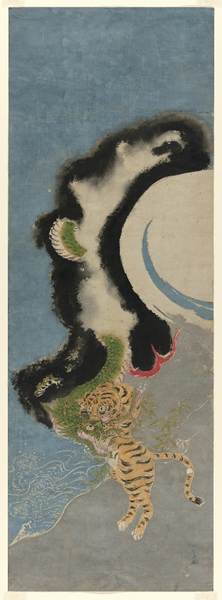
Isoda Koryusai, Dragon and tiger, tate-e, Art Institute of Chicago
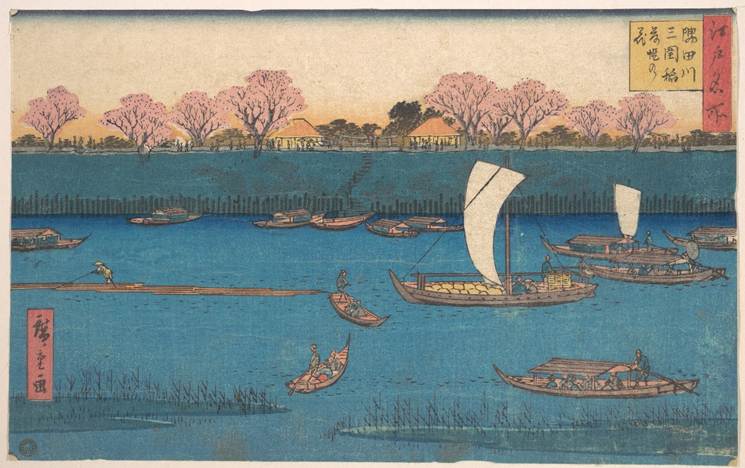
Utagawa Hiroshige II, A journey along the Sumida River, yoko-e, The Metropolitan Museum of Art
The format of ukiyo-e depends on the paper they were printed on. The more used ones are the ōban (around 37 × 25 cm) and the chūban (around 25 × 19 cm). The different formats have variable dimensions according to the sources, so it can change about centimetres this is why this part will contain approximations. It may also not be an exhaustive list:
- Ōban, mesures around 37 to 38 × 25,5 cm;
- Ō-ōban, means “big ōban“ and is larger than the classic with around 58 × 32 cm;
- Chūban, around 25 to 26 × 17 to 19 cm;
- Chūtanzaku, approximately 36 × 13 cm;
- Yatsugiri, a rare format that is half a chūban, and measures around 19 × 13 cm;
- Aiban, about 34 × 23 cm, quite rare size between ōban and chūban;
- Koban, corresponds to half an aiban, is roughly 23 × 17 cm;
- Hosoban, a rare and narrow format around 33 × 14,5 to 22 cm, commonly used in older woodblock prints of actors in the 18th century and used for kacho-ga prints in the 19th century;
- Hashira-e, long and really narrow print to be hung on the pillars of a house, measures around 70 × 12 cm;
- Kakemono-e, scrolls hung vertically on a wall, long and rather narrow, often consists of two ōban-sized prints one above the other to form a diptych;
- Mameban, measures around 12 × 8 cm, sometimes nicknamed “toy printing”;
- Ōtansaku, about 37 × 17 cm;
- Shikishiban, around 21 × 18 cm, ofter used for surimono prints;
- Nagaban, approximately 20 × 50 cm.
