A Normandy road trip through Monet’s landscapes and changing light
A road trip through Normandy
I have just returned from one of the most unusual trips of my life, not because I went somewhere particularly strange, far from home, tropical or exotic, but because I visited places and landscapes I had seen a thousand times in paintings by the great Impressionists, but never in real life. I planned a road trip through Normandy, starting in Paris and visiting Rouen, Étretat, Honfleur, Le Havre, Trouville-sur-Mer, Caen, Bayeux and Giverny, all in about five days. Perhaps too few?
I was able to visit all these places in such a short time because, during the trip, I came to the conclusion that there was absolutely nothing to see in most of these towns and villages: you could walk around them in a few hours, have dinner early, and by 9 p.m. there was no one left outside, so you went to bed. Then you woke up the next day and, at 10:30 a.m., the town was still asleep. The shops were closed, perhaps because it was Monday or Tuesday and they only opened at weekends. But wait: there was a café open for breakfast. You went in and you were the only customer.
Perhaps those towns seemed empty to me because I was looking for something to see in a hurry. Once I slowed down, I started noticing everything that changed.
Learning to look
But then why did I enjoy this trip so much? Perhaps it has something to do with a personal inclination that makes me feel, in some ways, close to Monet and the other Impressionist artists of the nineteenth and twentieth centuries. Monet grew up in Le Havre and settled in Giverny in 1883, where he lived and worked until his death in 1926. There, he created his water garden and its water lilies, which he painted many times. Monet also returned to other subjects, such as haystacks, poplars, the monumental Water Lilies series and Rouen Cathedral. By painting them in series, he could follow changes in light and atmosphere. The places I had come to know through his paintings had become part of my own journey for a few days.
Even when those places seemed asleep, they had something that made me want to stop and look. I think I managed to discover Normandy’s beauty too, not only with my eyes, but with my heart and mind.
The silence, the calm and the feeling that these towns are slightly removed from the world make you want to notice every little detail.
Landscapes I recognised — and saw differently
In Étretat, I found serenity and depth. A few weeks earlier, at the Musée d’Orsay, I had stopped in front of a Monet painting of the cliffs of Étretat. I had spent a long time looking at the play of light and colour. When I later stood in front of the Manneporte arch, I recognised the landscape, but it was different. The light, the sky and the sea transformed it. The day I visited, there was fog, a fine drizzle was falling and the ground was damp. The colours were not the ones I had admired in the painting: everything looked softer, almost silent. It was still magical, but in a different way.
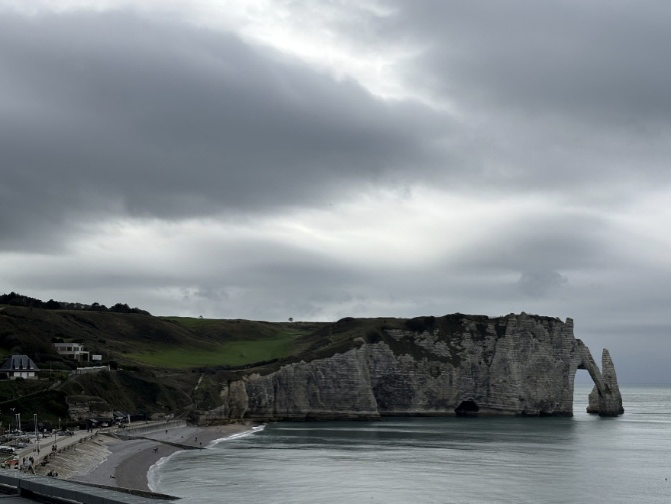
The cliffs and natural arch of Étretat beneath a cloudy sky Photo by the author
The little houses around Honfleur’s harbour change colour as the hours pass: beautiful at sunset, lit up, and beautiful in the morning, reflected in the water. Rouen, meanwhile, has a slightly eerie atmosphere in the evening, almost like a horror film. In the morning, it completely changes its face: with its half-timbered houses, it looks almost like a fairytale town.
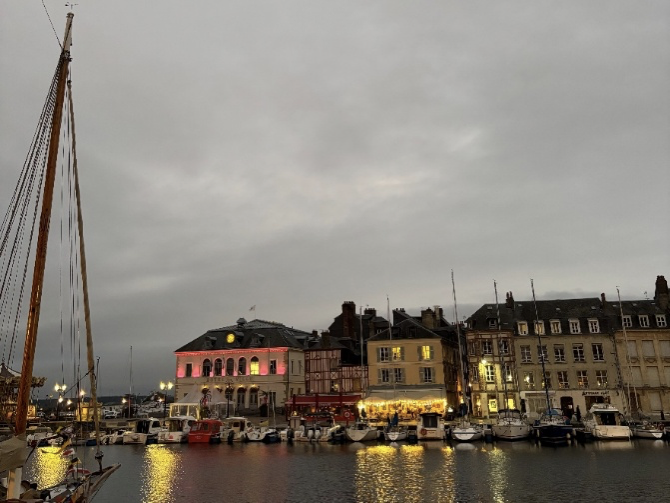
Honfleur’s harbour at sunset Photo by the author
Monet painted Rouen Cathedral several times, capturing it in different conditions: in the morning, under grey light, in full sunshine. I saw it at 7:30 p.m., after sunset, when it was already dark. Looking at his paintings, I understand better that perhaps he was trying to paint not just a cliff or a façade, but what they became at a particular moment.
Small discoveries on the way to Giverny
And then there are the little stone villages you pass through on the way to Giverny. Without Monet, Giverny might have remained like the others: a small village without grand cafés or bistros, where finding somewhere to have breakfast is a challenge. Then, as if by magic, you turn a corner and see a sign saying boulangerie, but you actually find yourself in a small grocery store. On the conveyor belt there was a basket with four pain au chocolat and three croissants. A grandmother and a little girl were leaving. There was no one around, except for a man doing roadworks, there were quite a few of those, and he looked at me a little strangely when I stopped the car to look at the unusual place, at least to me, where I had just arrived.
At Giverny, the pond did not seem as captivating as I had always imagined it from the paintings, with the water lilies in full bloom. What struck me instead was everything around it: Monet’s vast garden, whose full scale I had never really grasped from the paintings.
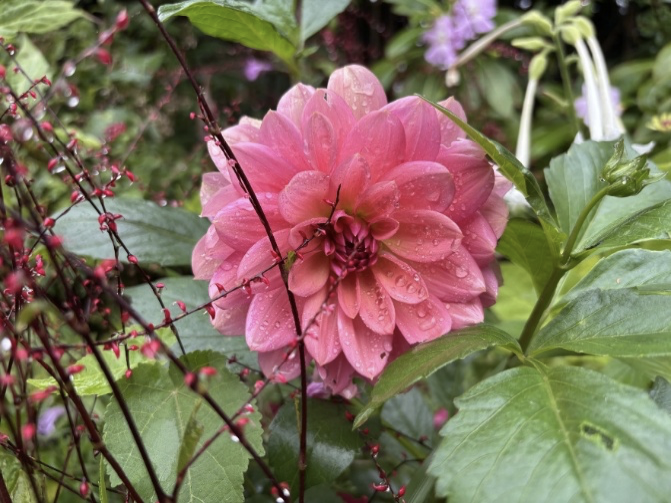
A rain-speckled flower in the Monet’s garden at Giverny Photo by the author
The weather was not at its best that day either, but tiny drops of dew glistened on the leaves and flowers around the water. It was almost as if the garden had prepared itself to welcome visitors: clean, fragrant and shining. There were so many flowers, in such a variety of shapes and colours, that the garden seemed like a world of its own, not just a frame for the pond.
Finding everything in nothing
I believe the magic that drew so many artists to these places more than a hundred years ago is still intact. And that fills me with immense joy.
I like to imagine that, for those painters, these places were more than just a flower, a plant, a landscape, a cliff, a little house, a cart on a snowy road or a church. Perhaps they also meant freedom, vastness, all the living species that inhabit nature, diversity and the passing of time. They meant the possibility of seeing something different every time, every day: life.
After so many sunrises and sunsets, the flower you had seen has opened and another has faded; the ocean has risen a little and swallowed the rocks that were there before, so you can no longer see them. If you look up, even the light is different: one day the sky lights us up, the next it cries; it is a little moody, like people. Then there comes a time when it stays gloomy and grey for quite a while, and there is no sign of the sun returning. Everything becomes harder to see, a little blurred, out of focus.
That is the beauty of finding everything in nothing: never getting bored and being able to paint the same cliff and the same pond fifty times, because every day you notice something new and something new actually happens.
Monet’s obsession
Monet himself described those landscapes of water and reflections as an obsession. In a 1908 letter to the critic Gustave Geffroy, he wrote: “These landscapes of water and reflections have become an obsession.” In the same letter, he explained that, despite the strain of old age, he still wanted to express what he felt. He continued working on the Water Lilies cycle until his death in 1926. The eight monumental panels at the Orangerie were installed after his death.
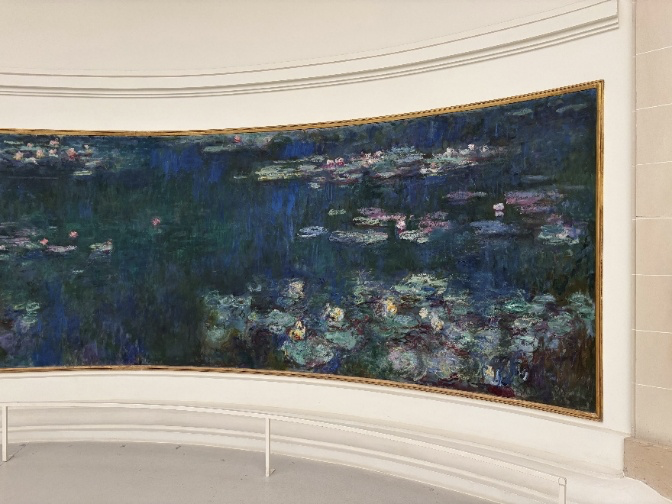
One of Claude Monet’s monumental Water Lilies panels at the Musée de l’Orangerie in Paris. Photo by the author
As 2026 marks a century since Monet’s death, I find myself thinking of this journey as a small, unplanned tribute to the painter whose landscapes encouraged me to look more closely at the world around me.
Normandy left me with one thought: no landscape is ever quite the same. Everything keeps changing, and each time someone stops to look, they notice something new.
And that is the wonder of finding everything in nothing.
Written by Bianca
Sources:
https://www.musee-orsay.fr/it/risorse/repertorio-artisti-personalita/claude-monet-18495
https://www.musee-orangerie.fr/it/programma/agenda/mostre/monet-e-il-tempo