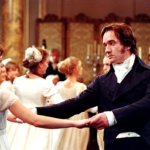
Is it really that uncommon to see two women having a conversation on screen ? In 1985, American cartoonist Alison Bechdel highlighted a paradox in film : women may be present in real life, yet they remain a minority, or confined to certain roles, in the stories told on screen. From this observation came the Bechdel Test, which has since become a popular tool for examining the place of women in film. But what does it actually measure, and what are its limitations ?
An Idea Born from a Feminist Comic Strip
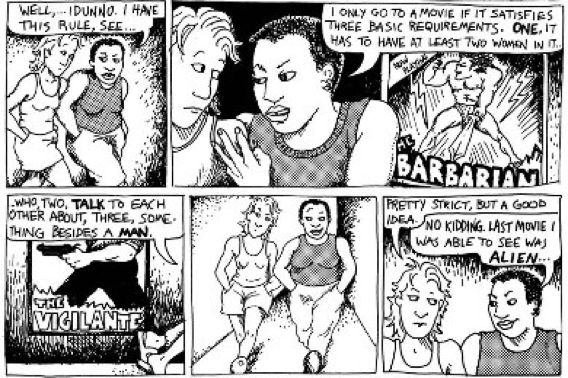
By Portion of « The Rule » in Dykes Bechdel’s
Comic and issue by Alison Bechdel, circa 1985
The Bechdel Test first appeared in 1985 in “Dykes to Watch Out For”, a comic strip by American author Alison Bechdel. In a strip titled “The Rule”, two women discuss how they choose which movies to watch. One explains that she only watches movies that meet three simple criteria. She was reportedly inspired by her friend Liz Wallace, as well as by the reflections of writer Virginia Woolf in her 1929 essay “A Room of One’s Own”.
In this book, Virginia Woolf points out, among other things, that female characters in literature are often defined by their relationships with men, even though women could have their own concerns and relationships with one another independent of male characters. This observation echoes what the Bechdel test seeks to highlight in film : Do women have a narrative existence that is not only tied to men ?
Originally, the test was primarily a humorous and critical observation within a feminist comic strip. It was not designed as a scientific tool intended to objectively evaluate films. However, with the rise of the Internet and discussions about the representation of women in the media, it has gradually gained popularity. It has become a simple way to highlight inequalities in representation and to question the choices made by screenwriters, directors, and the film industry.
Three simple but revealing criteria
To pass the Bechdel Test, a film must meet three conditions :
First, it must feature at least two female characters.
Secondly, these two characters must speak to each other.
Thirdly, their conversation must be about something other than a man.
Some versions of the test add that the female characters must have names, but this criterion was not part of the original formulation. The goal, here, remains to determine whether women exist in the narrative for reasons other than their relationship to a male character.
The simplicity of these rules makes the test particularly accessible. It requires neither cinematic expertise nor an in-depth analysis of the screenplay. Yet many popular films fail to meet its criteria. The original “Star Wars” trilogy, for example, is often cited to illustrate the difficulty of bringing together two female characters who talk about something other than a man. Conversely, a film can pass the test with just a single, very brief conversation between two women.
This observation reveals an imbalance. Indeed, for a long time, female characters were often written as love interests, mothers, or supporting characters, while men took on a wider variety of narrative roles. The test therefore encourages us to question not only the roles given to women, but also the topics they are allowed to discuss in the stories told on screen.
A Representation That Is Evolving, but Remains Unequal
The Bechdel Test has helped popularize discussions about the representation of women in film. However, it is just one indicator among many. Quantitative studies provide a better way to measure inequalities in the industry.

@geenadavisorg
A study by the Geena Davis Institute of 120 films released worldwide between 2010 and 2013 found that only 31% of named characters were women. Women accounted for only 23% of protagonists or co-protagonists, and only 7% of the directors of the films studied were women. These figures illustrate the imbalances that have long characterized both women’s presence on screen and their access to creative roles.
However, the situation is changing. Women now play more leading roles in various productions and are more visible in debates about filmmaking. But progress varies by country, film genre, and the specific roles considered. The presence of a female protagonist does not necessarily mean that women are represented in a diverse way. Female characters an still be subject to stereotypes based on their appearance, age, background, or role in the story.
Thus, the Bechdel Test serves as a starting point for reflection, but it is not sufficient to account for all of these issues. To understand inequalities in representation, we must also examine who writes the stories, who directs them, who finances them, and which works ultimately get produced and distributed.
The BechdelTest.com website : a tool that has become collaborative
As the test has gained popularity, online initiatives have made it possible to identify which movies pass it and which do not. The BechdelTest.com website is one of the best-known examples. This collaborative database includes more than 10,000 films and allows users to view ratings, suggest new titles, and participate in analyzing the films.
The website makes the test practical and easy to use. Users can compare films from different eras, identify trends, and discover that some very well-known works do not meet the three criteria. Statistics published by the platform indicate that approximately 57% of the films listed pass the test. However, this figure should be interpreted with caution. Indeed, the database relies on user contributions and does not constitute a representative sample of global film production.
Beyong the statistics, this website helps to raise awareness on this issue and encourages discussions among viewers. It demonstrates how an idea derived from a comic book can become a shared tool for examining cultural representations. Moreover, the test has also been incorporated into professional debates on screenplays and representation policies, although its use does not replace an in-depth analysis of the works themselves.
Passing the test does not mean the movie is feminist
The main limitation of the Bechdel test is what it measures : it assesses the minimum presence of female characters and the existence of a conversation between them, but says nothing about the quality of that representation.
A film can pass the test while still perpetuating misogynistic stereotypes. Two women may, for example, discuss clothes or work for a few seconds, while the rest of the narrative reduces them to secondary characters or portrays them in a derogatory manner. Conversely, a film may fail the test while featuring a complex, autonomous female character who is central to the story.
This is particularly the case with “Gravity”, which primarily follows the character of Ryan Stone, played by Sandra Bullock. The film features a woman at the heart of the narrative, but does not include two female characters who can interact with one another. It therefore fails the test. But this conclusion is not enough to prove that its heroine is poorly written or that the film is sexist.

Sandra Bullock dans le film américain et britannique d’Alfonso Cuaron, « Gravity ». COURTESY OF WARNER BROS. PICTURE
These examples show that the test is not a measure of a film’s quality, nor does it tell us anything about the creators’ intentions. Indeed, it does not take into account the importance of the characters, how they are portrayed, or the complexity of their stories. Hence, a film that passed the test is not necessarily feminist, just as a film that fails it is not necessarily sexist.
The test therefore serves primarily as an indicator. It encourages us to ask further questions : Do the female characters have goals of their own ? Are they defined by anything other than their appearance or romantic relationships ? Do they truly contribute to the plot’s development ? And what diversity of women does cinema portray ?
Beyond the Bechdel Test, Other Tools Exist
The Bechdel Test is not the only tool designed to examine representation in film. Other tests focus on different aspects of diversity and character development.
The Mako Mori Test examines whether a female character has her own narrative arc, independent from the male character. The DuVernay Test examines the representation of people of color and their role in the narrative. The Vito Russo Test, developed by the LGBTQ+ organization GLAAD, examines the representation of LGBTQ+ characters in film and television. Finally, the Riz Test focuses on stereotypes associated with Muslim characters.
These tools do not all address the same questions. Nevertheless, they show that representation is not limited to the number of characters on screen : it also concerns their autonomy, their importance in the story, and the diversity of the roles assigned to them. But to be precise, none of these tests, on its own, can fully capture the complexity of a work.
An Imperfect Test, but Still Useful
Nearly forty years after its creation, the Bechdel Test remains a simple tool for examining the role of women in film. Its strength is precisely in its simplicity : three questions are enough to reveal imbalances that viewers don’t always notice.
However, it cannot determine whether a film is good, feminist, or representative of the diversity of women. Moreover, it doesn’t take into account all aspects of filmmaking, from writing and financing to directing and distribution.
Its values lies in encouraging us to look at films more critically and question the choices behind their stories. Indeed, a simple conversation between two characters raised a broader question : who gets to be at the centre of a story, talk about their own concerns, and exist beyond how others see them ?
Written by Lucie
Sources :
https://geenadavisinstitute.org/?s=Bechdel+test
https://en.wikipedia.org/wiki/Bechdel_test#Application