“Sorcières”: a new lecture of History at the Château des Ducs

If you thought witches are only good for scaring children in Grimm tales or making brooms fly in Harry Potter, it is time to review your classics. Until June 28, 2026, the Château des Ducs de Bretagne in Nantes invites us to a dizzying dive into one of the darkest and most fascinating periods of our history with the event exhibition: “Sorcières” (Witches). Get rid of the image of the witch with a hooked nose. This exhibition is serious, and pure history, but served with an immersive scenography. Before rushing into the Nantes dungeon, let’s take a moment to dust off our grimoires, and really understand all the historic veracity behind the word “Sorcière”. 

Antiquity, or the golden age of sorceresses 

In Antiquity, the female figure linked to magic is not necessarily evil, it is ambivalent. Think of Circe or Medea. Sure, it was not good to cross their path if you had the misfortune of upsetting them, but they embodied a form of power and knowledge. They were the mistresses of thresholds, the ones who knew the virtues of plants (the pharmakeia), the lunar cycles, and the secrets of life and death. Magic was an integral part of the cosmos; it was feared as much as it was respected. The woman « who knows » was not yet the woman « who is burned ».

The Middle Ages and the great misunderstanding 

Contrary to a tenacious legend, the Middle Ages was not the golden age of the stakes. For long centuries, the Church even considered the belief in witchcraft as a… pagan superstition. The Canon Episcopi (a text of canon law from the 10th century) stated that it was illusory to believe that women could fly at night with the goddess Diana. At that time, the Church worried more about heresies (Cathars, Waldensians) who challenged its theological dogma than about countryside healers. However, the wind turned insidiously at the end of the medieval period. Successive crises (black plague, The Hundred Year’s War, famines…) create a fertile ground for anxiety. Society needs guilty persons. The Devil, until then a theological figure, invites himself into daily life. People start to whisper that the misfortunes of the times are not divine punishments, but the work of the devil himself. The shift happens: popular magic becomes learned demonology.

The Renaissance, or the retreat of women’s rights 

Paradoxically, it is during the Renaissance, the era of humanism and discovery, that the witch hunt explodes. The 16th and 17th centuries are the true centuries of the stakes. This is precisely what makes the period so disturbing: at the very moment when European thought was celebrating Reason, championing the individual, and redrawing the boundaries of science and philosophy, it was also burning women by the thousands. How to explain such a contradiction? In the background, the same intellectual revolution that gave rise to Erasmus and Leonardo da Vinci also created a brutal system for controlling female bodies. The Malleus Maleficarum (The Hammer of Witches), written in 1487 by the Dominican inquisitors Heinrich Kramer and Jacob Sprenger, was made widely available thanks to the printing press, which is hailed as the great means of advancement and knowledge dissemination. This guide to the ideal inquisitor explains in great detail why women are more likely to make a deal with the Devil by nature: they are morally unstable, intellectually weaker, and carnally insatiable. The book is reprinted numerous times and becomes a bestseller throughout Europe. A collective psychosis is about to begin. Acts are no longer judged, but nature is. It’s already suspicious to be a woman. There is a structural explanation for this paradox: significant social change also occurred during the Renaissance. Strong fears were brought on by the rise of centralized states, the redistribution of economic power, and the Reformation’s upheavals. Widows, healers, and elderly women living alone were examples of women who lived outside of male authority and became the lightning rods of a society in crisis. The role of the midwife and the herbalist, those wise women who had for centuries held knowledge of the body, was directly threatened by the very advancement of medicine, which tried to prove its authority over bodies and healing practices. Additionally, persecuting them weakened the legitimacy of their knowledge and seize it for the benefit of an institutional, lettered, male-only science. For tens of thousands of them, it did not end well. The German-speaking territories, Scotland, and Lorraine, characterized by political division and fierce religious battles between Catholics and Protestants, were where the stakes burned the highest. The witch hunt was not exclusive to the Inquisition; Protestant magistrates and secular tribunals also participated in it. Fear, local criticism, and the systematic use of torture to coerce confessions that implicated other accused were the main causes of this social phenomenon, not a religious anomaly. In a deadly spiral, each trial led to more.

Nowadays, the witch reinvents herself 

The return of the witch is rooted in a rigorous intellectual and militant approach, far from being merely a fashion effect or a « witchy » aesthetic trend for social media. The figure has been resurrected as a symbol of opposition to patriarchy since the 1970s, thanks to movements like W.I.T.C.H. (Women’s International Terrorist Conspiracy from Hell) in the US and Xavière Gauthier’s magazine Sorcières in France. The contemporary witch is the one who liberates herself rather than the one who submits. She is the embodiment of the woman who defies male authority, lives on the periphery of familial conventions (marriage, pregnancy), and asserts complete control over her body and mind. This is by no means a surface-level reappropriation. Since the 2010s, it has permeated popular culture, literature, and even spirituality, extending far beyond feminist circles. Best-selling books, TV shows, and social media aesthetics now frequently feature characters like the witch, sorceress, or wise woman, but beneath this prominence is a much darker undertone. Many women now use the term « witch » to describe a real-life experience of being seen as too talkative, too self-reliant, too intelligent, or just too « other » to conform to social norms. Reclaiming the word means reclaiming the history of everyone who was silenced. This revival has been greatly aided by the theoretical writings of essayists such as Silvia Federici (Caliban and the Witch, 2004) and Mona Chollet (In Defense of Witches, 2019). Federici in particular presents a radical argument: the witch hunt was a foundational instrument of emerging capitalism rather than a historical accident or a symptom of religious fanaticism. The persecutions effectively destroyed a whole social fabric that opposed the new economic order by deliberately targeting women who possessed reproductive knowledge, engaged in communal healing, and upheld ties of solidarity outside of the market economy. According to this interpretation, burning the witch also meant destroying a society where women had real power in their communities, bodies were not commodities, and knowledge was shared. In a much wider sense, the witch now represents subversive female power. She is called upon in eco-feminist movements, which connect women’s subjugation to the devastation of the natural world. The same reasoning that allowed the exploitation of the female body, turning it into a resource for reproduction, also allowed the exploitation of the earth, turning it into a raw material. The witch becomes the symbolic ancestor of those who today oppose extractive capitalism and advocate for a different relationship between humanity and its environment because she upheld a profound, respectful, and living knowledge of the natural world. Thus, identifying as a « witch » in the twenty-first century is a claim to a history of disobedience. It affirms the ability to act (empowerment) in the face of conventional demands for youth, beauty, and submissiveness. It is turning a historical slur into a symbol of liberation. The witch continues to be a highly political figure in a society that still punishes women for knowing too much or making too many demands. She serves as a reminder that the persecution of the past was a system rather than an anomaly and that vigilance is still necessary.

The Nantes exhibition: a journey between shadows and lights 

To serve this dense subject, the Nantes History Museum has deployed a museography that avoids the pitfall of sensationalism while being profoundly evocative. Immersion is the key word. The visitor wanders between collective imagination and occulted memory. The 180 works gathered are exceptional. We meet engravings by Dürer or Goya, showing how great artists participated in the visual construction of the witch myth (old, ugly, surrounded by monstrous creatures). We discover objects of popular protection (amulets, talismans) which testify to an omnipresent magical thinking. Multimedia devices punctuate the visit: animated maps allow us to visualize the contagion of trials across Europe (the « Catholic backbone » but also Protestant lands were touched). The sound design creates an atmosphere that is sometimes oppressive, reminding us that we are walking on the ashes of a historical tragedy. One does not come out unscathed from the section dedicated to interrogations, where the words of the accused, often extorted, resonate through the centuries. The exhibition puts into perspective the works of historians and essayists, such as Mona Chollet (In Defense of Witches) or Silvia Federici (Caliban and the Witch). This reappropriation is eminently political. It postulates that the witch hunt was not an accident of history, but a founding tool of nascent capitalism, aiming to enslave the female labor force and destroy community solidarities. Today, the witch becomes the archetype of subversive female power. She is summoned in eco-feminist struggles, linking the destruction of nature to the oppression of women. She symbolizes an alternative relationship to the world, based on the knowledge of the living, care, and the refusal of rational and predatory domination. Calling oneself a « witch » in the 21st century is claiming a heritage of disobedience, it is affirming a power to act (empowerment) in the face of normative injunctions of beauty, youth, and docility. It is transforming a historical insult into a banner of freedom.

In summary: should you go? 

Whether you are passionate about history or a convinced feminist, this exhibition is made for you. It is intelligent, beautiful, sometimes hard, but always necessary. We come out a bit shaken, but mostly much less stupid. And who knows, maybe you will discover a modern witch’s soul in yourself when leaving?

Written by Kenya Mézière

Why are iconic french musicals making a comeback on stage today?

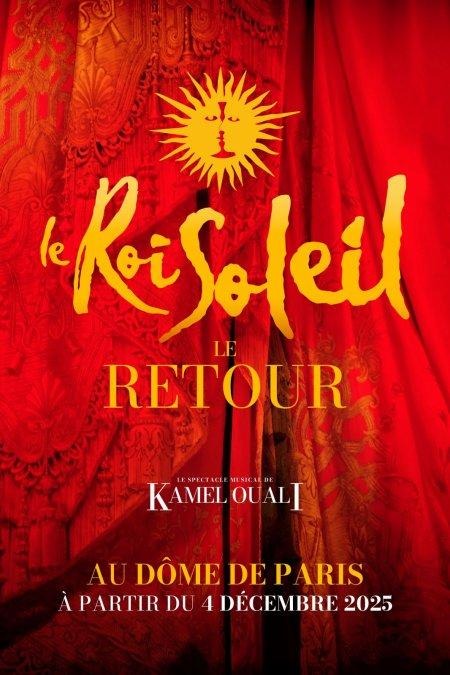
Starmania, Notre Dame de Paris, Le Roi Soleil, Roméo et Juliette and soon Mozart, l’opéra rock and? For several years now, the great musicals that have marked generations in France and internationally have been returning to the French stage. 

Throughout the press, the 2025 season was presented as particularly rich for musicals in the capital. Shows multiplied on the bill, to the point that some journalists evoked the possibility of Paris rivaling Broadway. Seeing so many musicals on stage has generated great enthusiasm within the French cultural landscape. And as someone who has been passionate about French musicals since childhood, I too welcome this increased visibility. Yet a certain sense of reserve remains: why are we witnessing the revival of major landmarks of French musicals from the 2000s? 

Presenting this phenomenon as something new would mean ignoring the very history of French musicals. This movement is, in fact, not new: Notre Dame de Paris (2005, 2016, 2023, 2025…), Roméo et Juliette (2010), Starmania (1988, 1992, 2022), La Révolution française (2024), or Les Dix Commandements (2024)… In the same way, French adaptations coming from the West End or Broadway, such as Mamma Mia! (Mogador, Palais des Sports, Casino de Paris, Seine Musicale…), among many others, have been staged successively on Parisian stages. Moreover, some musicals have never truly left the stage, continuing their trajectory and international life, particularly in Asia. Shows such as Mozart, l’opéra rock, Roméo et Juliette, Le Rouge et le Noir, or more recently Molière, le spectacle musical, continue to be performed and adapted.

What raises questions today is therefore not the principle of return or revival itself, but rather their concentration and succession. Indeed, the return of Le Roi Soleil, followed by the announcement of that of Mozart, l’opéra rock, gives the impression of a movement that is accelerating. In a landscape where the production of musicals still relies on an oligopoly, limited number of producers and structures, this raises further questions. 
Should this necessarily be seen as a problem? These revivals allow these productions to live beyond their initial creation, to reach new audiences and new stagings. Without them, an entire generation, including myself, would never have been able to discover Starmania on stage.
A broader question therefore arises: within this dynamic of revivals, how much room is left for the emergence of new works in the French musicals model?

© 2026 Le Roi Soleil • Décibels Productions 

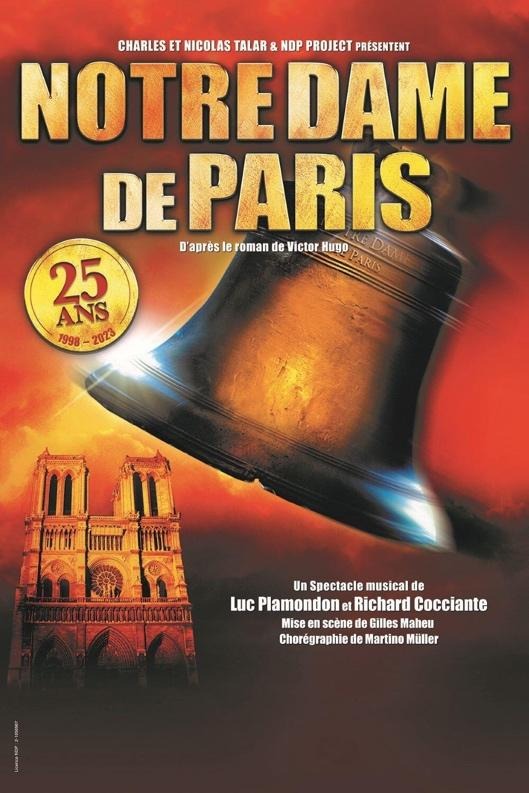
Notre-Dame de Paris, official poster of the show of Luc Plamondon et Richard Cocciante (© NDP Project)

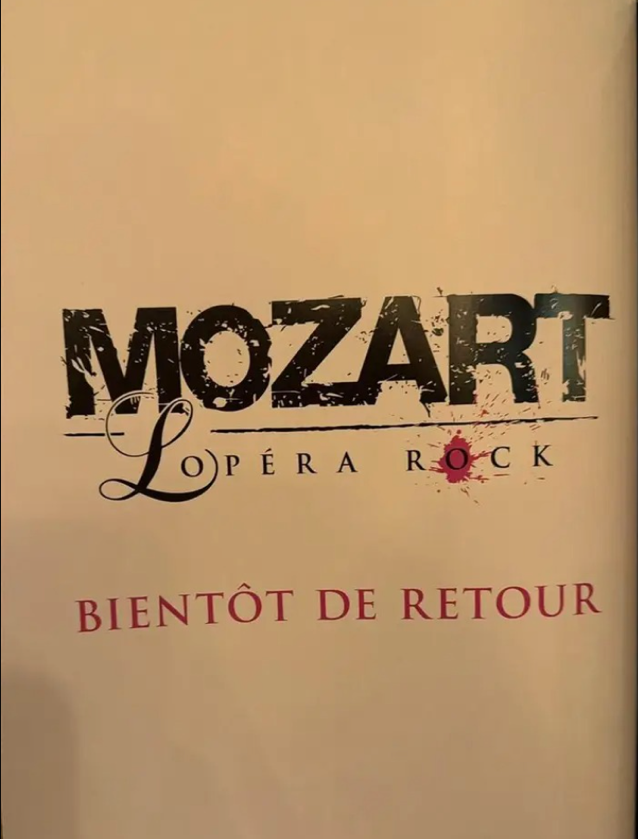
Image credit: visual taken from the program of Le Roi Soleil evoking the return of Mozart, l’Opéra Rock, shared by Marine Level on social media.

To better understand this phenomenon, it is necessary to look back at the role musicals played in France in the 2000s. Indeed, if musicals may appear today as a genre that is sometimes poorly regarded or even dismissed in France, this has not always been the case. It is enough to recall the early 2000s, when musicals were major successes driven by hit songs. Many of these productions are now regarded as emblematic works of French culture and heritage.

These emblematic productions are described by the researcher and specialist in French musical theatre, Bernard Jeannot Guérin, as forms of industrial production, belonging to an era of “producer-led shows” (“spectacles de producteurs”). This era corresponds to a moment in which the genre stabilized around a star system, the creation of hit songs, and a production logic closely tied to the record industry. Musicals from this period were not conceived solely as stage performances, but as global projects. It involved stakes that go beyond theatrical performance alone and carried the expectations of a wide range of stakeholders (Bernard Jeannot Guérin, 2019).
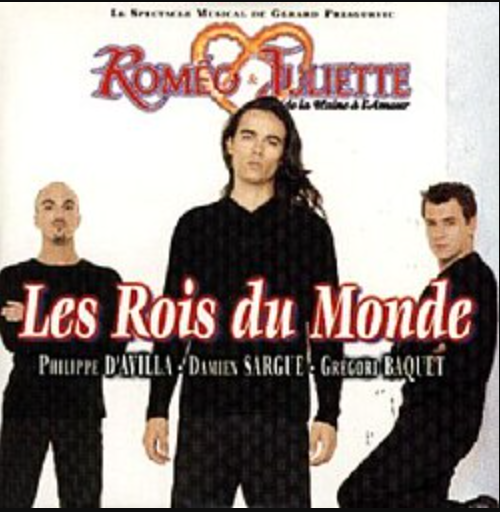
“Belle”, “Les Rois du Monde”, “L’Assassymphonie”, “L’Envie d’aimer”… These songs are not merely derived from musicals. They became genuine hits, circulating widely on radio and television independently of the shows from which they originated. 
To give a few figures, “Les Rois du Monde” from the musical Roméo et Juliette remained number one for 17 weeks and stayed in the Top 100 for 39 weeks, selling 1.500.000 copies in France. These hits have become embedded in French popular culture to the point that one could know the songs without knowing the musical.

Image credit: « Les Rois du Monde », single from the musical Roméo et Juliette (© Dove Attia / Gérard Presgurvic)

These successes of the 2000s undoubtedly explain why these musicals are returning today. But beyond nostalgia, what does this wave of revivals actually produce? The current success of these revivals is undeniable. Enthusiasm is visible both in theaters and on social media. The reception of Le Roi Soleil and the announcement of Roméo et Juliette testify the shared excitement surrounding these returns.
The aim here is not to judge whether these returns are good or bad, but to understand what they concretely generate within the landscape of French musical theatre.

On the one hand, within this movement, the main concern is not so much the commercial nature of musical theatre, but the way it is expressed today. Musicals are designed to reach a wide audience and fill venues. This is also the very purpose of live performance: to be heard, seen, and shared. Historically, strategies such as hit songs or the star system, have supported the circulation and sales that characterized the industrial era of French musical theatre. Producers can hardly be blamed for seeking to fill theatres and ensure the success of their production through this revival strategy.
The issue rather lies in the growing dominance of a logic of risk management, which seems to be imposed at the expense of creation and innovation. This shift occurs in a context of crisis affecting the sector and, more broadly, the economy. The repeated recourse to revivals is not specific to musical theatre. It fits into a broader logic and is particularly characteristic of cinema. Cultural production is marked by a high degree of uncertainty: no one can predict success in advance, and each work is a gamble. Faced with this structural risk, cultural industries have developed risk-management strategies, which in cinema take the form of franchises, remakes, sequels, and reboots. The idea is to limit the economic uncertainty inherent in cultural production.
When transposed to the field of musical theatre, this can also be understood as a form of security for audiences. By already knowing these shows, audiences have a clearer sense of what to expect and therefore take fewer risks in their choices of cultural outings. This occurs in a context where musicals are costly and inflation weighs on household spending, particularly on cultural experiences.
This convergence of expectations nevertheless raises a central question: will French musicals become part of a model in which the pursuit of economic guarantees comes at the expense of creation? This is where my main frustration lies. I want to walk into a theatre and be surprised by an original story, discover new songs, and rediscover that sense of amazement in front of a new show. Of course, it would be illusory to claim that creation has disappeared: new shows are still being produced, but what concerns me more is the growing tendency for revivals establishing themselves as the norm.

On the other hand, it would be reductive to claim that all revivals produce exactly the same effects. Some, on the contrary, manage to offer genuine artistic reinterpretations. To cite just one: Starmania in Thomas Jolly’s version is undoubtedly the strongest counterexample to my previous argument. Far from a simple reconstruction, the staging succeeds in proposing a true artistic re-reading, through adaptation and a new stage direction that firmly anchors the work in the present. Conversely, other revivals leave a far more mixed impression. When productions seek to reproduce almost identically the original shows that were once immense successes, comparison with the original becomes inevitable. This often results in more modest sets, simplified costumes, reduced casts, and an excessive reliance on screens. 
These elements can sometimes give the impression of a trade-off between financial deficits and artistic deficits. 

These revivals are not necessarily problematic in themselves. Bringing a show back to the stage also makes it possible to pass it on to new generations. It also allows audiences who did not experience it at the time of its creation the opportunity to encounter major works. Moreover, revivals may appear controversial mainly to French audiences, for whom they have not traditionally been the norm.
If we look at Broadway or the West End, the revival of a show constitutes a norm, a structural practice of musical theatre. For example, during the 2024-2025 Broadway season, of the 43 new productions that opened, 10 were revivals (5 musicals and 5 plays), representing nearly a quarter of all new openings. Similar proportions can also be observed in the previous season. This regular presence of revivals in theatre programs is far from marginal and instead forms part of the normal production cycle. This can be illustrated by West Side Story, which has been revived on Broadway multiple times between 1957 and 2020.
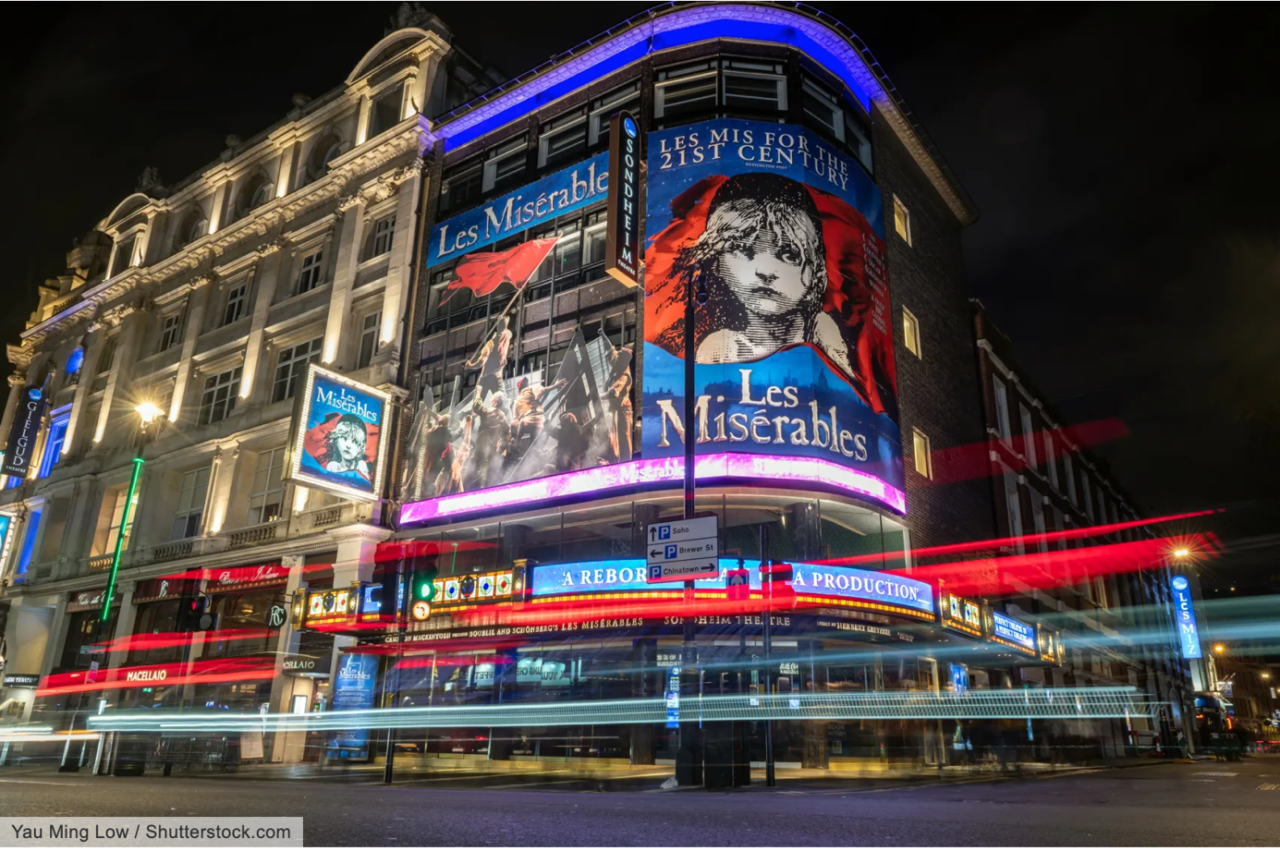
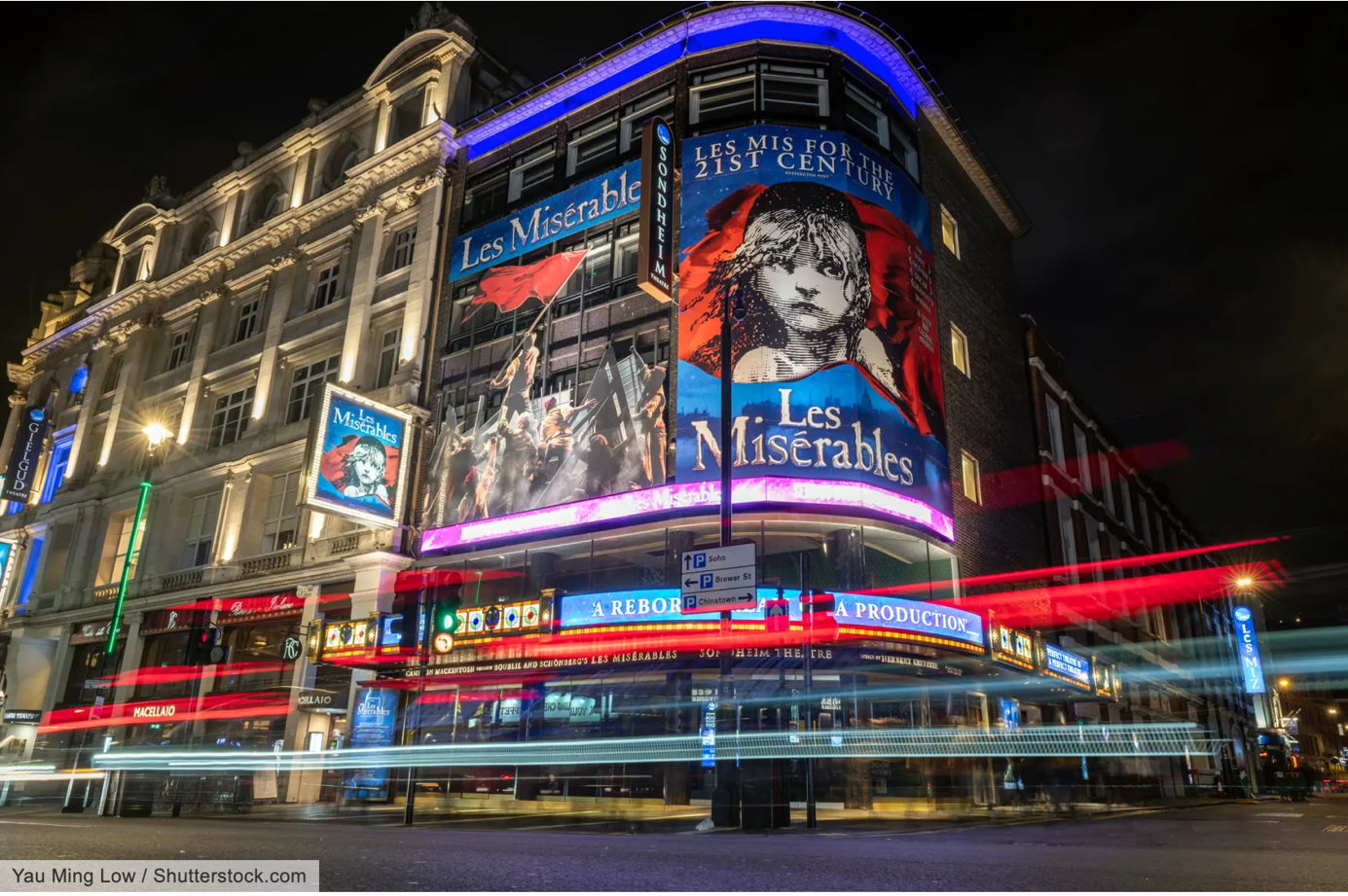
In London, the practice of revivals is also part of the standard functioning of the West End. Several landmark musicals have been performed without interruption for decades: Les Misérables since 1985, The Phantom of the Opera since 1986, and Mamma Mia! since 1999. At the same time, musicals such as Oklahoma!, Gypsy, or Sweeney Todd are regularly revived. Revival here reflects less a deficit of creation than a repertoire-based logic, in which works circulate and evolve in meaning over time.

The difference may lie less in the practices themselves than in how they are perceived. Whereas revivals are seen elsewhere as a legitimate form of continuity, in France they remain associated with the idea of a lack of renewal. Indeed, audiences have gradually become accustomed to a dynamic of creation driven by emblematic producers such as Dove Attia, helping to establish the idea of a constant renewal of the genre.

Image credit: Les Misérables at the West End, London – Yau Ming Low / Shutterstock

In order to conclude, it is worth mentioning that nostalgia does not necessarily imply a return to the exact same form. Indeed, it can also become a point of support for inventing new forms and renewing the audience’s relationship with musical theatre. Some projects fit precisely within this logic, using classic French musicals not as an end in themselves, but as a medium for creation.
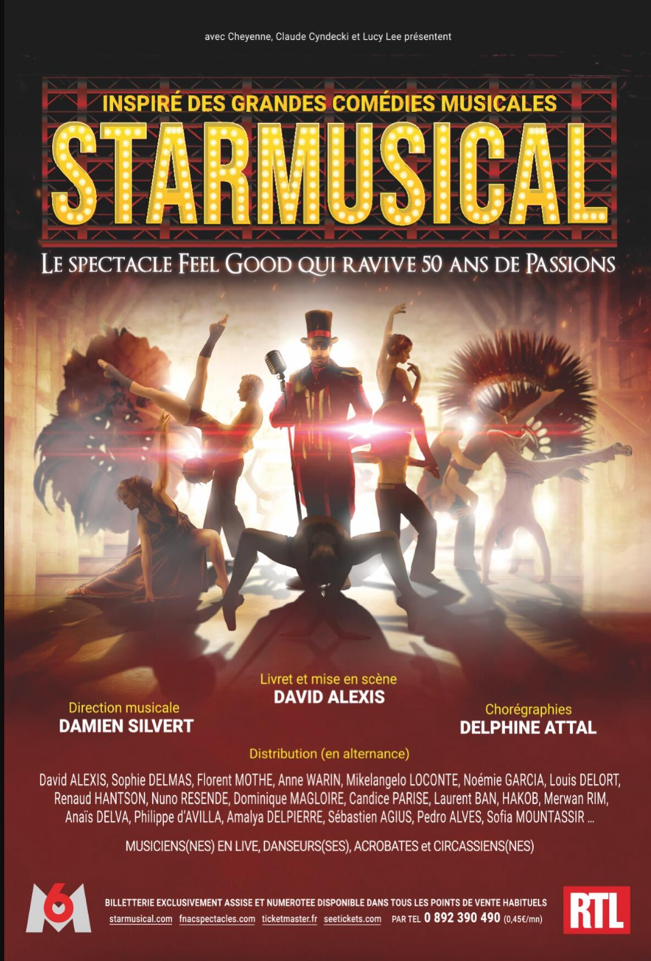
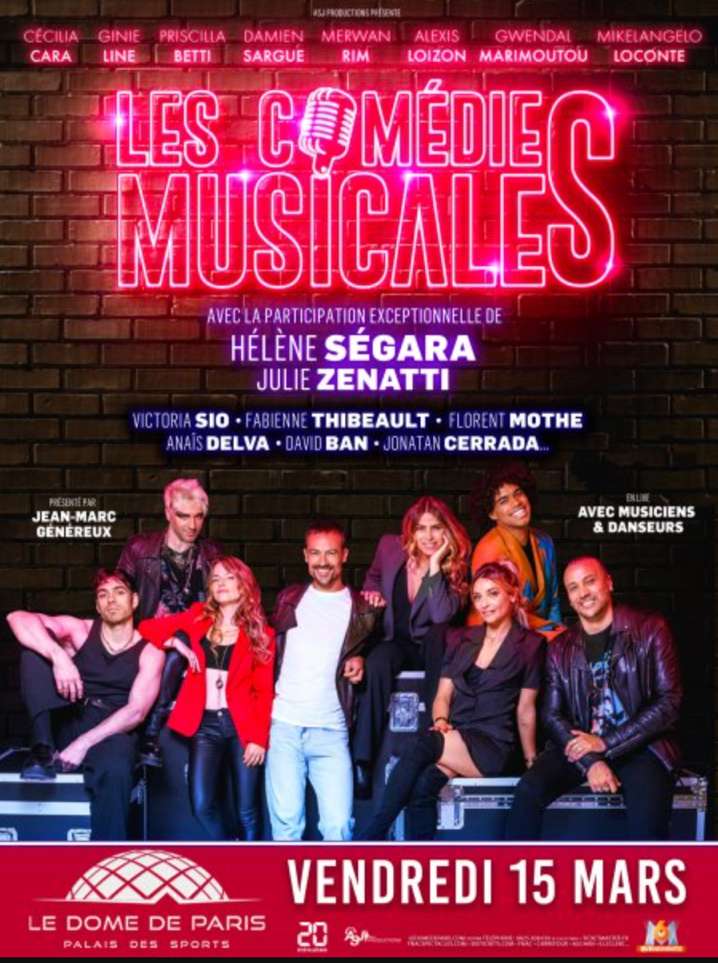
This is notably the case with Starmusical, a musical built from classic French musicals and featuring artists from these iconic productions reprising their roles. It constitutes a genuine mise en abyme in which both the narrative and the staging question the very history of the genre. Le spectacle des comédies musicales is another format that draws on classic French musicals, but takes the form of a concert, once again led by major figures of musical theatre. The aim is to keep this music alive and to maintain a connection with this audience.

Image credit: Official poster of Starmusical, promotional visual for the show (© Starmusical)

Image credit: Official poster of the show Les Comédies Musicales (© Les Comédies Musicales)

One question remains open: can nostalgia still function as a creative driving force, or does it now signal the limits of a model in search of renewal?

Written by Caroline Jabre

SOURCES: 

Sovereign Women in History and Art: An Eternal Ideological Stake

From Cleopatra to Elizabeth I, from Mary Stuart to Marie Antoinette, the names of great sovereign women evoke powerful myths of grandeur, beauty, and tragedy that nourish our imagination. But what remains of reality behind these narratives? Did Marie Antoinette really say, “Let them eat cake”? Was Cleopatra truly the most beautiful woman of the ancient world? History rarely concerns itself with certainties when it comes to queens: first and foremost, they are images, popular fables, and then objects of artistic fascination. The question then arises: can we truly write an objective history of great sovereign women, when their representations are filtered through ideology, the biases of sources, and the power of art?

History and Art as Ideological Construction

Since the 1970s, feminist criticism has shown that the history of art and political history are anything but neutral. In her foundational essay Why Have There Been No Great Women Artists? (1971), Linda Nochlin explains that if women seem absent from dominant narratives, it is not because they did not exist, but because the institutions of memory and knowledge were designed by and for men. Art historians such as Griselda Pollock remind us that women have long been muses and models, rarely creators or active subjects of visual history. Applied to sovereign women, this means that a queen is almost never studied for herself: she is either an ideal or a threat. Art and narratives do not seek to understand who she was, but to fix what she embodied.

This ideological construction is compounded by a concrete obstacle: the scarcity and one-sidedness of sources.

  • For Cleopatra, nearly all accounts come from her Roman adversaries (Plutarch, Dio Cassius), whose aim was to justify Octavian’s war against Mark Antony, officially ending the Roman Republic. Cleopatra as enemy of the Roman Republic helped unite citizens. Propaganda against her allowed Octavian to justify seizing power and removing Mark Antony, who was seen as a traitor to his homeland.
  • For Mary Stuart, chronicles differ depending on whether they come from Protestants (her political opponents) or Catholics (her supporters), in a context of rivalry for the English throne with her cousin Elizabeth I, compounded by religious conflict between Anglicans and Catholics.
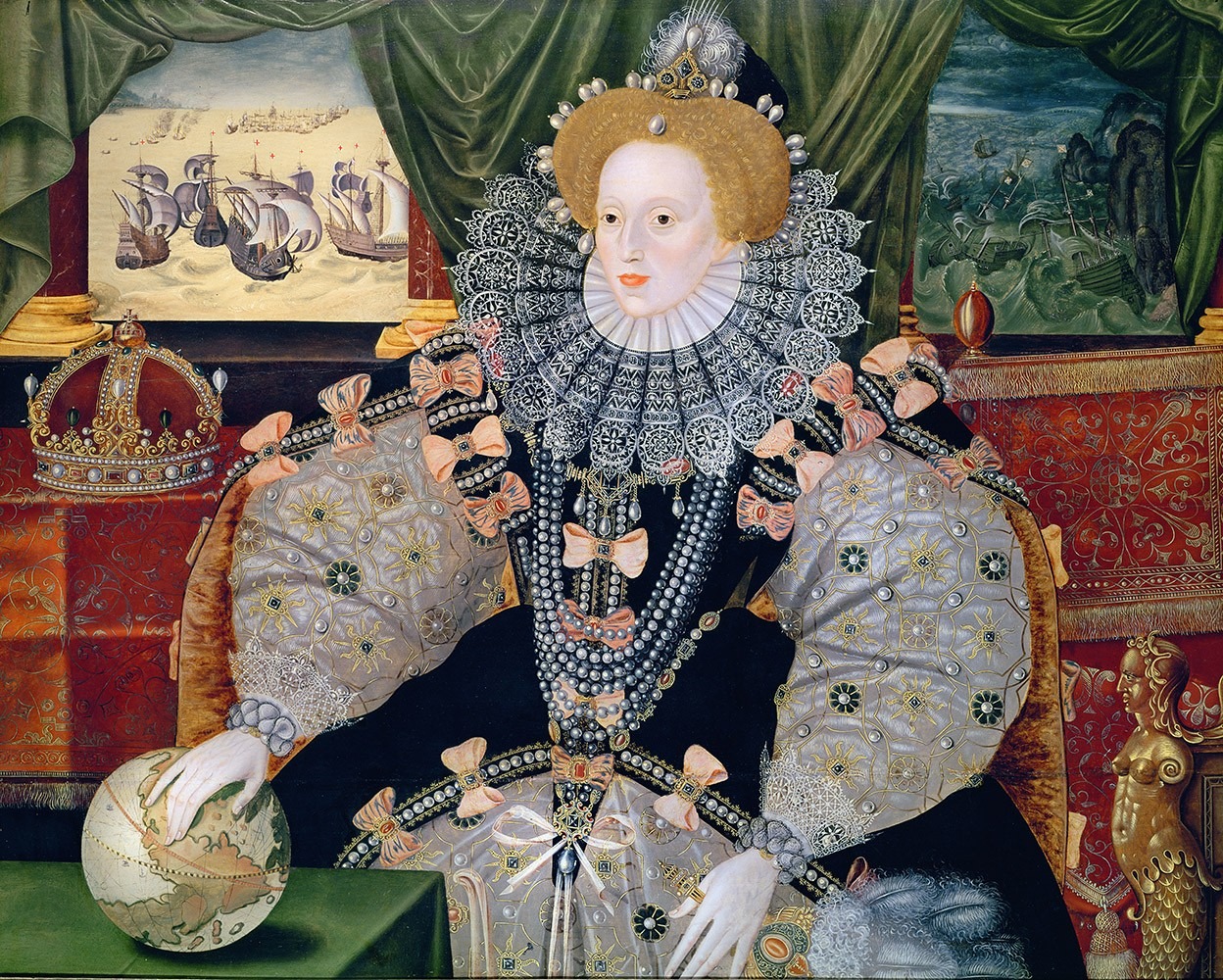
  • For Elizabeth I, official portraits were produced as instruments of propaganda: the famous Armada Portrait shows an invincible sovereign, far removed from real political dilemmas. Even when we have direct sources, their reception is biased. The correspondence between Mary Stuart and Elizabeth I reveals respect and even affection. But this female voice has been largely obscured in favor of the Manichaean narrative of a deadly rivalry, a narrative that served military and religious rivalries for the English throne.

Thus, historical objectivity seems illusory, but not entirely out of reach: it requires cross-referencing sources (archives, iconography, archaeological data) and, above all, adopting a critical stance that accepts recognizing areas of uncertainty. Writing the history of sovereign women also means accepting to say: “we do not know.”

The Archetypes Imposed on Sovereign Women

Rather than analyzing queens as complex individuals, historical and artistic narratives have classified them into archetypes. These categories reassure some (men) by simplifying, but distort reality.

Roman propaganda forged the image of Cleopatra as a queen-prostitute, using her charms to seduce Caesar and then Mark Antony in order to retain power. The implicit idea is clear: a woman cannot rule alone, especially not over a power like Egypt.

“By her charms, by her last favors, Cleopatra obtained from Caesar the kingdom and the death of Ptolemy. She was so passionate that she often prostituted herself; so beautiful that many men bought their existence for the favor of one of her nights.” Aurelius Victor, De viris illustribus urbis Romae, LXXXVI.

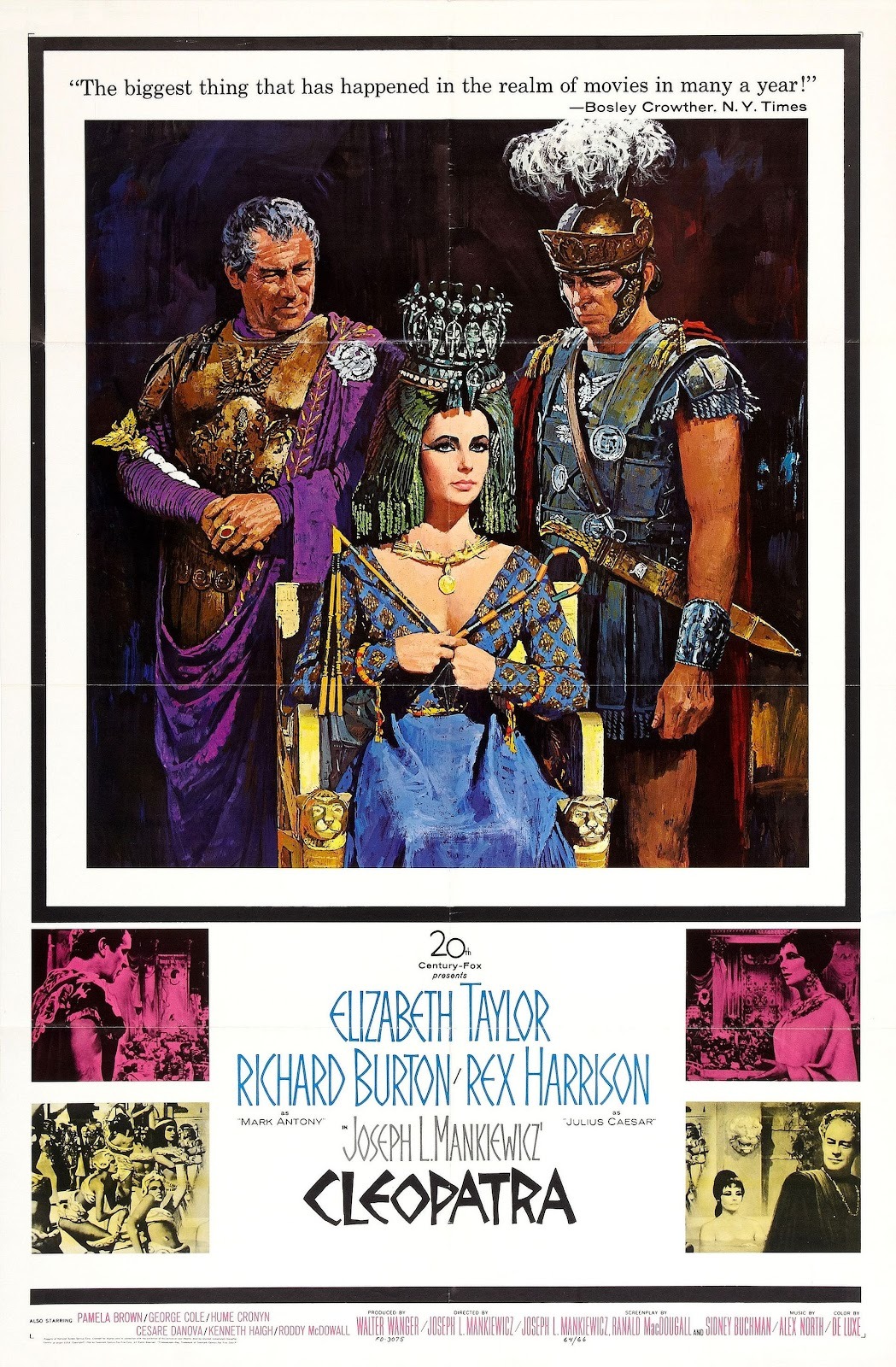
Orientalist art of the 19th century, followed by Hollywood in the blockbuster Cleopatra (1963) with Elizabeth Taylor, amplified this vision: Cleopatra became an object of artistic fantasy, more muse than sovereign. Her beauty and tragic death (suicide by asp bite, according to legend) are central, her political action erased. Yet reality is quite different. Here is a brief but more faithful portrait of the queen: Cleopatra was a polyglot, speaking nine languages, and the only one in her dynasty to learn and speak Egyptian fluently. A skilled diplomat, she managed to stay on the throne (despite coups by her brother, with whom she shared the throne at barely twenty years old) by forming an alliance with Julius Caesar, convincing him that it was better to have Egypt as an ally than as a colony. She was an economic strategist, restoring the value of the tetradrachm (Egyptian currency), whose value had been divided by three under her father’s reign. She innovated by displaying the fiduciary value on the reverse of bronze coins, thus curbing the inflation of bronze relative to silver. Cleopatra also claimed her pharaonic heritage, presenting herself as the embodiment of a cosmopolitan Egypt, changing her name from Cleopatra Thea Philopator (“Cleopatra, goddess who loves her father”) to Thea Neotera Philopatris (“new goddess who loves her homeland”).

Mary Stuart, for her part, embodies the archetype of the martyr queen. A Catholic queen facing a Protestant Scotland, she is seen either as a saintly victim of her faith (beheaded after a botched execution, the executioner having to strike three times) or as a traitor conspiring against England. Stefan Zweig’s literary biography Mary Stuart (1935) feeds this romantic myth: a queen intellectually brilliant, a pupil and muse of Ronsard, a recognized musician, but with a tragic destiny, sacrificed in struggles for power. Behind this image lies a more prosaic reality: a sovereign caught in religious and dynastic struggles, forced to abandon her one-year-old son, whose fate was less chosen than endured.In contrast, Elizabeth I illustrates the archetype of the “un-womanly woman.” To reign, she chose to marry herself symbolically to her kingdom and to embody the myth of the “Virgin Queen.” This political strategy shocked 16th-century society: to refuse motherhood was to refuse the very essence of femininity according to the mentality of the time. She is credited with numerous love affairs, now almost confirmed, including one with her childhood friend Robert Dudley, presented as the love of her life. This masculinization fuels rumors: some claim she was not really a woman. Articles (such as La vérité choquante sur le corps d’Élisabeth Ire que la famille royale a tenté d’effacer., on an unreliable site) present unverified hypotheses as top-secret royal facts just revealed to the public, and give into the sensational.

Portrait of Elizabeth I of England, the Armada Portrait, Anonymous, circa 1588, oil on panel, 110,5×127 cm, Woburn Abbey.

In France, Catherine de Medici is portrayed as a virago, manipulative and cruel, held responsible for the St. Bartholomew’s Day Massacre. A woman who loved her husband, who preferred her Diane de Poitiers, she was the queen mother who ruled in place of her three sons, who died one after the other without issue. A devotee of astrology, a science very much in vogue at the time, she was accused of frequently resorting to black magic and the services of Nostradamus. When a woman wields power, it must be explained: either she is not a “real” woman, or she derives her power from black magic.

Finally, Marie Antoinette embodies the archetype of the frivolous and spendthrift queen. Nicknamed “Madame Deficit,” she crystallizes popular hatred. Her supposed frivolity is summed up in the famous phrase “If they have no bread, let them eat cake” during the Women’s March on Versailles—a phrase she never actually uttered. Yet history reveals another facet: a young woman sent as a teenager to a foreign court, a patron of the arts, a mother devoted to her children. Her personal expenses were modest compared to the kingdom’s structural debts, but the archetype of a frivolous and guilty queen was more politically effective in the revolutionary context.

Attempts at Control and Contemporary Reception 

Some sovereign women tried to control their image. Elizabeth I, through her official portraits (Rainbow Portrait, Armada Portrait), projected an image of power and chastity (which she was forced to reaffirm in the face of her detractors). Isabella of Castile based her legitimacy on piety and Spanish unity—a valued register during the Reconquista (1492, reconquest and reunification of Spain against the Byzantine Empire). Christina of Sweden, finally, blurred the lines by voluntarily abdicating and reinventing herself as a European intellectual during the Enlightenment, writing her memoirs to shape her posterity. But these strategies are rarely entirely effective: public opinion and art reinterpret according to the narrative serving best the country, with a hint of sexism in the process.Art does not seek to tell the truth or bear witness to historical reality, but to produce images. Paintings, sculptures, and then films fix archetypes. The danger arises when these visual myths are taken for truths. Hollywood is a striking example: Cleopatra (1963) or Mary Queen of Scots (2018) emphasize glamour and romance, reducing queens to love intrigues and spectacular dramas (in the Latin sense: things to be seen). Their image is all the more cinematic because both queens met tragic ends: Cleopatra committed suicide in 30 BCE following the defeat at Actium, to avoid becoming a war trophy of the Roman army; Mary Stuart, condemned to death for treason, saw her executioner take three attempts to succeed in beheading her.

Poster of the Cleopatra movie, 1963, after Howard Terpning, public domain.

Recent academic research seeks to correct these biases. Historians such as Stacy Schiff (Cleopatra: A Life, 2010), Olivier Gaudrfroy (Cléopâtre l’immortelle, de l’Histoire à la légende, 2017), or specialists like R. Knecht (on Catherine de Medici) offer portraits stripped of clichés. We rediscover Cleopatra the strategist, Catherine de Medici the patron, Marie Antoinette the political figure. However, the problem persists. Contemporary female politicians are subject to similar mechanisms: Hillary Clinton is judged too harsh, Ségolène Royal is criticized for her dresses, Angela Merkel is reduced to her coldness. Moreover, women are regularly referred to by their first name, unlike their male counterparts, who are referred to by their surname (Kamala vs. Trump, for example).

Yesterday as today, female power continues to be perceived through and sometimes reduced to archetypes and sexist formulations.

Cleopatra, Mary Stuart, Elizabeth I, Marie Antoinette: all have been reduced to archetypes, the seductress, the victim, the virago, the frivolous woman, rather than being considered as complex individuals. If you wish to discover lesser-known queens, you can look into Zenobia of Palmyra or Boudicca, queens who opposed the Roman Empire, though we have little reliable (non-Roman) information about them.

Can we achieve total objectivity? Probably not, but we can approach it by cross-referencing sources, adopting a critical and gendered reading, and accepting the gray areas of history. Our contemporary responsibility is to distinguish between myth and historical reality and to ask ourselves, finally: in our media and current representations, do we draw a faithful mirror of women in power, or do we simply manufacture new myths ?

Written by Nine Letourmy

22nd Longueur d’Ondes Festival : Radio, Podcasts & Sound Innovation

From January 28 to February 1, the 22nd edition of the Longueur d’Ondes Festival, the “Festival of Radio and Listening,” took place in Brest. Since 2002, this event has been organized by four friends passionate about radio and sound expression: Laurent Le Gall, Aurore Troffigué, Laurent Venneuguès, and Hélène Vidaling. Over nearly five days, French-speaking radio professionals, journalists, authors, listeners, and radio enthusiasts of all kinds gathered at Brest’s national stage, Le Quartz, to participate in roundtables, conferences, workshops, and live-recorded broadcasts.

The program for this year’s edition revolved around three main themes: “Defending Public and Independent Media,” “In the Name of Feminist Struggles,” and “Cherishing Listening.” Every evening, between the festival’s intense days, attendees could also enjoy numerous shows and concerts organized alongside the festival, blending the auditory experience with broader cultural events.

But one might ask, why is a festival of such renown held in Brest? The answer lies in the city’s historical and ongoing relationship with radio. Brest is unanimously considered a “radio city,” thanks to its rich history and exceptional associative dynamics in the field of radio. Since the liberalization of the airwaves in 1981, several pioneering free radio stations emerged in the city, including Radio Neptune (1982) and Fréquence Mutine (1982). These stations established a model of local, alternative, and engaged radio. Alongside them, RCF Rivages (1992) and Radio U (2001) have contributed to a diverse radio landscape where associative stations collaborate rather than compete, united by a shared ethos: Brest.

Picture of Brest during the Festival

The Key Role of Associative Radios in Sound Creation

Until 1970, the ORTF (Office de Radiodiffusion-Télévision Française) held a monopoly over all radio broadcasting in France. Following the social upheavals of 1968, a number of pirate radio stations, often popular and illegal, began spreading beyond Paris. These small, independent stations laid the groundwork for a new type of radio, one closer to its community, freer in content, and experimental in format.

In 1981, under the presidency of François Mitterrand, these stations were legalized, provided they adhered to certain requirements that offered protection for artistic creation. Today, there are approximately 600 associative radio stations in metropolitan France and 130 in overseas territories. They collectively attract around one million daily listeners, each tuning in for about an hour. By contrast, Radio France reaches seven million listeners for two hours of listening on average.

However, these associative radios are increasingly forced to fight to maintain editorial independence. Funding from the FSER (Fonds de Soutien à l’Expression Radiophonique) has been diminishing, placing vital local stations in jeopardy. Stations such as Radio Campus Paris, Radio Grenouille in Marseille, or Jet FM in Nantes, staffed by a few salaried employees and around a hundred volunteers, and financed 80% through public subsidies, risk disappearing if these reductions continue. Beyond their informational role, associative radios serve as critical training grounds for French radio professionals. Many current Radio France employees began their careers in these community-driven environments, learning the craft in a way large public broadcasters rarely allow.

Thus, associative radios are not only engines of local culture and artistic creation but also incubators of the next generation of media professionals, fostering innovation, experimentation, and diversity in a media landscape that often risks homogenization.

Picture of one of the first free radio stations

Copyright Issues for Podcast Creators

The festival also served as an important forum for discussing copyright challenges in the evolving podcast sector. As with the BIS (Biennales Internationales du Spectacle Vivant) in Nantes, the Longueur d’Ondes Festival highlighted the urgent need to adapt copyright law to new cultural formats, particularly independent podcasts.

Podcasting, a relatively recent and rapidly growing medium, now encompasses nearly 100,000 independent series and 100 million individual podcasts worldwide. These productions often explore topics overlooked by traditional radio, offering listeners a fresh and immersive experience. Yet the legal framework surrounding podcast creators remains minimal. Questions abound: should funding responsibilities fall under the CNM (Centre National de la Musique) or the CNC (Centre National du Cinéma et de l’image animée)? The ambiguity hampers both creators’ protections and opportunities for support.In response, representatives from the IGAC (Institut Général des Affaires Culturelles), the SCAM (Société Civile des Auteurs Multimédia), the PIA (Pôle Innovation Audiovisuelle), ARCOM, and Radio France convened in a roundtable titled “The Sound Work: The Overlooked Aspect of the Cultural Sector.” They recognized that the podcast industry remains the only cultural sector not systematically subsidized, aside from a few small grants. An agreement was nevertheless reached between Radio France and the PIA, aiming to promote independent PIA podcasts on the Radio France platform and ensure proper remuneration, contrasting with platforms such as Spotify or Deezer, which often undercompensate creators.

This dialogue marks the beginning of a larger legislative initiative. The goal is to create a sound creation ecosystem modeled on audiovisual frameworks, defining authors, co-authors, and regulations that protect creative rights and eventually integrate into the SMA (Services Media Audiovisuels) directive. By establishing clear protections for podcast creators, the industry moves closer to a sustainable and equitable model, legitimizing podcasts as a vital cultural and professional medium.

Podcasts as Political Influencers

The 22nd edition of the festival also explored the growing political influence of podcasts, particularly evident during the 2024 U.S. presidential elections. One conference featured a journalist specializing in American politics, who noted that many U.S. citizens no longer relied on traditional TV news channels like Fox News. Instead, they increasingly turned to podcasts, including shows hosted by Andrew Tate, which attracted up to twelve million listeners during the election period.

What astonished observers was the format itself: three hours of daily, unscripted content in which podcasters shared opinions “as they came to mind.” Unlike conventional media, these programs offered no structured debate or editorial counterpoints, creating what the journalist described as a “form of shouting broadcast,” unfiltered and often polarizing.

This shift toward podcasts correlates with a historical regulatory change. In 1987, the Reagan administration abolished the Fairness Doctrine, which had required U.S. broadcasters to provide balanced and diverse content on local and federal channels. Without this regulation, citizens increasingly sought alternative sources of information, with podcasts emerging as a primary vehicle for unmediated political discourse. The implications are profound, not only for the media industry but also for democratic engagement and information literacy, highlighting the capacity of audio media to shape public opinion in ways that traditional outlets increasingly cannot.

Challenges Facing Public Broadcasting

Finally, the festival addressed ongoing challenges to public broadcasting, notably the Cohen-Legrand affair, discussed in the presence of Thomas Legrand, a leading French journalist. Legrand replaced Laurence Bloch, former director of Radio France, who was absent due to her upcoming summons before the Parliamentary Inquiry Commission on public broadcasting neutrality.

Participants discussed the growing scrutiny over the cost and neutrality of public broadcasting, especially since the 2022 elimination of the public broadcasting license fee. Concerns were raised regarding the perceived pressure to maintain “neutrality,” with the commission urging broadcasters to appear politically impartial. Legrand emphasized that neutrality should not be a superficial display, but rather an opportunity to reflect the complexity and diversity of opinions so that every listener can identify with public service content. His remarks underscored that expressing opinions differs depending on the platform: as an editorialist for Libération, he exercises a different voice than when contributing to France Inter, illustrating the nuanced responsibilities of public media professionals.

A female participant also highlighted the ideological stakes in public broadcasting debates. Opposition to public service is increasingly used as a political tool, framed as an electoral argument rather than a financial or operational critique. This underscores how media policy debates can become entangled with broader ideological battles, reflecting shifts in public discourse, political strategy, and the very role of media in society.

Picture of Jean Lebrun, Nathalie Sonnac and Thomas Legrand at the Conference about Challenges Facing Public Broadcasting.

Conclusion

The 22nd edition of the Longueur d’Ondes Festival has demonstrated the enduring importance of community-driven dialogue in the French-speaking radio landscape. By bringing together professionals, volunteers, listeners, and enthusiasts, the festival fostered critical reflection on pressing issues: the sustainability and independence of associative radios, the emerging legal and economic structures needed for podcasts, the transformative influence of audio media on political discourse, and the ideological pressures facing public broadcasting.

Beyond simply discussing problems, the festival highlighted solutions: collaborations between public broadcasters and independent podcast networks, legislative efforts to secure creators’ rights, and ongoing advocacy for funding and editorial independence. These conversations are vital, not only for the survival of diverse radio formats but also for nurturing a culture that values listening as much as speaking, creativity as much as consumption, and informed engagement as much as entertainment.

In addition, the festival underscored how media, in its many forms, shapes society, not only by delivering content but by defining how audiences experience, interpret, and interact with the world. From local associative radios to globally influential podcasts, sound media continues to be a conduit for knowledge, debate, and cultural expression. By providing a forum for collaboration, debate, and celebration, the Longueur d’Ondes Festival ensures that the art and craft of listening remain central in a rapidly changing media landscape.

Ultimately, the 22nd edition reaffirmed that radio and audio storytelling are more than just technologies, they are social practices, educational tools, and instruments of democracy. They foster connection, provide platforms for marginalized voices, and offer spaces for experimentation and reflection. As the festival concluded, participants left not only with new ideas and renewed energy but with a shared understanding of the stakes, responsibilities, and possibilities inherent in the world of sound. The conversations, debates, and collaborations sparked during those five days will continue to resonate, echoing far beyond Brest and shaping the future of radio and audio media for years to come.

Written by Judith Laithier

Strike at the Louvre

Strikers protesting for better work conditions, higher wages and more workers, and against the obsolescence of the building and the LNR Project (© LeParisien LP/Ahmed Benazzouz)

On Monday, February 16, an assembly of more than 200 employees of the Louvre Museum voted to go on strike, making it impossible to fully open the museum. Launched in mid-December, the strike movement at the Louvre has taken on an unprecedented scale over the past few weeks for France’s largest museum institution. On several occasions since December, the museum has been forced to close entirely to the public as a direct result of the mobilisation of a significant share of its workforce. On January 26, several hundred employees gathered in a general assembly at the auditorium voted to renew the strike notice initially filed on December 8 by an inter-union coalition bringing together CFDT, CGT and SUD Culture, marking a new phase in what has become a prolonged social conflict.

According to the trade unions, the mobilisation originated in a spontaneous movement by non-unionised staff members in June 2025, accompanied by the drafting of a list of grievances that, in their view, received no adequate response from management. The jewellery theft that occurred in October 2025 is described as a further shock to the institution’s social fabric, as it exposed long-standing shortcomings in security, investment priorities and staffing management. Since then, the inter-union group says it has been closely monitoring the conflict, consulting employees every week on whether to continue the strike. The participation of staff from the Denon wing — which houses the Mona Lisa — led to the museum’s complete closure on several occasions, an outcome union representative has described as historic.

The various union statements converge in portraying an institution facing deep structural difficulties. The unions denounce working conditions they consider increasingly degraded, an ageing building whose deterioration has led to repeated technical failures, and a chronic lack of staff. According to them, these constraints result in the daily closure of galleries beyond the forecasts of the guaranteed opening plan, hindered visitor circulation and limited access to the collections, to the point that a visit to the museum has been described as an “obstacle course” by the workers. Internally, staff report a steadily increasing workload, growing tensions in human resources management and contradictory directives that they say are incompatible with the calm exercise of a public service mission.

The social tensions unfolding at the Musée du Louvre also coincide with uncertainty surrounding one of the institution’s most ambitious transformation projects. Scheduled to meet on February 11, the jury of the international architecture competition for the “Louvre–Grande Colonnade” project — part of the broader Louvre–Nouvelle Renaissance plan — ultimately postponed its deliberations to an unspecified later date. Officially justified by the need for further analysis of the proposals, the delay comes amid a series of crises affecting the museum, including security failures, infrastructure damage and ongoing labour disputes. Announced in January 2025 by President Emmanuel Macron, the project aims to redesign the museum’s eastern wing to improve visitor flow and access to the Mona Lisa, with an estimated cost of more than one billion euros. While the museum’s management insists on the project’s strategic importance, trade unions — already mobilised against what they describe as deteriorating working conditions and fragile funding priorities — have openly opposed the redevelopment, arguing that it diverts attention and resources from more urgent issues related to safety, staffing and day-to-day operations. The postponement of the jury meeting has therefore been interpreted by union representatives as a signal of broader instability, reinforcing their criticism of governance choices at a time when the institution is already under strain.

At the heart of the demands are issues related to the institution’s governance, site safety and security, project and pricing policies, the creation of permanent civil service positions, the stabilisation of contract staff, salary increases and the overall improvement of working and visiting conditions. These demands are also part of a broader reflection on the museum’s economic model, a large share of whose budget now relies on its own revenues, fuelling, according to the unions, tensions between financial imperatives and staff working conditions.

Asked about the situation, Culture Minister Rachida Dati publicly acknowledged on January 13, during an interview on Europe 1, the existence of a “governance problem” at the head of the institution, while announcing forthcoming decisions without specifying their nature. Despite several rounds of negotiations with management and supervisory authorities, the unions believe that the responses provided so far remain insufficient. Staff members, who say they are deeply attached to the Louvre, now describe their mobilisation as a major warning about the future of the institution’s social and cultural model and, more broadly, that of France’s major public cultural institutions.

On Tuesday, January 28, 2025, Emmanuel Macron announced the future transformation of the Louvre Museum. ©Twitter/©Elysee

The state of public museums in France

Beyond the Louvre alone, the strike movement reflects a broader context of weakening across France’s public museums, which have been facing persistent structural pressure for several years. Staff point to rising workloads, increasingly tight schedules and enforced versatility, often within ageing buildings whose maintenance has been significantly delayed. Deteriorating infrastructure, regularly reported by employees, raises concerns about safety, the preservation of artworks and working conditions alike, while budgetary trade-offs increasingly favour self-generated revenues, high-profile events or profitability at the expense of day-to-day operations.

In this context, pricing policies, the growing number of exceptions and discounts, and pressure to increase visitor capacity are widely perceived by staff as contributing to the erosion of public service quality. These dynamics create a widening gap between the museums’ heritage and educational missions and the resources actually allocated to fulfil them. Added to this are recurring human resources issues: increased reliance on precarious contracts, limited career prospects, declining purchasing power and a widespread feeling of exclusion from strategic decision-making.

The demands set out in union statements — including the creation of permanent positions, salary increases, improved working conditions, recognition of staff expertise and clearer governance — echo a malaise shared across many public cultural institutions. Employees warn of the risk of a gradual erosion of the French museum model as an accessible public service grounded in professional expertise.

This situation can partly be explained by changes in the economic model of public museums, marked by growing dependence on own-source funding such as ticket sales, sponsorship, space rentals and blockbuster exhibitions, at a time when state and local authority funding is stagnating or declining. Under the supervision of the Ministry of Culture, many institutions are encouraged to boost revenues and attendance, resulting in intensified activity without corresponding increases in human or technical resources. For staff, this translates into mounting daily pressure: denser visitor flows, extended opening hours and increased reliance on evening, weekend and public holiday work, often seen as necessary to offset declining purchasing power.

Material working conditions remain another major point of tension. Much of France’s museum heritage is housed in historic buildings requiring heavy and continuous investment to maintain and upgrade. Staff regularly warn of technical failures, safety concerns and spaces ill-suited to mass tourism, all of which complicate their work. These issues affect visitors through partial gallery closures, restricted circulation and degraded visiting conditions, while also exposing staff to heightened risks and a growing sense of lost purpose.

Human resources challenges are equally central to the discontent expressed. The increasing use of contract staff, the multiplication of employment statuses and the precarisation of certain professions undermine service continuity and fuel feelings of inequality within teams. Employees denounce limited career progression, insufficient recognition of their skills and management practices perceived as increasingly top-down, leaving little room for dialogue or consultation. In this context, governance has become a key issue, with unions calling for staff to be more closely involved in strategic decisions shaping the future of museums.

The Louvre Museum with its famous glass pyramid, built between 1985 and 1989 (image libre de droit)

What lies ahead?

The outcome of the conflict at the Louvre, as in other public museums, will largely depend on the ability of public authorities and institutional leadership to translate widely shared diagnoses into structural decisions. In the short term, targeted measures — temporary staff reinforcements, budgetary shifts in favour of safety and maintenance, and commitments on certain pay demands — could help ease tensions and restore more stable operations. However, without a long-term strategy, such measures risk falling short of addressing the depth of the problems identified.

In the medium term, the economic and social model of major public museums appears to be a central issue. The growing reliance on own revenues and mass attendance, often framed as unavoidable, could be reassessed in light of its impact on working conditions, conservation standards and the quality of visitor reception. A redefinition of priorities — refocusing on core public service missions, sustained investment in buildings and staff, and a better alignment between cultural ambitions and available resources — is one scenario frequently discussed by sector stakeholders.

Change may also require a renewal of governance practices. Recent social movements reveal strong expectations for greater recognition of staff expertise and for more meaningful social dialogue upstream of major strategic decisions. Closer staff involvement in shaping institutional choices could help rebuild trust and prevent recurring crises, while ensuring that stated objectives better reflect on-the-ground realities.

Finally, beyond the Louvre itself, these mobilisations may influence broader national cultural policy orientations. Under the authority of the Ministry of Culture, the State faces the challenge of clarifying its role and level of commitment in financing and regulating major heritage institutions. Without structural responses, social conflicts may multiply, turning such movements into lasting warning signals about the sustainability of the French cultural model. Conversely, a clear policy shift could open the way to a more balanced equilibrium between international prestige, accessibility and working conditions.

The debates raised by the strike at the Louvre Museum, and by similar movements in other institutions, go beyond the social dimension alone. They raise questions about the very future of cultural policy in France. As several observers point out, persistent underinvestment in public museums, combined with growing reliance on their own revenues, could gradually weaken their ability to fulfil their public service missions. In the long run, the preservation, study and transmission of cultural heritage could increasingly fall to private actors, foundations or institutions whose operations are shaped by profitability requirements, sponsorship strategies or audience-driven objectives.

Private museums and independent cultural initiatives undoubtedly contribute to enriching and diversifying the cultural landscape. However, their goals do not necessarily align with the long-term imperatives of conservation, research and universal access. Public museums have historically played a central role in preserving collections regardless of their immediate appeal, ensuring affordable access to knowledge and maintaining scholarly independence from commercial pressures. The concerns expressed by museum staff therefore resonate as a warning signal: that heritage management could gradually shift towards a market-driven logic.

Ultimately, the current mobilisations can also be read as a call to reaffirm public responsibility for cultural preservation at a time when the balance between public service and economic constraints appears more fragile than ever.

Written by Gabriel Maget

Sources:
CGT Etat : « Caisse de grève pour les agent·es du musée du Louvre (Intersyndicale Culture) »
Cfdt : « Les salariés du Louvre en grève pour leurs conditions de travail »
France info : « Nouvelle journée de grève au musée du Louvre, qui n’ouvre que partiellement »
Le Monde : « Grève au Louvre : nouvelle journée de mobilisation, le musée n’est que partiellement ouvert ce lundi »
Connaissance des arts : « Louvre : entre crises à répétition et polémiques, nouveau coup dur pour le musée et son grand projet de réaménagement à 1,15 milliard d’euros »

European Painting Confronted with the Transition from Polytheism to Monotheism

For centuries, Europe lived surrounded by visible gods. They had bodies, faces, stories, tempers, desires, and a profoundly human dimension. They inhabited the walls of houses, public squares, temples, and frescoes. Then, gradually, this familiarity with the divine faded. Not through an immediate iconoclastic upheaval, but through a slow shift in which images more than texts carried the trace of a deep transformation: the passage from a polytheistic world to a monotheistic one.

The history of European painting can be read as the silent narrative of this transformation. It tells how the sacred moved from body to sign, from presence to absence, from multiplicity to unity. Above all, it reveals how the image, far from being abolished, had to learn to express differently what it could no longer show directly. Painting thus became a fragile, sometimes contradictory space, where the balance is negotiated between what can be seen, what must be believed, and what can be shown.

The Age of Visible Gods

Vénus d’Arles, Inconnu (Sculpture antique romaine, Ier siècle av. J.-C., probablement d’après un original grec de Praxitèle) Musée du Louvre, Paris, Domaine Public

« Le Lararium de la Maison des Vettii« , Inconnu (Artiste romain, Ier siècle après J.-C.), Parc Archéologique de Pompéi, Domaine Public

In Greek and Roman antiquity, the relationship to the divine was above all visual. The gods were not abstract entities: they were recognizable, embodied, almost familiar. They shared the world of humans and reflected what we ourselves are our passions, our excesses, our desires. Painting and sculpture were not theological problems; they were cultural certainties, natural extensions of myth.

Figures such as Apollo, Aphrodite, or Zeus were not abstract symbols, but identifiable presences endowed with narratives, attributes, and specific functions. The image made it possible to recognize the god, to invoke them, and sometimes even to contain them symbolically. Mythological frescoes, far from being merely decorative, participated in a daily relationship with the sacred.

In Pompeii, the walls reveal a striking intimacy between humans and divinities. Gods appear in atriums, painted gardens, bedrooms, kitchens. They are not confined to temples; they coexist with domestic life. This proximity reflects a worldview in which the sacred is never radically separated from the profane.

Formally, this vision translates into a celebration of the body. The divine body is measured, balanced, ideal. It embodies a cosmic order as much as an aesthetic ideal. To represent a god is to affirm that the world is intelligible, that the divine accepts a human form. Here, to see is to believe.

The Emergence of the Invisible God

« Le Bon Pasteur« , Sculpteur Paléochrétien Inconnu (IVe siècle), Musée Pio Cristiano, Domaine Public

With the rise of Christianity, something fractures in the visual certainty inherited from Antiquity. This is not an immediate rupture, nor a brutal destruction of earlier images, but a long period of disturbance, doubt, and profound re-evaluation of the gaze. Where ancient gods offered themselves freely to sight, the Christian God introduces a radical distance. He is not one being among others: He is unique, absolute, transcendent. He cannot be circumscribed by form or enclosed within an image without the risk of betrayal.

This theological novelty gives rise to what might be called a foundational crisis of the image in European culture. For the first time, seeing becomes a problem. Looking can become a fault. The image once a site of the sacred’s presence suddenly becomes ambiguous.

Christianity inherits an ancient suspicion toward figurative representation, rooted in the biblical prohibition of idols. “You shall not make for yourself a graven image”: this commandment weighs heavily on the early centuries of Christianity. The issue is not merely to avoid certain images, but to rethink their legitimacy altogether. The image becomes a dangerous, unstable territory, poised between permission and prohibition. It can divert faith, fix the invisible, replace God with His appearance. It can become an object of worship in itself precisely what Christianity seeks to prevent.

In this context, painting is no longer an obvious or decorative act. It becomes an act laden with spiritual responsibility, almost a risk. Every form, every figure, every iconographic choice implies a theological position. The artist or more often the anonymous artisan no longer invents freely; they search, hesitate, and proceed with caution.

The earliest Christian images bear witness to this profound hesitation. They often seem to speak in a whisper. In the Roman catacombs, Christ is rarely represented directly. When He does appear, it is not as a glorious god or an idealized body, but through indirect, metaphorical, almost effaced forms. The Good Shepherd borrowed from rural imagery and late antiquity suggests a presence without fixing it. The fish, the vine, the anchor function as discreet signs, intelligible only to the initiated.

This symbolic language is not merely an aesthetic choice; it is a strategy for the survival of the image. It allows a message to be transmitted, teaching to occur, a community to be formed, while respecting divine transcendence. The image becomes allusive, fragmentary, deliberately incomplete. It does not show Christ; it allows Him to be inferred.

This period is therefore marked by an almost insoluble tension. On the one hand, Christianity needs images in order to spread, to teach a largely illiterate population, to render visible a history founded on incarnation. On the other hand, it must prevent these images from becoming idols. It must show without showing, represent without fixing, make the divine perceptible without betraying it.

This contradiction lies at the heart of the Christian image crisis. The image ceases to be a site of direct incarnation of the sacred and becomes a space of translation, subject to constant vigilance. It is never fully legitimate, never entirely rejected. It exists conditionally watched over by dogma, tolerated more than embraced.

Yet it is precisely in this fragility that the Christian image finds its strength. By renouncing full visibility, it gains new depth. It no longer offers God to sight; it opens a space for reflection, interpretation, and faith. This crisis is therefore not a negative episode in the history of European art, but a foundational moment. It forces the image to rethink itself, to become charged with meaning, to exist as a site of tension between the visible and the invisible.

From this initial hesitation, from this slow search for a possible effigy, the Byzantine icon and later all Western Christian imagery will emerge. Before becoming a stable form, the image of Christ was first an open question.

The Icon: Seeing Without Seeing

“Le Christ Pantocrator du Sinaï”, Anonyme (Style encauste, VIe siècle), Icône du Sinaï – Monastère Sainte-Catherine, Domaine Public

“Vierge à l’Enfant” (dite Madone Stoclet), Duccio di Buoninsegna, The Metropolitan Museum of Art (Met), New York, Domaine Public / OASC

“Le Christ” (Détail de la Mosaïque de la Déisis), Mosaïste Byzantin Anonyme (XIIIe siècle), Hagia Sophia – Sainte-Sophie, Istanbul, Domaine Public

It is in the Byzantine world that this tension between visibility and prohibition finds its most stable and enduring form and also its most decisive one for the history of European art: the icon. Far from definitively resolving the problem of divine representation, the icon organizes it, channels it, and above all makes it transmissible. It accepts the image, but at the cost of a radical transformation of its function, status, and language.

The Byzantine period is crucial because it establishes the first coherent system of representing Christ in European history. Before it, Christian imagery hesitated, circumvented, suggested. With the icon, Christ acquires a stable, reproducible, immediately recognizable face. This face no longer stems from the artist’s free invention; it follows precise canons, transmitted, repeated, almost immutable. For the first time, Europe possesses a standardized image of the divine.

Christ Pantocrator is not a narrative or emotional figure. He tells no story, performs no action. He asserts Himself. His frontal face, fixed gaze, and near-abstract immobility create a radical distance from the viewer. There is no realistic décor, no landscape, no horizon. The gold background abolishes illusionistic depth: there is neither heaven nor earth, only eternity. Christ is not situated within the world; He stands above it.

This choice is not aesthetic in the modern sense it is theological. The icon does not seek to move or seduce. It rejects pathos and direct identification. Where ancient art glorified bodily beauty, Byzantine art sacralizes fixity, frontality, and repetition. Christ’s face becomes a surface for spiritual projection, not an object of sensual fascination.

This discipline of the gaze is essential. The icon does not represent God as He is, which would be impossible but as He can be contemplated and understood without being possessed. It establishes an asymmetrical relationship: it is not the viewer who masters the image, but the image that sustains and returns the gaze. To look at an icon is not to consume an image; it is to accept being looked at in return.

This new visual regime durably grounds Christian iconography. Even when medieval and later Renaissance Western art distances itself from Byzantine style, Christ’s face remains deeply marked by this legacy: persistent frontality, meaningful gaze, spiritual function of the image. Even the Renaissance, despite its naturalism, never fully erases this Byzantine matrix.

Thus, the icon is not a frozen episode in art history; it is a visual infrastructure, a foundation upon which all European Christian imagery is built. It allows the image to survive prohibition, to remain at the heart of worship without becoming an idol, and above all to anchor Christ’s figure permanently in collective memory.

Christian imagery therefore does not disappear; it changes regime. It ceases to be a direct incarnation and becomes a codified mediation. It becomes at once a pedagogical, liturgical, and theological tool. It does not show the divine; it points toward it, tracing a narrow path between the visible and the invisible, between the necessity of the image and the danger of its power.

The Return of the Body: The Renaissance as Compromise

“Le Jugement Dernier”, Michel-Ange, Chapelle Sixtine – Musées du Vatican, Domaine Public

“Vierge à l’Enfant” (ou La Madone Campana), Sandro Botticelli, Musée du Petit Palais (Avignon), Domaine Public

The Renaissance marks a subtle turning point. By rediscovering antiquity, Europe reactivates an ancient visual language based on the body, perspective, and harmony. This return does not occur against Christianity, but within it.

With Michelangelo, the body becomes central once more. Christ regains a physical power reminiscent of ancient heroes. Muscles, torsions, expansive gestures reintroduce a pagan energy within a Christian theological framework.

The Virgin Mary also transforms. She becomes mother, protector, a figure of embodied tenderness. Her representations sometimes borrow from ancient mother-goddess archetypes, without ever explicitly claiming them. Monotheism thus reinvests archaic forms in order to make the sacred once again perceptible.

The Renaissance does not abolish Christian distance; it negotiates it. It accepts that the body can once again become a language of the divine, provided it serves a spiritual purpose.

A Pagan Memory Beneath the Christian Surface

What this long history reveals is that the transition from polytheism to monotheism was never a visual tabula rasa. Forms survive, shift, transform. The image preserves what theology rejects.

Even when religious discourse becomes iconophobic, painting continues to work through the memory of ancient gods. It absorbs their gestures, proportions, and narratives, redistributing them through new figures.

Thus, the history of European painting is not merely that of a change in belief. It is the story of a displacement of the sacred, of a constant effort to make visible what must no longer be shown.

What the Image Still Tells Us Today

When we observe these works, one thing becomes clear: the image never ceases to be a field of tension between faith, power, and the desire to see. Monotheism did not suppress the need for images; it made that need more complex, more ambiguous, more symbolically charged.

Perhaps this is why European art has never stopped dialoguing with the sacred, even when it moves away from it. Behind every Christ, every Virgin, every icon, the faint silhouettes of ancient gods persist.

Painting, in this sense, is less a mirror of faith than a site of cultural memory. It remembers what texts forget. It tells us that gods never disappear entirely, they simply change their faces.

Written by Paul Saoud

Culture 3.0: Towards a New Financial Structure for Cultural Institutions

Beeple (Mike Winkelmann), Everydays: The First 5000 Days, 2021. NFT. ©Beeple

From Speculation to Infrastructure: The Genesis of a Regulated Cultural Web 3.0

The year 2021 was marked by a sudden and unprecedented explosion in the field of Non-Fungible Tokens (NFTs). This period was characterized by a level of speculative euphoria that remains difficult to fully comprehend today, highlighted by extraordinary records in the world of public auctions. One cannot discuss this era without mentioning the seminal work of the artist known as Beeple, which was successfully transacted for a sum exceeding 69 million dollars through the auction house Christie’s. However, when we look at the current landscape, a fundamental question arises : how many individuals within our contemporary society remain truly informed about the nature and purpose of NFTs today ?

The reason for this collective distancing is that, starting in 2022, this technology underwent what appeared to be a total and absolute collapse. Transaction volumes did not merely decline; they decreased by more than 90%, a downturn so severe that it led many observers to contemplate the fundamental incompatibility of the cultural and artistic sectors with the technological framework of Web 3.0.

Nevertheless, with several years of hindsight and perspective, we are now in a position to assert that this volatile phase was, in fact, a strategic necessity. It served as a critical testing ground to probe the ultimate limits of the technology and to act as a filtering mechanism designed to maximize its eventual utility. Projects that were fundamentally devoid of intrinsic meaning or long-term value were systematically discarded. This process made way for what major industry reports now describe as a state of “irreversible institutionalization.” We have moved past the era of speculating on digital images; the current focus has shifted toward utilizing blockchain technology for tangible assets. This shift allows for the construction of the legal and technological foundations that are essential for the establishment of a market that is both stable and fundamentally healthy.

For those individuals who may not be entirely familiar with the intricacies of blockchain technology, one can simply visualize it as a vast, decentralized ledger. This ledger systematically catalogs all information in a manner that is entirely transparent, accessible to every participant, and characterized by the absolute impossibility of modification or alteration. Within the specific confines of the cultural world, blockchain provides several critical utilities:

  1. Total Traceability: It enables a system of comprehensive traceability that functions as an immutable digital certificate of authenticity. Every time a specific work of art undergoes a change in ownership, this information is indelibly recorded within the blockchain.
  2. Automated Procedures: It facilitates the implementation of automated procedures, which effectively eliminates the burden of administrative complications and removes the necessity for various intermediaries.
  3. Tokenization of Rights: It allows for the transformation of a specific right (here, for instance, we can utilize the ownership right of a physical painting as an example) into a digital asset known as a token. It is specifically through this process of tokenization that a single work of art can be subdivided into thousands of distinct shares, all while providing a guarantee that each individual share remains unique and entirely secure.

Since the beginning of the current year, the global regulatory environment appears to be shifting strongly in favor of digital frameworks, thereby ensuring the existence of a healthy market, even for the cultural sphere. Within the European context, the official entry into force of MiCAR (Markets in Crypto-Assets Regulation) has fundamentally altered the entire operational system for cultural entrepreneurs. Whereas there was a profound sense of mistrust regarding tokens, viewing them as potential « scams » (an opinion I myself held only a few months ago), the new cultural projects being launched in nations such as France or Belgium can now be disseminated across the European Union with a robust sense of legal security.

Furthermore, companies are now mandated to demonstrate a high degree of transparent marketing, a requirement that effectively marginalizes and discards surrealistic promises of profit. Consequently, those individuals who choose to provide financing for cultural projects are fully aware that they are engaging in a long-term investment. This type of investment closely resembles traditional patronage, even though it retains the potential to generate a financial capital gain. Finally, the implementation of the DORA (Digital Operational Resilience Act) imposes strict requirements on financial institutions and their various partners to guarantee a high level of resistance against cyberattacks. This factor, while complex, addresses what was previously a significant deterrent for those wishing to enter this innovative space.

Currently, however, what appears to be capturing the attention of the most serious investors is no longer merely the digital realm in isolation, but rather the tokenization of Real World Assets (RWA). This specific phenomenon seems to carry significant and far-reaching strategic opportunities for both commercial enterprises and public cultural institutions by digitally fragmenting the legal ownership of physical cultural works.

We are therefore justified in questioning why this particular subject is so inherently interesting and why it represents such a critical strategic stake. A work of art, regardless of its specific nature or medium, can now be subdivided into several thousand digital shares. In an era marked by a significant and persistent decline in public subsidies, cultural institutions are no longer forced into a position where they must separate themselves from their heritage or struggle to find a single, massive donor. Instead, they have the capability to tokenize their real assets by offering fractional investment opportunities to the general public. This development implies several transformative consequences:

  1. A significantly larger number of individuals can now choose to participate in the financing of a work of art, which serves to diversify the available sources of funding.
  2. The art market, which has historically been characterized by its difficulty in sales and the resulting liquidity problems for cultural enterprises, can now benefit from transactions that are nearly instantaneous. This allows for the maintenance of a more robust and substantial cash flow.
  3. As previously established, the blockchain remains accessible to all participants. Once information has been entered into the system, it cannot be modified. It thus becomes an indispensable tool for ensuring the absolute traceability of artworks and for guaranteeing a high level of ethical standards.

Nevertheless, the successful democratization of this model presupposes a majority adoption by the community of collectors, who are often perceived as being detached from new technological developments. However, while it is true that senior collectors demonstrate an interest in digital assets of only approximately 14%, we are on the precipice of an immense transfer of wealth toward the younger generations. Approximately 50% of these new, incoming collectors are deeply interested in fractional investment models. They have understood that blockchain is not merely a technological artifact, but rather the essential machinery of a new cultural market that is inherently more equitable and transparent.

From Patronage to Investment

The fundamental landscape of cultural financing is currently undergoing a complete and total transformation. We have all been educated under the premise that the support for culture rested upon two essential pillars: public subsidies and traditional philanthropy. In both of these historical cases, the underlying assumption was that one had to accept « losing » money for a symbolic purpose or a fiscal benefit. This is no longer the reality of the situation, thanks to the emerging possibility of realizing fractional cultural investments.

One might be inclined to think that this specific approach bears a resemblance to crowdfunding. Indeed, crowdfunding effectively initiated the concept of public participation in specific projects. However, it presents clear limitations insofar as there is generally no financial return on investment for the participant, despite the presence of various symbolic rewards. The tokenization of real-world assets fundamentally changes this equation. This is because the holder of a token possesses a genuine financial share of the underlying asset. This reality is significantly more interesting for professional investors and allows for a substantial increase in market liquidity. If an investor chooses to purchase a token at the start of a week and subsequently wishes to resell it by the end of that same week, this is entirely possible. It is a financial placement in the truest sense.

This democratization of financing does not concern art alone; it also encompasses high-value assets across various sectors. Nonetheless, for cultural organizations, this represents a strategic stake in governance, particularly regarding the reduction of their long-standing dependence on public subsidies.

Furthermore, the sheer magnitude of the change that is currently unfolding is projected to be immense. The market for the tokenization of illiquid assets is expected to reach a value of 16 trillion dollars by the year 2030. According to the Boston Consulting Group, this would represent approximately 10% of the total global GDP. These projections serve to confirm that the cultural sector is simply aligning itself with the broader movement of the global economy. The historical barriers to blockchain accessibility are currently falling away due to the implementation of new regulations. Consequently, what was previously reserved for a narrow financial elite (such as the ownership of masterpieces) is simply becoming an accessible savings product. These products may very well offer a financial yield that is superior to the historically low rates currently provided by traditional banks. This does not, by any means, signify the end of philanthropy or human generosity; rather, it signifies that we are arriving in an era where culture, which was previously perceived merely as an expense or a deficit, can now generate true financial value.

Case Study: From Pioneer Project Towards a New Standardization?

James Ensor, The Carnival of Binche, 1924. ©KMSKA (Royal Museum of Fine Art Antwerp)

Now that the theoretical foundations of this evolution have been established, we can turn our attention to a concrete case study: that of the Royal Museum of Fine Arts Antwerp (KMSKA). This model is widely considered to be a pioneer in the field, although it must be noted that it remains an exceptional case within an environment that is currently in a state of profound mutation.

In the year 2022, the KMSKA became the first major museum in Europe to financially fragment a work of art: The Carnival of Binche by James Ensor. This operation was conducted with the specialized assistance of the Rubey platform. Through this mechanism, investors were able to purchase Art Security Tokens, which successfully raised 1.4 million euros from 250 interested participants. The entry price, or « ticket, » was set at 150 euros, making the investment significantly more affordable for the general public. This allowed for the creation of a dedicated community of partners. Consequently, the museum was able to secure a long-term loan of the work, which had previously belonged to private collections — an achievement that would undoubtedly have been difficult, if not impossible, through traditional financing channels.

However, it is critically important to observe that the Antwerp model does not yet represent the industry norm due to several persistent hurdles:

  1. The Principle of Inalienability: This legal principle governing public collections asserts that works acquired by the State belong to the public domain. The State is not the « owner » in a private sense, but rather the custodian, and therefore cannot sell or give away these artworks.
  2. Implementation of Regulations: Policies and regulations are only just beginning to be implemented, which leaves a perception of greater risk for those cultural institutions that are not yet prepared to take this technological leap.
  3. DORA Act Constraints: The requirements of the DORA Act imply the need for massive financial investments to protect against cyberattacks, an expense that the majority of cultural institutions cannot currently afford.

While the tokenization of tangible assets remains complex, institutions are nonetheless attempting to implement strategic technological measures. One notable example is the Musée d’Orsay, which, since 2024, has utilized blockchain technology to generate “Digital Souvenirs.” This specific initiative allows for the identification of the visitor as a member of a community rather than an anonymous passerby, with the ultimate goal of fostering long-term loyalty.

Cultural institutions are beginning to understand that blockchain is not merely a simple experiment, but rather the essential infrastructure for the projects of tomorrow. It is a core component of a new global financial standard that is both transparent and highly regulated. Evolving alongside technology is not merely a question of image for cultural organizations that are generally perceived as being archaic; it is a genuine necessity for ensuring their long-term sovereignty. The tokenization of real-world assets is a vital tool for achieving financial independence by transforming traditional donations into structured investments. It also allows for the attraction of a new demographic of young investors who are deeply interested in transparency and the fractional nature of financing.

The transition is certainly complex, and perhaps even impossible to implement for smaller organizations, at least for the time being. The challenges regarding widespread adoption are numerous and span legal, technical, and cultural dimensions. Accepting the idea that our collective heritage can be fractioned or managed as a financial asset necessitates a profound change in mentality within the very heart of museum directorates. Nevertheless, profound changes always require time and a strong collective will.

The goal is certainly not to replace the profound emotion we experience when standing before works of art with cold algorithms, but rather to utilize these algorithms to facilitate the meeting between the public and the works themselves. In a world where the art market is often polarized and reserved for a narrow elite, despite various attempts at democratization, it is fundamentally important to make our collections accessible to the greatest number of people. If the situation appears somewhat unclear today, I am firmly persuaded that the cultural institutions that will survive future budget cuts and political shifts will be those that have successfully managed to diversify their operations through the strategic use of technology.

Written by Léana Seguin

Glossary:

Blockchain: A secure, decentralized technology for storing and transmitting information. It operates
as a shared digital database where content is verified and secured through cryptographic methods.
Once validated by network users, the information becomes permanent, transparent, and immutable.
DORA (Digital Operational Resilience Act): An EU regulation imposing strict digital resilience standards on financial institutions and their partners to ensure systems remain secure against cyberattacks.
Inalienability: A legal principle stating that works in public collections belong to the public domain. They cannot be transferred, sold, or donated by the State, which serves as their custodian.
MiCAR (Markets in Crypto-Assets Regulation): The European Union’s legislative framework designed to regulate digital asset markets, providing legal certainty for issuers and enhanced protection for investors.
NFT (Non-Fungible Token): A unique, non-interchangeable digital token issued on a blockchain, used to certify the ownership and authenticity of a digital or physical asset.
RWA (Real World Assets): Physical assets (such as real estate or artwork) that are digitized on the blockchain to facilitate exchange, management, and fractional ownership.
Tokenization: The process of converting real-world rights (such as ownership) into digital tokens on a blockchain, enabling an asset to be split into multiple financial shares.

Bibliography:

Boston Consulting Group. (2022). Relevance of on-chain asset tokenization in ‘crypto winter’. BCG Global. https://www.bcg.com/publications/2022/relevance-of-on-chain-asset-tokenization
Deloitte, & ArtTactic. (2023). Art & Finance Report 2023 (8ème éd.). Deloitte Tax & Consulting SARL.
Musée d’Orsay. (2023, 19 septembre). Le musée d’Orsay s’allie à la Fondation Tezos pour explorer les applications de la blockchain. Communiqué de presse. https://www.musee-orsay.fr/fr/actualites/le-musee-dorsay-sallie-la-fondation-tezos
Musée Royal des Beaux-Arts d’Anvers (KMSKA). (2022). Become a co-owner of a Masterpiece: James Ensor – Le Carnaval de Binche. https://kmska.be/en/become-co-owner-masterpiece
PricewaterhouseCoopers (PwC). (2026). PwC Global Crypto Regulation Report 2026: Navigating the Global Landscape (4ème éd.). PwC LLP. https://www.pwc.de/de/unterlagen/pwc-global-crypto-regulation-report-2026.pdf
Rubey. (2022). Case Study: Art Security Tokens for the Royal Museum of Fine Arts Antwerp. https://www.rubey.be/casestudies

How “Amazing Night 2” Uses Comedy to Examine the “Invisible Pain Points” of Contemporary Society

In this era dominated by big data recommendations and fragmented information, finding a carefree and unrestrained bout of laughter seems extremely easy, yet it is also incredibly precious. The punchlines are mass-produced, and jokes are quickly forgotten. Amidst the noisy wave of entertainment, have we ever felt a sense of emptiness at a moment when laughter ceased? Against this backdrop, a Chinese online comedy variety show called « Amazing Night 2 » has unexpectedly entered the public’s view with a weighty presence. It is not a traditional star competition or topic hype; instead, a group of actors and screenwriters from « Single Independent Comedy » and other production houses, using sketch comedy as the main form, engage in collective creation under a limited theme. Here, comedy is no longer a simple pastime floating above life; instead, it is a delicate scalpel sinking into the texture of life. It has dissected the shared yet silent « invisible pain points » of our era – those about workplace alienation, social performance, generational gaps, and identity anxiety, which are difficult to express but understood tacitly by all.

Workplace Internal Competition and « Mental Strain »

The core theme of the work « The Mansion with a Strong Wind » is that bad people are frightened by other bad people. This is a haunted mansion where three « parasites » who live off the food and resources of others are regarded as ghosts by the owner. So, a master and his master’s teacher are invited to drive out the ghosts. The so-called owner is also a parasite. Until the end, the real owner returns home. 

This mansion is like a miniature society or workplace. Everyone inside is « rolling » for their own interests: the parasites want to move into the mansion, the family members have their own anxieties, and the master uses a materialistic approach to « transform » Wang. They are all competing for resources and living space in their own ways. The family and various things inside the mansion are actually the projection of his inner anxiety and inner demons. He is trapped in this mansion, just like we sometimes get trapped by the pressure of work and life and cannot extricate ourselves. And the last sentence from the master, « Wang, you shouldn’t keep going like this, » can be regarded as a call to break free from « internal competition » and find oneself.

The term « internal competition » is no longer merely about intense competition; it is more like a « gyroscopic vicious cycle ». The more you strive, the more others strive as well, but ultimately, everyone’s gains do not increase; instead, they all fall into an endless cycle of depletion. Just like the « parasites » in « The Mansion with a Strong Wind » who resort to any means to survive, they seem to be striving to make money, but in fact, they are mutually vying in a dead end with no way out, ending up in a miserable situation. This is the most suffocating aspect of internal competition. You cannot easily give up because once you quit, you will be labeled as a « loser » and face huge pressure from society and family. This pressure makes everyone feel like being tied to a spinning top, unable to let go and having to spin faster and faster. The definition of success in society has become narrower and narrower, as if only « upward mobility » counts. This leads everyone to be confined to the same race track, lacking personalized choice space and blindly following the trend, constantly comparing and constantly feeling anxious.

« Amazing Night 2 » performance work « The Mansion with a Strong Wind » still image. From left to right in the picture are the actors: Jixu WANG, Jiye LIXIN. Jointly produced by Tencent Video and Mi Wei Media

The Dilemma of Idealists

« The Old Police vs. the Enemy » is actually a story about an inner struggle between « idealism and compromise », and how a police officer maintains his original principles in a black-and-white world. The story is set in Hong Kong in the 1980s, where the police force colluded with the underworld and corruption was rampant. When Detective Li and his partner Zhang Cheng were investigating the corruption case of the bureau chief, they found themselves in a huge moral dilemma. After Li was promoted to the position of captain, he seemed to start compromising with corruption, going against his partner Zhang Cheng’s righteous stance. Their relationship became tense.

The plot keeps reversing. First, it reveals that the heroic police officer who was hospitalized with serious injuries (played by Yang Zuofu) is actually the bigger villain. He colluded with the underworld to « gain more power to change everything ». Then, a bigger twist comes – partner Zhang Cheng actually died two years ago. All his words and deeds were the embodiment of Li’s inner conscience, a fierce struggle between Li and his own inner « compromise » and « desire ».

After going through a series of struggles, Li finally chose to uphold justice and personally shot dead Captain Wang, fulfilling the unfinished wish of his deceased partner. At the end, Li salutes « Zhang Cheng » in front of the mirror, symbolizing that he finally made a firm choice, keeping his original principles eternal.

« Amazing Night 2 » performance piece « The Old Police vs. the Enemy » still image. From left to right in the picture are the actors: Cheng ZHANG, Songran LEI, Jointly produced by Tencent Video and Mi Wei Media

This story does not have a simple dichotomy of « good guys » and « bad guys ». It presents a more complex social reality:

The grey areas of the system: In the play, the chief, Captain Wang, even the gangsters, may all have their own calculations and helplessness. The chief colludes with the gangsters to maintain the survival of the police station, and Captain Wang’s « black eating black » is also for the power struggle. This reflects that in the real society, good and evil are not black and white; often, the people involved are making « suboptimal choices ».

The disappearance and rebirth of « old police »: The « old » in the story refers to a kind of uncompromising and reckless police spirit that is fading away. We miss « old police » not because of poverty, but because of that purity that was not contaminated by the mundane world. At the end of the story, Lei Zi chooses to inherit Zhang Cheng’s will and becomes that « old police », which means after recognizing the complexity of the world, still choosing to hold on to that part of one’s inner self.

The police character in the play who advocated for whistleblowing and ultimately sacrificed himself represents the « unbreakable » and uncorrupted original intention in our hearts. His sacrifice has forever captured the « passion » and « honesty » at that youthful moment, becoming the embodiment of conscience in the hearts of those who are still alive. The living police: The protagonist Lei’s pain is precisely the portrayal of the lives of most of us. He had to struggle between ideals and survival, his heart filled with exhaustion and struggle. This huge gap between « spiritual wealth » and « realistic poverty » made countless viewers feel deeply empathetic. The reason why the story is tear-jerking is that it awakens our nostalgia for « the old times ». What we remember is not the poverty of the past, but that pure state of mind that has not been consumed or weighed in terms of gains and losses.

Why is « comedy » an excellent medium for reflection?

The reason why comedy can become the sharpest and most acceptable surgical tool for dissecting the « invisible pain points » of society lies in the fact that it creates a psychological safe distance. When heavy and real social issues – such as « The Mansion with a Strong Wind » – where « internal competition » and « mental tension » consume meaning, the audience can view those anxieties that might directly trigger defense mechanisms in reality from a safe position as an observer or appreciator. 

This « safe distance » effect enables comedy to go beyond mere satire and becomes a gentle form of social dialogue and a collective psychological stress reliever. It allows us to replace sighs with laughter and dissolve loneliness through resonance. Just as in « The Old Police vs. the Enemy », we don’t have to personally confront the rigidity of the system, but through the characters’ predicaments and struggles, we can release the sense of powerlessness accumulated in similar situations within ourselves. Comedy publicizes personal pain points and lightens heavy topics, enabling us to accept a profound understanding of our own situation at the moments when our psychological defenses are weakest and when we can laugh.

The Value and Limitations of Reflection

The profound comedic reflection practiced in « Amazing Night 2 » holds the primary value of achieving a crucial « collective affirmation ». When there is a burst of heartfelt and prolonged laughter in the theater for a certain work, it is not merely an expression of appreciation for the performance; it is also an unspoken cry: « It’s not just me who feels this way! » This sense of affirmation, in an atomized society, counters loneliness and dispels the self-doubt of « Is it only me who is abnormal? « , and has fundamental psychological healing significance. 

Secondly, it provides a healthy channel for emotional release. By observing the exaggerated and extreme responses (or breakdowns) of the characters in the works in similar predicaments, the accumulated anxiety, anger and helplessness of the audience can be symbolically released. This is a low-cost and harmless social psychological safety valve. 

However, this kind of comedic reflection also has its inherent boundaries and limitations. On one hand, in order to achieve comedic effect and wide dissemination, the presentation of issues must undergo simplification, exaggeration, and typification, which may blur the more complex structural causes behind social problems. On the other hand, the instantaneous catharsis and resonance brought by laughter, if not leading to deeper individual reflection or public discussion, may also slide towards the shallow and simplistic « storytelling » of pain, thereby gradually undermining the motivation to change the current situation. Excellent comedy is like a precise mirror, clearly reflecting our « pain points », but how to heal these pain points still requires each person looking into the mirror and the entire society to, after the laughter subsides, take the courage to face the truth directly and the wisdom to take action. 

This is precisely the most valuable lesson that « Amazing Night 2 » has imparted to us: The highest form of comedy is not merely an art that makes people laugh, but also an invitation for the audience to gaze together, in the midst of laughter, at the complex and real reflection of the era in which we exist.

Written by Guanrong Zhang

Édouard Manet tried to warn us about the male gaze

We often come across the expression male gaze on the internet and in the media. It refers to the act, in arts, of depicting women and the world from a heterosexual male perspective. This perspective represents women as sexual objects, for the pleasure of the heterosexual male audience. The concept of male gaze was first articulated by the British feminist film theorist Laura Mulvey in her 1975 essay, « Visual Pleasure and Narrative Cinema ». This theory also refers to historical precedents. For example, in the European oil paintings from the Renaissance period, the female body was, most of the time, idealized and presented from a voyeuristic male perspective. However, the concept of male perspective had already been studied a long time before 1975.

In fact, in 1882, the impressionist painter Édouard Manet presented his new painting Un bar aux Folies Bergère (in English: Bar at the Folies Bergère), which is an analysis of male perspective in arts, and more generally, in society. In 1979, the photographer Jeff Wall creates the picture Picture for Women as an answer to Manet’s painting. This conversation between Manet’s work and Jeff Wall’s one shows us how male perspective has been discussed through the last centuries.

Presentation of A bar at the Folies Bergère

The Un bar aux Folies Bergère painting represents the Folies Bergère concert hall, an iconic place of leisure in Paris that has always been famous for its shows and parties. At the center of the picture we can see a woman behind a bar, who is clearly the bartender. We can easily notice her absent and suffering stare, which can be surprising for a barmaid. She is surrounded by alcohol, drinks and other leisure objects such as fruits and flowers. Behind the barmaid is a mirror. The particularity of this painting is that, except for the forefront – which are the barmaid and the bar – the rest of the painting is the mirror. Which means that most of what we see is a reflection of what is actually in front of the barmaid. 

The Folies Bergère from the outside Paris © BY-SA 3.0
Paris (60) – mercredi 14 octobre 2021. Double page patrimoine sur Les Folies Bergère. Le Hall © Arnaud Dumontier pour Le Parisien

The purpose of the mirror is to give us depth and context about the passive and jaded attitude of the barmaid. In the reflection, we can see a typical scene of a party. In fact, the room is really crowded, everyone is well-dressed and some people are drinking. We can even see the feet of an acrobat. But the most important thing is the reflection of the barmaid’s back, and we can notice that she is actually talking to a man standing in front of her. The mirror allows us to understand that the barmaid has this attitude because of the man she is talking to. She is looking at him. This makes us – the viewer – as if we were this man. Who is he? What is going on?

Édouard Manet, Un bar aux Folies Bergère, 1882 © The Samuel Courtauld Trust

The purpose of the painting is to see the party, and more specifically, the barmaid, from the man’s point of view. At this point, we can realize that, even if she is working, she is completely passive. She is clearly suffering but she has to stay neutral. If we look at her outfit, we can notice symbols of erotism, like the flower on her chest. She is a product, like the drink she sells. Being a product is part of her job, and maybe, being the product is the main part of her job. In this big party, there are plenty of entertaining elements, like the drinks and the acrobat. But the most important element is actually the barmaid’s body. And even if she doesn’t want to, she has no choice. The barmaid must stay silent and play this entertaining role.
The Un bar aux Folies Bergère painting is a reflection about male’s perspective in society. More specifically, it makes the viewer think about how the female body is used as a product in so many sectors, and how women are forced to silently accept it.


Presentation of Picture for Women

Picture for Women is a photographic work by the artist Jeff Wall made in 1979. Jeff Wall is a Canadian artist born on September 29th of 1946. He has been a key figure in Vancouver’s art scene since the early 1970s. 

Picture for Women is a key early work in Wall’s career. One edition of this picture is in the collection of Centre Georges Pompidou in Paris. When the Centre will re-open, do not hesitate to go there and see it! There is also an artist’s proof in Wall’s personal collection.

Jeff Wall created Picture for Women to answer Manet’s painting. In fact, the photographs’ compositions often allude to historical artists like Diego Velázquez, Hokusai, and of course Édouard Manet. Along with an earlier work called The Destroyed Room (1978), Wall considers Picture for Women to be his first success in challenging photographic tradition. This picture is also a key photograph in the shift that took place in the 1980s in art photography and museum exhibitions, from small-scale black and white photographs, to large-scale colour photographs. 

Jeff Wall, Picture for Women, 1979 © Centre Pompidou, Paris

This picture, as many others, is staged. It was photographed in a borrowed studio in Vancouver in winter 1979 and printed on two separate pieces of film which are joined using clear tape. We can notice a cinematic dimension, due to the choice of lights and colors.

On the left slide of the foreground, we can see a woman laying her hands on a table. She has the same blue eyes as the barmaid in Manet’s painting. Her outfit also reminds us of the protagonist of Manet’s painting because of the grey/purple color of her shirt. On the right side of the middle ground, there is Jeff Wall himself. But this is actually a mirror reflection of him taking a picture of her. In fact, like in Manet’s work, there is a mirror behind the woman. 

Jeff Wall, indeed, used the same mechanism chosen by Manet. In fact, except the woman and the table, everything that is shown in the picture is a reflection given by the mirror. As Édouard Manet did, Jeff Wall used the mirror to give depth and context to his painting. What is reflected here is Wall’s studio. The scene is surprisingly empty, except for the big camera in the middle of the room, taking the picture of the woman. We can assume that Jeff Wall and the woman are looking at each other, but through the mirror.

Everything except the woman and the table is quite dark and a little blurred. The only sources of light are the lamps and the woman. This also reminds us of the Un bar aux Folies-Bergère painting. Another mechanism that reminds us of Manet’s painting is the fact that the first thing that we notice is the female character, while the male character is darker and blurred.

Analysis of Picture for Women

This picture can firstly be seen as a representation of Jeff Wall’s process in creating his pictures. This would explain why the camera is in the middle, meaning that the camera symbolizes the photographer’s process. In this case, Wall would give us here an occasion to look at what is “behind the scenes”. There is a voyeuristic dimension here, as if we weren’t supposed to see what is going on. Furthermore, the light shed on the woman can be interpreted as if she was the future work of art. The question suggested is, what is behind a work of art?

But let’s go more in depth of what is going on in this picture. It is made by a complex web of viewpoints. Jeff Wall has realized, with his work, a sort of deconstruction of Manet’s painting. The quest of male pleasure here is shown in its whole process. 

The point of view in Manet’s picture is a male one, such as in Wall’s picture. Jeff Wall is clearly revealing to us that artists actually choose, most of the time, to take the male’s point of view. And it is not just about taking heterosexual male’s point of view, but also about pleasing them by sexualising women’s bodies. Picture for Women comes as a sort of confirmation: yes, the point of view of Manet’s picture – and most of artworks – is a male’s one, there is indeed a male behind the camera, or holding the brush.

The power relationship between the male artist and the female model is particularly shown by the passivity of the woman. This confirms us that the barmaid was passive. The staging dimension of Wall’s picture suggests that women are often forced to play a role to please heterosexual men’s perspectives. In his empty studio, Wall takes away all the party scenography. The people, the acrobats, the alcohol, are all out. The fake happiness is gone and everything is quiet. We can also notice the quietness by the fact that the woman is holding her hands. This quietness and emptiness permits us to reveal completely the mechanism of how a work of art is made. 

Tate Modern exhibited Picture for Women during the Jeff Wall Photographs 1978-2004 exhibition, from 2005 to 2006. As the exhibition’s text explained, the issues of the male gaze, and more specifically the power relationship between the male artist and the female model, such as the viewer’s role, are implicit in Manet’s painting ; but Jeff Wall chose to update the theme by positioning the camera at the center of the work. In this way, he captures the act of grasping the image, through the scene reflected in the mirror, and, at the same time, looks straight at us.

Jeff Wall invites us to find out the creation process in every artwork that we see. He suggests asking ourselves “What is the point of view here?”, “Is there a male gaze?”. Most of the time, the answer is, yes. Édouard Manet and Jeff Wall show us that the male gaze is the most common point of view of what we see, and most of the time we aren’t even aware of it. Male gaze is an unconscious norm. To conclude, I would like to invite you to go further and ask yourself how the male gaze in arts influences our way of behaving in society. Do we dress, talk, act as we want to, or as we are told to ? 

Written by Lucia Pelos


Is the traditional Franco-Belgian comic format coming to an end?

Persepolis ©Marjane Satrapi, published by L’Association

When Art Spiegelman’s Maus received the Pulitzer Prize in 1992, the work was presented as a ‘graphic novel’. The term is once again imposed in traditional media when Persepolis by Marjane Satrapi meets with major critical and institutional success. These works are rarely described as comic strips (“Bandes Dessinées” in French, often abbreviated as BD), even though they fully share their language and narrative codes.

This choice of vocabulary is not anecdotal. Through him, part of the comic strip seems to change its status: it leaves the field of popular entertainment to enter that of recognized literature, exhibited, awarded, taught. The ‘graphic novel’ then appears as a new way of naming certain comics, giving them a more important place and legitimacy.

This recognition is accompanied by a rapid editorial development of the graphic novel, which in a few years has become an integral segment of the comic book market in France. Understanding this rise in power involves observing how the market has been moving out of the Franco-Belgian format, and what this evolution reveals about the broader transformations of the ninth art.

The traditional format of Franco-Belgian comics: a hard cover, a number of pages not going beyond 50 and a price around 10-15 euros, still occupies an important place in the French edition. Each year, between 5,000 and 6,000 new products are published, making France one of the most productive countries in the world in this field. This editorial abundance is accompanied by a strong cultural presence, illustrated in particular by events such as the Angoulême International Comic Strip Festival, which continues to attract several hundred thousand visitors and benefit from extensive media coverage.

Poster of the 2022 Angouleme Comic Strip Festival©

However, this strong production does not necessarily translate into an equivalent consumption dynamic. For a few years, sales figures have shown a gradual slowdown in Franco-Belgian comics. If the installed series are doing well, like Lucky Luke or Asterix, albums outside these series struggle to sell. The classic format, a hardcover album of about fifty pages, cannot maintain its level of distribution.

The multiplication of new releases has visible effects in bookstores. Albums have less shelf exposure time, sometimes only a few weeks, before being replaced by new releases. Many titles thus struggle to meet their audience, not for lack of quality, but due to a lack of sufficient visibility. The market seems saturated, and traditional comic book consumption is no longer growing at the same pace as production.

In this context of slowdown, one segment is an exception: that of the graphic novel. While overall sales of classic comics are stagnating, this format is experiencing better resistance, or even relative growth, driven by another editorial logic and a distinct readership.

To understand the success of the graphic novel and its impact on the market, it is necessary to go back to the origin of this term and what it actually covers.

The term graphic novel appeared in the United States in the 1960s-1970s, championed by authors like Will Eisner with A Contract with God (1978). The objective was not to create a new genre, but to distinguish from popular comics certain longer, autonomous narratives intended for an adult audience. This lexical shift makes it possible to present these works as books in their own right, and not as simple fascicules intended for children.

In France, the term began to spread from the 1990s, with works such as Maus by Art Spiegelman, Persepolis by Marjane Satrapi or L’Arabe du futur by Riad Sattouf. Economically, the graphic novel is based on a different model from that of traditional comics. The prints are generally more modest, but the books benefit from a higher selling price, often between 20 and 30 euros, and a longer shelf life in bookstores. Unlike many classic comic books, these books are not immediately subject to the logic of permanent novelty and can be part of a more spread-out time.

Although they fully use the language of comics, they are systematically referred to as graphic novels in the press, bookstores and cultural institutions. This distinction is based less on form than on reception and cultural valorisation: the graphic novel becomes a label of legitimacy, capable of crossing the boundaries between popular culture and recognized literature.

Beyond the symbolic recognition, this positioning has concrete effects on the market. Graphic novels benefit from better visibility, a longer exhibition in bookstores and a wider audience, often adults and less familiar with traditional comics. Their economic success, illustrated by the hundreds of thousands of copies sold of Persepolis or The Arab of the Future, shows that this symbolic repositioning is also commercially promising.

Thus, the graphic novel functions both as a tool of cultural legitimation and as a new editorial dynamic, offering the comic book market a segment that is both recognized and profitable, distinct from traditional comics. But if the traditional comic strip is being challenged in terms of legitimacy by graphic novels, it also loses ground in terms of its popularity compared to another competitor, more economical and more practical, the manga.

One Piece (volume 1)©Eiichiro Oda, published by Glénat

Indeed, in France, manga today represents more than half of the volumes of comics sold, with certain series reaching several million copies. Titles like One Piece, Naruto or Demon Slayer illustrate this domination, attracting a large readership, mainly young, but increasingly adult.

Several factors explain this success. The pocket-sized, lightweight and easily transportable format is ideal for children and teenagers who read in class, on public transport or at home. This portability contrasts with the traditional cardboard album, heavier and bulky, and makes manga particularly suitable for a nomadic and regular consumption.

Seriality is another major asset. Long series retain readers over several years, while successive volumes stimulate recurring purchases. This logic of loyalty, combined with regular publication and media circulation (animated adaptations, social networks, applications), creates a mass effect that greatly exceeds what traditional comics can generate.

Finally, the rise of manga contributes to reconfiguring the audience for comics. Young readers, attracted by this practical and accessible format, today consume much less classic Franco-Belgian comics. While the graphic novel occupies the legitimate and cultural space, manga has established itself in the popular segment, accentuating the movement of the reader away from traditional albums.

This dual dynamic, graphic novel on the legitimate market and manga on the popular market, shows how much the landscape of comics in France has changed: classic, traditional comics, once at the centre of the market, must now find their place between these two poles, facing formats better suited to their respective audiences.

Astérix le Gaulois ©Goscinny and Uderzo, published by Hachette

Traditional comics are confronted with new logics of valorisation and dissemination. The ‘classic’ series that continue to meet with widespread success, such as Asterix, Tintin, Lucky Luke or Blake and Mortimer, are no longer just works of authorship: they have become real cultural franchises.

These franchises largely exceed the framework of the comic strip. They give rise to film adaptations, animated series, merchandise, exhibitions and even theme parks. The ownership of these universes often passes from the hands of authors to those of publishers or large groups, such as Média-Participations or Hachette, which today manage the marketing, communication and circulation of licenses.

This transformation has a direct impact on the authors themselves. Where the creator could once exercise control over his work, today he often becomes a performer or contributor in an already industrialized universe, sometimes replaced by other artists or screenwriters. The commercial success is intact, but the artistic and individual dimension is largely framed by the logic of openness and economic imperatives.

At the same time, this concentration of success and visibility contributes to accentuating the gentrification of comics. Prestigious and heritage works are valued and distributed in media and institutional channels, while traditional comics, excluding franchises or established successes, struggle to occupy the same space, both commercially and symbolically. The market is thus polarized between ultra-industrialized formats, culturally legitimate segments like the graphic novel, and a set of more fragile traditional productions, often relegated to a niche or to a loyal but restricted audience.

Between the massive franchises that structure traditional comics and the economic and cultural successes of the graphic novel and manga, the landscape of French comic strips today appears highly segmented, and classic albums seem to have an increasingly fragile place there.

The graphic novel established itself as a segment that is both economically viable and culturally legitimate, capable of reaching an adult readership and crossing the boundaries between popular culture and literature. On the other hand, manga dominates the popular market, thanks to its practical format, addictive seriality and its ability to massively attract a young audience.

Between these two poles, the traditional Franco-Belgian comic strip is now in an intermediate position. Heritage series, transformed into industrial franchises, are experiencing significant commercial success, but at the cost of a gradual dispossession of authors and standardization of universes. Albums without franchises and without a label of cultural legitimacy must, for their part, contend with a saturated market and distribution channels favouring spectacular or already valued novelties.

This double polarization, graphic novel for legitimacy, manga for volume and popular consumption, raises a central question for the future of the medium: can traditional comic strips still exist as both a popular and creative form, or will it be forced to reposition itself on one of these two segments? More broadly, it invites reflection on how editorial and symbolic categories influence not only commercial success but also the perception and cultural value of an art.

In sum, the current French comic is no longer a homogeneous block: it has become a segmented market, where each format, graphic novel, manga or classic album, must find its place in a fragile balance between innovation, recognition and popularity.

Written by Justin WISLER-LAMBS